Down-home Lujiang


A weekend with Ayi's family in her hometown provides a perspective-shifting experience...
I remember the moment I decided I would never get pernickety again about the way our ayi, Zhang Hui, washes our clothes. It was when she told me that about 10 years ago she had to wash her family’s laundry in the river – suddenly I didn’t care that my favorite clothes sometimes came out of the washing machine mangled and covered in fluff. She volunteered the information when I showed her a picture of a lady I met carrying clothes to the river on a yoke when I visited the rural village where she once lived.
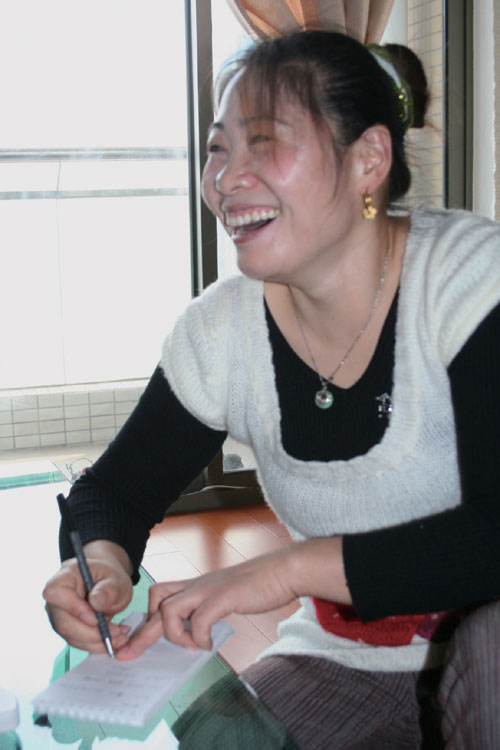
Like many foreigners, my relationship with my ayi can be pretty awkward at times. My family never employed people to clean for us back in England so it's strange to have a lady come round three times a week to tidy after us. My flatmate Cecilia and I had often chatted with 37-year-old Zhang Hui about what her life was like back in Anhui. Like most ayis, she is humble and is always amazed when we show a particular interest in her "ordinary" life. An incredibly cheery, upbeat woman, she’ll broadly smile, agreeing emphatically whether we’re sharing a moan over the weather or struggling to communicate in our second languages. Zhang Hui does speak a little English, though, because she took lessons many years ago so that she could understand basic conversations about bills, washing powder and mops.
So how did I end up visiting her hometown? In early December my flatmate and I were both planning a weekend trip to the Yellow Mountains while Zhang Hui was folding clothes. Zhang Hui had mentioned she was from a town nearby, so we thought this could be the perfect opportunity to see it firsthand. Within seconds, she had written out her parents’ address and the phone number of her aunt, Ding Shijuan. We were all very excited. How many foreigners could say they had been to their ayi’s home? Come to that, how many ayis have had foreigners turn up on their doorsteps? Visiting Zhang Hui’s place felt like far more of an adventure to us than the well beaten path to Huangshan.
For most foreigners living in Shanghai, Anhui is synonymous as the place where ayis come from. You won’t find write-ups of Lujiang, located south of the provincial capital Hefei, in a guidebook. Lujiang is a mining and agricultural county with a population of 1.2 million sprawled over a cluster of 17 towns. “Dear my dear you stay you” came a text message. It was late and we were standing in a lay-by somewhere on the outskirts of Lujiang where our coach had dropped us. As foreigners we were getting a lot of attention. Zhang Hui’s aunt, Shijuan, proud to show off the English she had been brushing up on in anticipation of our visit, had sent us a text urging us to stay put and wait for our ayi’s brother-in-law to collect us. We had no idea what to expect. You can only presume that a woman who leaves her daughter behind to come to Shanghai and clean homes must come from a desperately poor family. Would we be picked up on a scooter? Would we be taken to a tiny shack with concrete floors where we’d have to share a room with six other people and wash outside? We decided beforehand that whatever situation presented itself we would be gracious. We were, after all, privileged to be invited.
He turned up in a spacious, modern van and out jumped Zhang Hui’s niece, nephew and her 15-year-old daughter Ding Fangna, all very excited to meet us. Their apartment, it turns out, was a comfortable Chinese family home with posters on the wall for the children to learn their Chinese characters and a row of shoes at the door. The only signs of hardship were that people were wearing coats inside now, while there was an army of fans ready to combat the next blistering summer heat. As soon as we had put on our slippers we were ushered into a bedroom and greeted by our ayi, appearing from Shanghai on a huge flat screen by the wonders of Skype. As her family gathered around, Cecilia and I looked at each other. It was rare to get a Skype call from our own folks back in Europe and here was our ayi and her family comfortably at home video chatting. With the comfortable family car and modern electronics, this was clearly a middle-class family with aspirations. Most of all, they were proud to hear Zhang Hui speaking in English to us.
That evening Zhang Hui’s mother prepared a traditional meal including dumplings, lotus root and a selection of processed meats that were boiling in a pot in the middle of the table. Pulling out all the stops for their foreign guests, Zhang Hui’s father opened two bottles of beer for us and a bottle of red Chinese wine. We played the perfect guests, duly tucking into our boiled sausages and baijiu. Lavishing us with typical Chinese hospitality, it was clear they wanted us to feel welcome and provided for, but knowing that the family was maybe providing beyond their means made the moment all the more poignant.
We stayed the night in an adjacent apartment that Zhang Hui and her husband lived in from 1999 until they started working for long stints in Shanghai in 2005. It was strange sleeping in our ayi’s bed, but it turned out her mattress gives a far better night’s sleep than our own beds in Shanghai. In fact, the flat was bigger and the shower more powerful. We looked at a family picture on one of the shelves in the living room and repeated the question that had bugged us since we arrived: “Why wasn’t she here?” Her home was comfortable and spacious, her oldest daughter and her extended family were here. Why wasn’t Zhang Hui? The irony of this question wasn’t lost on us. Someone visiting our family homes in England and France might ask exactly the same thing of us. And in fact, when Zhang Hui was beamed in on Skype and seen by her family speaking in English to us, we realized she was probably made to feel like the exotic big shot similar to what friends and family think of us simply because we’re in China. It turns out that ayis and foreigners have a lot in common; we’re both migrant workers.
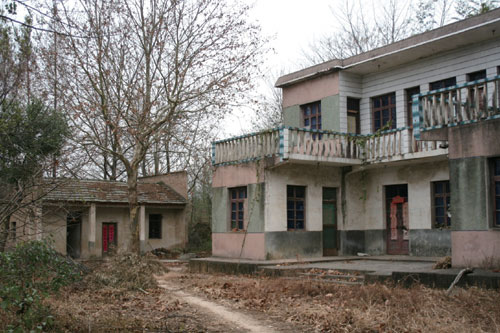
The next morning we asked to see the house in the countryside village of Tuntuang where Zhang Hui first lived when she got married in 1993. An hour’s drive away, it was a picturesque place with lakes, vegetable small-holdings and cotton fields dotted about. Overlooking a small lake, next to another abandoned home stood the two-storey house Zhang Hui left in 1997. It looked like it could have once been a great family home. But as she later explained, life there was tough. The house has no running water and so clothes were washed in the river. To eke out a living her husband worked in Jiangsu a few months at a time at a factory, leaving Zhang Hui to look after their daughter Fangna. She said she missed her husband very much at that time and eventually joined him for short stints, also working at the same factory. With the men working in cities, the village is now only occupied by elderly people and women looking after children on their own. One woman we spoke to earns RMB10,000 a year from her crops. Painted on the front of one of the white-washed homes was a propaganda slogan daubed in red paint: “Have fewer children and you will get richer faster.” The village told the story of China’s economic rise.
In 2003 Zhang Hui’s second daughter, Xiao Jiu, was born when they were both permanently living in Shanghai. Xiao Jiu attends primary school, but without a Shanghai hukou, like Fangna, she will also have to leave her parents and return to Lujiang for high school. Despite the upheaval for her family, Zhang Hui insists that Shanghai provides opportunities that are just not available in her hometown. “In Shanghai we still have to spend a lot, but at home in Lujiang we can’t make much money. Plus we like it in Shanghai,” she says.
She hates to think that Xiao Jiu will have to leave eventually, but admits it’s her oldest daughter who has borne the brunt of the family’s upward mobility. “It was very bad for Fangna,” she says, when they had to spend their time apart. But she feels that by being migrant workers they have improved their children’s lives. “We were the generation that had to do this, but our children won’t have to.” Zhang Hui recognises that education is the key. She hopes her daughters will go to university and have a better outlook than she did at their age. It’s not that our ayi was on the breadline in Anhui; she simply wanted a better future for her children and moving away was the way to secure it.
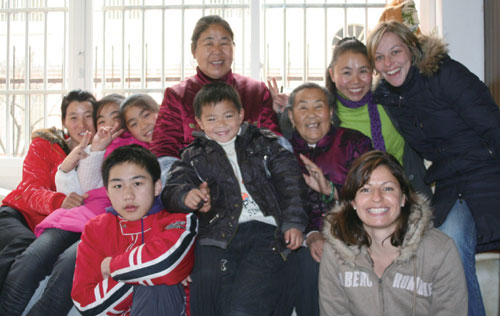
Before leaving Anhui, we asked to take a family photo. They had made us feel like a part of their own, feeding us at every opportunity and catering to our every need. Trying to orchestrate a group picture was reminiscent of herding my own family together for a photo. Nobody
wanted to be the first to sit down, the youngest kept messing around, the oldest protested that she shouldn’t be in the picture and the timer wouldn’t work. The big difference was that it was just an average Monday, not a big family occasion, yet with one click of the finger they mustered three generations of their family. We lose sight of the fact that we call our cleaners ‘Aunty,’ but for that one moment it made total sense.
Forget the Terracotta Army or the Great Wall; I learned more about China by going to stay with the family of the woman who’s in my house three times a week. Migrant workers think they’re ordinary, but their pure heart and soul are one of the best things China has going for it.