Unfit for export?


|
2010 Skillogalee Gewurztraminer is on the list at some of Australia's best reastaurants, but apparently unfit for export. Source: The Australian |
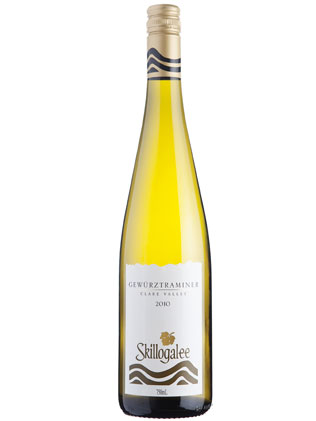
DAVE Palmer should be rather chuffed. His 2010 Skillogalee Gewürztraminer has been poured by the glass at Tetsuya's in Sydney. It's also on the wine lists at other prestigious restaurants such as Rockpool, Flower Drum and Ezard in Melbourne.
But Palmer is, instead, rather miffed. His UK importer tasted the wine on a recent buying trip Down Under, thought it was “delightful ... exactly what our customers are looking for” and subsequently placed an order. But Palmer can’t export the 2010 gewürz because it failed the official taste test every Australian wine undergoes before it is allowed to leave our shores.
“It came as a complete shock to me when we found out the wine had been rejected,” Palmer says. “We’ve been getting export approval for all of our wines every year for a decade. Now our place in that UK importer’s portfolio will probably be taken by a product from elsewhere – probably New Zealand – doing us commercial damage, not just this year but into the future.”
What’s going on here? How can a wine that sommeliers and wine merchants think is delicious be rejected for export? The answer exposes a serious flaw at the heart of Australia’s export approval system – and shows how that system is out of step with Australia’s global marketing push.
Every wine that leaves these shores has to receive approval from Wine Australia, the statutory body responsible for export regulation. As well as analytical testing and checking to ensure the labels are correct, each wine is also tasted blind in Adelaide by a team of inspectors (winemakers, retailers, show judges) to ensure it is – in Wine Australia’s words – “sound and merchantable” (see "One man's fault", below).
The problem is that the terms “sound and merchantable” are open to interpretation and are, therefore, subjective.
Take the Skillogalee gewürztraminer. I have tasted it a couple of times. Yes, it has noticeably lifted volatile acidity (VA): you can sense this as a slight prickle in your nose when you smell it, and a slight sharpness on the tongue when you taste it. But plenty of great gewürztraminers I’ve tried in the past have also had this lifted character. It’s part of their charm.
There is a legal limit for VA in Australian dry white wine of 1.5 g/L; if a wine exceeds this it will be refused export approval at the analytical stage of the process. Fair enough. The law’s the law. But the Skillogalee wine is well under that legal limit: it was rejected by the tasting inspectors because, in their opinion, the “wine [could not] sustain the level of VA” – meaning it is, in their opinion, out of balance.
The VA in this wine doesn’t bother the sommeliers at Tetsuya’s or Rockpool. It doesn’t bother Dave Palmer’s UK importer. Indeed, for these people, the lifted characters help give the wine character and personality. As Wine Australia’s compliance manager Steve Guy himself observes: “One person’s fault is another’s complexity.”
So the question has to be asked: is one slightly “unbalanced” gewürztraminer really going to ruin Australia’s international reputation? Or could it in fact enhance that reputation? This is the crucial point. For the past few years, the marketing arm of Wine Australia has been trying to convince the world that we don’t just churn out a sea of cheap, industrial chardonnay. And yet wines that could spread this message worldwide – Castagna’s incredible Genesis syrah, Torbreck’s Struie shiraz, Hewitson’s extraordinary Old Garden Mourvèdre, De Bortoli’s slinky shiraz viognier and now the Skillogalee gewürz – have all been rejected at some point by Wine Australia’s own tasting panel for fear of bringing the country into “disrepute”.
Indeed, you could argue (and many in the wine industry do) that the emphasis on exporting clean, fault-free but ultimately boring wines has done more to harm to Australia’s reputation by creating the cheap, industrial image in the first place. As one enraged industry commentator put it: “The tasting panel is the single greatest inhibitor to the development of the Australian wine industry. It totally favours big producers.”
And as one disillusioned inspector told me: “I reckon about 95 per cent of the wines that we pass are only fair to mediocre. They’re not bad. They’re certainly not faulty. They’re just… plain. And sometimes I think, well, if these plain wines are the best representation of Australia overseas, then that’s pretty depressing.”
Geelong winemakers Ray Nadeson and Maree Collis found out their 2006 Que Syrah Syrah had been rejected by the export tasting panel the same week the wine received a five-star newspaper review.
Like Dave Palmer, they were completely taken aback. “We had a purchase order from a very good UK importer for two pallets of this wine,” says Collis. “It was worth about $60,000 – very significant for us. The importer had travelled around the world – New Zealand, Australia, the States – and only selected four wineries, of which we were one. The wine had just got a good review, so it was clearly sound. We had a purchase order, so it was clearly merchantable. And yet here we were being told by the export inspectors that it was faulty.”
The wine was rejected for having excessive sulphides, a “fault” that can, at low levels, contribute a savoury complexity. So Nadeson and Collis put the wine up again to the review panel, accompanied by an explanation of the style and supporting evidence of how well received it was by media and trade; it was subsequently approved for export.
“The whole experience made me feel that any wine that just looks a bit different is faulted,” says Nadeson. “The whole push now with Wine Australia is for individuality, to show that we’re not just one big factory. But if they really want to do that, they should promote wines that are a little bit different, not knock them on the head.”
ONE MAN'S FAULT...
Some of the wines rejected by Wine Australia, and loved by everyone else:
2010 Skillogalee Gewürztraminer, Clare Valley
This wine is on the list at Tetsuya’s, Rockpool, Flower Drum and the café at the National Wine Centre, home to the offices of Wine Australia. So: the same people who refused it export approval can enjoy it with their lunch. Oh, the irony.
2006 Lethbridge Que Syrah Syrah, Geelong
This wine got five stars in Uncorked magazine: “Some Australian wine producers name their shiraz after the French syrah to indicate a supple, European style, as in this silky, spicy example. It has expressive fruit and good acidity and tannin structure.”
2003 Domaine A Cabernet Sauvignon, Coal River Valley
This wine was awarded 95 points by James Halliday, who wrote: “Right in the mainstream of the classically austere Domaine A style, with a degree of complexity and intensity within that austere exterior that is remarkable.”
2005 Giant Steps Miller Shiraz, Yarra Valley
After its rejection was overturned, this was accepted for Qantas Business Class, and garnered high scores and rave reviews from critics, who loved its funky, meaty characters, seeing them as delicious complexity, not faults.