Slow, low and plenty of time gives best results


 One of the best ways to cook during rainy, cold and windy weather or even in sunny times is with the slow-cooking pot. Various companies manufacture them and some versions are highlighted in the Trade Development Council's showroom in the Hong Kong Exhibition and Convention Centre in Wanchai.
This method of cooking has been around for centuries - recall large iron pots hanging over open fires stirred occasionally by useful grandmas or spinster aunties? More sophisticated now the pots of today are equally great for rendering cheaper cuts of beef, lamb, old hens or pork into succulent, tender, tasty fare over a period of hours.
One needs to understand the principles of cooking with a slow-cooking pot, essentially meant to be one-pot meals that can be a great boon for busy couples. The results are akin to sous vide cooking but much less costly; the pots are much cheaper and less complicated to use. But I can't emphasize enough the importance of reading the instructions carefully.
Slow cooking has many benefits; it allows you to prepare meals that are tender and savory with little effort. Plus, you can start the cooker in the morning and let the meal prepare itself.
And the pots make wonderful wedding gifts.
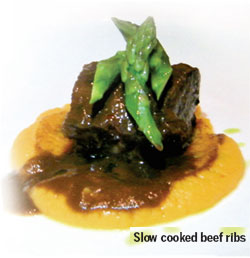
Recipe for Beef Spare Ribs slow cooked in red wine in a pot, served over polenta and garnished by asparagus tips.
Put 1/4 cup (12cl) vegetable oil into the pot, 3 - 4 lbs bone-in beef short ribs cut into pieces about 3 inches long and dipped in plain flour to coat. Brown the beef on all sides in the oil. Next dice and add 1/2 a whole celery, 1 yellow onion, 2 carrots, 4 garlic cloves, 1 tin tomatoes, 1/2 bottle dry red wine, 1 cup (24cl) beef broth, 1 cup (24cl) chicken broth, 3 bay leaves, 1 handful chopped parsley, and a good shake of black pepper and salt to taste.
Cook until the short ribs are tender, about 4 - 5 hours on the low-heat setting.
Slow cookers are electrically powered and can reach only moderate temperatures. Most are round or oval shaped and come with a well-fitted lid to prevent splattering. They are made of heat resistant materials such as stainless steel, ceramic or porcelain. The latest models are clear or have clear lids to allow viewing, and hold between 1 and 5 litres in capacity. It's best to get a slow cooker with a heating timer, then it will switch to a low temperature 'keep warm' mode after a set period or shut off altogether.
The vegetables will be very soft after this time, so you can mash then into the gravy and add a beef stock cube if necessary.
Polenta and grits are made from boiled and ground cornmeal but are not the same thing. Polenta is a staple of northern Italy. Bring 750mls water to boil with a pinch of salt, reduce the heat and add the polenta very slowly whisking all the while, simmer for 10 minutes. To see if it's ready, scoop a little onto a teaspoon, cool and rub a smidgen (tiny amount) between your fingers - if it's soft then it's ready. Add 1 Tbsp butter, 100mls thin cream, a shake of white pepper and whisk gently. Check seasoning.
At this stage the polenta is a meal in itself with a good grating of parmesan cheese!
Wash well and steam or pan-fry some asparagus spears to serve with and garnish the beef and polenta.
If you have leftover beef, put it into a covered container in the refrigerator overnight as it is equally good served cold or hot on slices of bread, toasted or not. And with a few tomatoes and a lettuce or some boiled potatoes you have another meal ready to enjoy.