Wild side of Rhône-Variety wines


Winemakers explain their techniques at annual Rhone Ranger San Francisco event
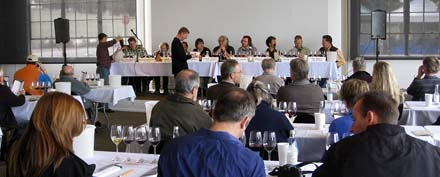
A panel of eight winemakers discuss and taste through their wines during the Rhone Rangers seminar Wild Wines and the Stories of How They Came to Be.
San Francisco, Calif.—Wildness, a core element of the Rhone Rangers’ movement, was the highlight of the Sunday afternoon session “Wild Wines and How They Came to Be,” moderated by Patrick Comiskey of Wine & Spirits magazine. Attendees sampled an eclectic lineup of eight American Rhône-variety wines from eight American producers. The challenges of growing wine while attempting to maintain a hands-off expression can be a challenging situation for winemakers. This session emphasized the struggles winemakers faced while walking on the wild side.
Gideon Beinstock, winemaker of 800-case Clos Saron, started his winery in 1998 in Yuba County in the Sierra Foothills. Clos Saron specializes in Syrah, Pinot Noir and blends. Beinstock’s wines represent the extreme edge of natural winegrowing. Made with no chemicals in the vineyard or cellar, no fining or filtering, the wines never touch a pump but are gently moved entirely by gravity.
Most years, Beinstock farms everything he produces, but the abysmal 2010 vintage led him to outsource fruit for his 2010 Out of the Blue from a vineyard of organic Cinsault planted in 1885. The fruit was picked at 22º Brix and co-fermented with 11% of Clos Saron’s Syrah. Since Beinstock’s Syrah was covered with mildew, clusters were carefully spray-washed by hand in the vineyards. An 11-gram-per-liter acid addition balanced out the weak acidity of the un-inoculated whole cluster fermentation.
Pax Mahle of 2,000-case Wind Gap Wines, Forestville, Calif., said he was “looking for the right mistake” when crafting his 2005 Agharta North Coast Syrah. Mahle said his approach to winemaking involves “pushing the envelope while standing on the shoulders of other winemakers.” The Agharta tasting came from a barrel selection from an array of vineyard sites, with a dash of Grenache for aromatic complexity, fermented entirely with native yeasts. The wine was aged 62 months, and although it was never racked, it was tasted frequently.
Mahle said he likes to forget about his wines and add very little sulfur dioxide, relying primarily on tannins and acids for preservation. “We wait for the wine to unfold and reveal a secondary nuance. It’s not about site, place or variety. It’s about trying to produce something unique and intriguing.”
Mahle tops his barrels twice per year at most, with the thought that the more a winemaker opens the bung, the more the wine is exposed to oxygen. Upon pressing, bungs are hammered into place and the barrels are rotated so the winemaker can’t remove the bung without spilling out half the wine.
Jordan Harris, winemaker and general manager at 9,000-case Tarara Winery in Virginia, 45 miles northwest of Washington D.C., discussed the challenged of growing wine in Virginia. Although there is a big push to grow Viognier in Virginia, the regional specialty remains undefined.
According to Harris, Syrah has found a great home in his vineyards. The biggest problem, he claimed, is very low diurnal temperature swings, making it harder to retain acidy. “With 95ºF during the day, and 85ºF at night, you have to pick as fast as you can and get the fruit in as cool as you can. It’s a mad dash whenever you have to pick. We typically start picking at 5 a.m.,” Harris said.
Another big issue is the chance of hurricanes passing through his vineyards. The 2007 vintage was Harris’ first. Prior to his release, there was no East Coast benchmark for Syrah.
The inspiration for Harris was the success of California and international Syrah. Through extended elevage, the barrel-sample tasting of his 2008 Estate Syrah spent 30 months in the barrel, consisting of native yeast co-fermented 94% Syrah and 6% Viognier.
Punchdowns were done by hand in 1-ton open-top fermenters. His goal is for the wine to age in the barrel for 42 months. According to Harris, “The wine speaks for itself. It tells me when it wants to come out of oak.”
Focus on accessibility and value
Rhone Rangers, a nonprofit, educational organization dedicated to promoting American Rhône-varietal wines, hosted its 14th annual San Francisco grand tasting event this past Sunday, March 27, at Fort Mason Pavilion, with 110 participating wineries.
According to Cheryl Quist, executive director for Rhone Rangers, attendance for the consumer side of the grand tasting was up 25%. Trade attendance was steady, but “better qualified.”
This year’s grand tasting was more sharply focused on accessibility from both consumer and trade standpoints. In order to make American Rhône-variety wines open and accessible to a wider audience during economically stressful times, this year’s ticket price was $45, down $20 from last year. “We preserved costs while still maintaining a quality experience,” Quist told Wines & Vines.
The addition of two food trucks parked in front of the tasting venue allowed Quist to reduce bread and cheese costs. The four-wheeled culinary lineup included Kashaya’s Pizza Kitchen pizza; 3 Sum-Eats macaroni and cheese egg rolls and Little Green Cyclo Vietnamese street food.
Plugging the value of American Rhône-variety wines, Quist said, “If you have $25 to spend on a bottle of wine, it’s going to be hard to find a decent Cabernet, but you’ll certainly be able to find a superb American Rhône.”
More than 1,000 trade tickets were distributed. At the request of participating wineries, trade status was restricted to those focused on finding and promoting American Rhône wines in their regional environment. Winery tasting room personnel, administrative assistants and tour operators were eliminated from trade-qualified status.
Sonoma’s The Girl and the Fig catered 170 guests during Saturday’s sold-out winemaker dinner at Dogpatch Studios in San Francisco. The auction raised some $25,000 to $30,000. Nineteen winemakers participated, donating 21 auction lots. Proceeds from the auction went toward a scholarship fund for students pursuing degrees in viticulture and enology who are committed to the study of American Rhône varieties in qualifying programs at University of California, Davis; CSU Fresno, Washington State University, California Polytechnic University in San Luis Obispo and Sonoma State University. Sunday’s silent auction at the grand tasting brought the total take up to $35,000.