Changyu Wine Museum -- numerous bygones


Changyu Wine Museum is located in the original site of Changyu Wine Company, Damalu, Zhifu District, Yantai City, less than a hundred meters apart from the seaside, and close to the Beach Square. The Museum occupies an area of 30000 ㎡, consists of the Wine Square, the Wine Museum building and a modern office area.
The open Square is shrouded with peace and tranquility, thanks to profound historical deposits. The old and nostalgic gate, classic and elegant screen wall, former underground vault, and century old barrels, all combined to diffuse the fragrance of bygones, making visitors dream back in time and space.
Shaded by two huge and lush plane-trees, The old arch gate is facing south, a unique mingling of East-West style. The Europian stack-pillar gate supports six overwhelming Chinese characters overhead -- 张裕酿酒公司 (Changyu Wine Company). It is said to be written by Minister of Revenue and grand minister of state Weng Tonghe, who was also the teacher of Emperor Guangxu of Qing Dynasty. Immediately inside the gate and facing it, sits a Qing style screen-wall, with a pipe-tile top. The double-unicorn relief on the screen-wall is impressively vivid, signifying good-luck and harmony. On the back of the screen-wall, there inscribed "Dedicated to Changyu", condensing the century old history of Changyu in a concise, rich, and grand prose of 586 characters.
Several oak barrels are standing on the east and west sides of the Square. A close look would reveal the rusty and loosened straps, the cracked body for want of use, all witnesses to a century of changes. A whiff of ancient flavor from them would fill one's heart with a nameless sentiment. They have done their duty for wine, and their old age becomes a medium for us to feel history.
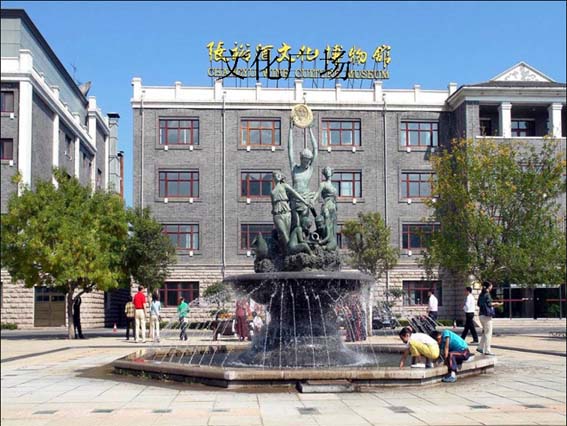
At the center of the Square is a group sculpture of Dionysus up-holding the emblem of the International Wine City. For the outstanding contributions Changyu has made to the world wine industry, Yantai was thus named in 1987 by the International Office of Vine and Wine, making it the only Chinese and even Asian city with this honor.
On the eastern side of the Square, the author of Changyu -- Mr. Zhang Bishi's bronze statue is standing on the grass lawn, dressed in official attires, looking far and deep. Zhang was born of a humble family, and went to South Asia at 18. At his heyday of career, his personal wealth reached 80 million teals of silver, ranked the first in the area, and making him the undisputable leader of overseas Chinese there. He was once Qing Dynasty's consul general in Singapore, was given an audience three times by the then empress dowager Cixi and emperor Guangxu, and was promoted to the first rank in the official hierarchy. As a commercial delegation leader, he went to USA for the World Exposition, with Huang Yanpei, another outstanding figure in Chinese history, as his secretary. It was at this Exposition that Changyu was awarded four gold prizes. He was also a bosom friend of Dr. Sun Yat-sen and a staunch financial supporter for Sun's revolution.... A legendary life in short. The winery he created with 3 million teals of silver has grown to be the largest in China and even in Asia. Today's bronze statue expressed the admiration and love for him of his followers.
The atmosphere in the Square urges every visitor to the inside of the Museum, which was originally build in 1992, and was renovated in 2000 on the spot of the old winery, designed by architecturers from Qinghua University, immitating what the company looked like a century ago. This is now China's first world-class wine museum, and also an AAA National Tourist Site, National Tourism Demonstration Site, Patriotism Education Base, and was named the "Most Popular Museum" in 2005.
Inside the Museum, precious old photos, ancient winery apparatus, earth-figures demonstrating wine-making process, all are telling a long history of the industry. Zhang Bishi had left no stone unturned in his search for specialists and changed three wine-makers before he invited Baron M. von Babo, of a long-standing wine family from Austro-Hungarian Empire, as his first chief wine-maker. Changyu's first general manager Zhang Chengqing devoted all his life to the winery and died young; the license for Changyu was issued by the then Prime Minister Li Hongzhang personally; Weng Tonghe only asked for 50 tires of silver for each character he wrote, as nominal brush-polishing fee; Changyu was awarded gold medals and a Grand Prize at the Panama-Pacific International Exposition in 1915 for Cognac Brandy,Red Rose Wine, Gewurztraminer,White Riesling .... All these stories are here flowing, spreading, making visitors meditative in amazement.
Here also, lots of dedications of dignitaries are kept as fond memories. Dr. Sun Yat-sen's inscription - "品重醴泉"is said to be his only one for any enterprise; Kang Youwei visited the Winery two times in 1917 and 1927 and left behind marvelous sister poems. General Zhang Xueliang also praised Changyu's management with reference to history --"圭顿贻谋;" Professor Liu Haisu, a renowned modern Chinese painter, wrote "醇厚芳香,朝晖光灿" (rich and aromatic, as brilliant morning sunlight), for the Winery at the age of 88 - just to name a few. The number and degree of traces left here by dignitaries and celebrities are an extreme wonder to see, making Changyu's legacy more charming.
A trip in the Museum, a walk in the mysterious century old underground cellar, is an unforgettable experience for life. Spiral stairs downwards, whiffs of wine aroma upwards, making people involuntarily breathe deep. Such a completely different world down in the cellar! Eight arch tunnels crossing each other like in a labyrinth, rows of barrels with wine or brandy lying there as in sleep, with the diffusive aroma as their dreams. Among the century barrels, three were known as the King Barrels in Asia, each with the volume of 15 tons. It would take a heavy drinker 80 odd years to drink all in one barrel half a kilogram a day. Many visitors tie red ribbons with their names on the King Barrel, and make silent wishes for good fortunes and blessings it's said to be able to bring about.
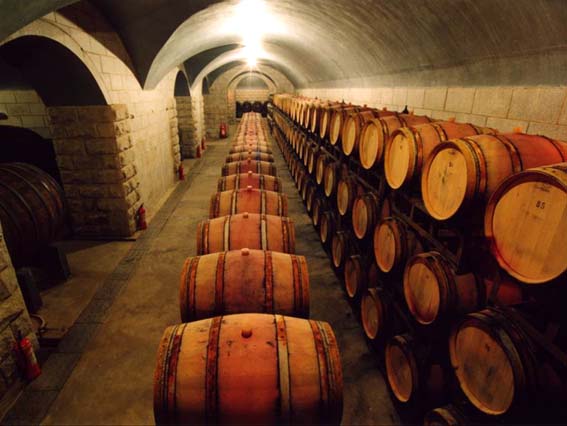
Absolutely no leakage so far has been observed in this oldest cellar in Asia, 7 meters underground 1 meter under sea level, and less than 100 meters away from the coast. This is a miracle in the construction history of the world. According to one tour guide, huge adversities was overcome during the construction. Started in 1894, collapsed soon later because of the sand-earth structure, renovated with western methods with steel fabrication and later inundated in torrential rains due to steel rust, and other frustrations. Countless experiments and collective wisdoms eventually led to the combination of Chinese-Western solution, a stone arch top, with stone-cement wall filled with broken bricks, sand and stones, making the cellar body particularly strong and water-tight. It took 11 long years for the final completion of the project in 1905.
Wandering in the cellar and reviewing all bygones, make one mistake now for then/present for past. In the flickering and murmuring underground bar, cup in hand, wine in mouth, I unconsciously drink away.
Translated by Dai Xinsheng