Tuscan Montepulciano vs. Abruzzi Montepulciano


|
Montepulciano is a small Tuscan town known for its red wine- Vino Nobile di Montepulciano made from Sangiovese clone known as Prugnolo Gentile whereas there is an indigenous grape varietal Montepulciano that is grown in the region of Abruzzo and other regions of Italy like Marche where it makes interesting blends with Sangiovese. Subhash Arora who visited Montepulciano recently, reflects.
| ||||||||
|
Montepulciano grape Perhaps the grape varietal is known more in India, thanks to the less costly Montepulciano d’Abruzzo DOC. In fact, whereas Sangiovese is the most dispersed Italian indigenous grape variety, Montepulciano is the second such variety, with 20 of the 95 provinces in Italy using the grape in DOC wines (except one appellation which is docg). The other region using it judiciously is Marche where Rosso Conero DOC and Rosso Piceno DOC use the grape as a blend-with majority being this varietal. These wines are already being imported in India and are quite affordable. However, there is no comparison or similarity except the colour, with the noble wines of Montepulciano. Vino Nobile di Montepulciano As the name suggests, this is a noble wine and is made from Sangiovese. It was the first red wine to be released by the Italian appellation system, as DOCG (Denominazione di Origine Controllata e Garantita) in 1980. Unlike Brunello or Rosso di Montalcino, only 70% of the grapes need to be Prugnolo Gentile- as the local clone of Sangiovese is known as, in this historical city, known as Pearl of Tuscany 400-500 years ago. Balance 30% can be any recognised Tuscan grapes- like Canaiolo. Of course there are restrictions on yield –like 8 tons/hA, 2 years of maturation in wood (min 18 months) and bottle, min solid extract of 23g/l (the weight of solids left if all the liquids are evaporated) etc. Rosso di Montepulciano The younger brother of Vino Nobile, the noble wine, is allowed the same proportion and blend although higher yields of 10 tons/hA and lesser requirement of 21 g/l minimum dry extract is needed. It does not also need much aging and can be released in March in the year following the harvest. Interestingly there is a provision to declassify Vino Nobile to Rosso within a specified period, making it really a younger and less age-worthy brother of the top wine from the relatively small appellation with 1400hAs of registered plantation which enjoys a world recognition as one of the favourite Tuscan ‘brands’. State of Health
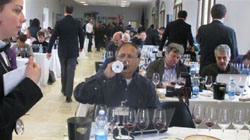
Montepulciano is a beautiful and picturesque town with a lot of history and is a highly recommendable place to visit, especially for wine connoisseurs and fans of Italian wines It was heartening to hear Carletti say that they propose to make it a free Wi-Fi town within this year. Think Noble- Drink Rosso Vino Nobile di Montepulciano is more expensive than Chianti Classico but almost half the price of Brunello di Montalcino. An age-worthy wine it makes great choice and value-for-money quality Tuscan wines, though not as popular as the Chianti Classico and Brunello. But Rosso di Montalcino, the young wine makes an even better option, especially in India. Made from the same grapes Rosso di Montalcino doc is a lot cheaper and costs barely 35-40% of Vino Nobile. With the unbearable heavy taxes, it makes a much more economic sense to drink this wine. Secondly, as most wines are drunk young in India, it would be ready to drink by the time it is imported and released in the market. It does have a shelf life of 3-5 years so that the importer or the consumer does not have to worry about the wine dying in the bottle. Rosso also makes it a darling for the vegetarian drinkers as the tannins are softer and the acidity is generally quite crisp and refreshing on the palate and ethey would find it delicious with their meals or snacks. It was not by coincidence that at the traditional lunch, all wines served were Rosso di Montepulciano and devoured by the visitors and producers alike. Of course, it would be no substitute at a serious dinner with rich cuisine or with dishes incorporating red meats like lamb, mutton, steaks or game. It is unfortunate that the Indian market is generally devoid of this wine. If imported with careful selection, it may be made available in retail for Rs.1500-2000 which ought to be acceptable level for discerning drinkers as a choice for regular drinking. Harvest of 2010 Although an issue not so important for the fledgling Indian industry, for the sake of academics and real connoisseurs, the harvest was rated a 4-star vintage. It was a rainy year with heavier rains in the vegetation period making flowering later than usual. It was also a colder year with slightly more acidic and fresh than usual. The increase in temperature during the last stages made it an interesting, quality vintage. Wines Tasted One of the most interesting features of events such as this is a gala dinner where one can meet the producers and taste several wines from a varied choice (here the option was from over 150 wines). Dinner at Montepulciano where I was privileged to sit at the table with Dr. Carletti, and the Mayors of Montepulciano and Chianciano Terme- the neighbouring wellness city where we were cooped up in a small hotel, and the governor of the Province of Siena. It appeared that there was less number of participants this year for the tasting-perhaps because of the difficult economic times. But out of the wines tasted from all the producers, I found the following wines more interesting with my short and quick tasting notes:
Vino Nobile di Montepulciano 2008 Boscarelli- spicy aromas, juicy, with acid on the back palate with medium length-but could be longer. Med body, dark cherry red colour turning brick, tannins well rounded Riserva 2007
La Berne- good balance, firm tannins, long and spicy, elegant but not feminine like some other wines Avignonesi Riserva Grande Annate- good drinkable, pleasant, elegant, good balance, juicy, but the end is a bit short and unimpressive Contucci- elegant, balanced but the back palate is weak, giving it a bit of emptiness-but after swallowing, the impression is long La Braccesca- Riserva - dark cherry red, well balanced, nice and juicy end, spicy, very fresh too Talosa- nice and elegant, slightly disappointing at the back palate Riserva 2006 Boscarelli- Bouquet not outstanding, dark choc turning g to Brick red , end too not so hot, great balance and juicy wine with plenty of black fruit on the palate. |