The long revolution


It is usually said that Americans didn’t get serious about wine until the early 1980s, when an historic bull market on Wall Street began and Robert Parker emerged as the country’s go-to wine guru. That’s the generally accepted narrative, one I’ve regurgitated more than a few times. So it was with some surprise that while Googling the other day, I found a Time magazine article—a cover story, no less—from November 1972 entitled “American Wine Comes of Age.” The story heralded the emergence of a very dynamic wine culture in the United States. It focused mainly on the production side, specifically the rise of the Gallo empire, but it also discussed at length the blossoming consumer interest in wine. It reported:
“Americans will spend close to $2 billion on wine this year, twice as much as in 1968. The growth in wine consumption is outpacing that of hard liquor and beer, though Americans will spend ten times as much on those beverages combined as on wine. This year a U.S. adult will drink an average 2.4 gallons of wine; that is still quite a few sips behind such iron-livered veterans as the French (29 gallons) or the Italians (30 gallons), meaning that the U.S. industry still has plenty of room to grow. Last year alone, retail wine sales rose 59% in Wisconsin, 65% in Vermont and 98% in Rhode Island. Young people have become particularly avid imbibers. On campuses, wines are considered the best accompaniment to informal meals and exotic smokes. Consumption will reach an alltime peak this week because the biggest wine-drinking day of the year is traditionally Thanksgiving.”
Wine and exotic smokes—now there’s a pairing! On a more serious note, I wonder to what extent college kids really embraced wine in the early 1970s. When I went to college in the late 1980s, there was literally no wine drinking; it was strictly beer and hard liquor (oh, and exotic smokes). I suspect that in the great trend-story tradition, the Time article probably exaggerated how much wine was being consumed on U.S. campuses at that time. Nonetheless, the story clearly indicates that oenophilia gained a foothold here earlier than is commonly believed, so perhaps that aforementioned narrative is in need of some revision.
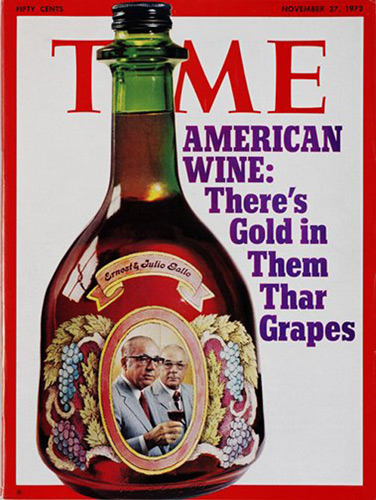
There is a lot of fun stuff to chew over in the article—the faith in technology, for instance, and the belief that intervention inevitably yielded better wines. I was particularly amused by the comments from Baron Philippe de Rothschild, owner of Bordeaux’s Chateau Mouton Rothschild, who voiced skepticism about California’s prospects. “To develop character, great wines must go through hardship,” he told Time. Snow. Drought. Storms. There must be suffering to produce it. In California everything is much too perfect. The soil is too rich. The weather is too good. The wine all comes out industrially uniform, like Coca-Cola.” Four years later, the 1970 Mouton Rothschild finished second behind the 1973 Stag’s Leap Wine Cellars Cabernet Sauvignon in the Judgment of Paris, and two years after that, Baron Philippe teamed up with Robert Mondavi to create Napa’s Opus One.