The year of the CATs


 Neil Pendock wonders why SA tasting notes are still stuffed full of inappropriate metaphors and similes. When did you last smell a tinderbox, eat a capsicum or use a toothpick fashioned from cassia wood? Time to follow the Chinese lead and embrace CATs (Culturally Appropriate Tasting-notes).
Simon Tam, recently appointed Christie’s Man in Hong Kong, is a new broom sweeping clean. His first housework chore is give inappropriate adjectives used to describe wines destined for Chinese cellars, the flick. As he told Decanter magazine “many western descriptors - such as blackberry and blackcurrant, or concepts such as ‘forest floor’ - are so uncommon in China as to be meaningless.”
So “honey and toast” are to be replaced by sugar cane juice while “Jin-Mao tea, also known as Golden Hair, a rare tea with scents of undergrowth, mushroom, truffle, wax, honey, vanilla and tobacco notes” is a godsend for chatting about claret in Chinese. Likewise earthy notes, often a euphemism for slight cork taint, will be replaced by Chinese herbal soup.
But this is far from a find-and-replace exercise in MS-Word, for Simon wants to substitute the atomist philosophy of wine deconstruction with a more synthetic approach. Buddha rather than Derrida. “The idea will not be to highlight individual components, single flavours, in a wine but to take a more holistic approach, to talk about the integration of flavour. We are going to use the whole of the vast Chinese culinary repertoire.”
Although Jancis Robinson, advisor to the cellars of QEII, waves a red flag of caution. As she noted in the How to Spend it supplement of the Weekend Financial Times earlier this month, in the case of Lafite (top of the snob pops in the PRC) the “very dry, almost austere, racy, elegant style must be difficult for newcomers to wine and torture to drink with most of the food served in China.”
Nevertheless, Simon’s translation exercise is urgently needed in SA as most tasting notes read like a slow day in the home counties, full of received pronunciation and inappropriate metaphors, especially to the Kwaito-tuned ears of Sipho and Sibongile. Time to reclaim the winespeak thesaurus from the arthritic hands of pundits in Kenilworth and Parktown, now well past their sell-by dates. Besides, SA has a rich palette of appropriate flavour descriptors, from peppadews to suurvygies with bokkoms and biltong in between Heck Simba Chips (the ones that roar with flavour) even ran a competition last year to discover the lekkerest SA flavours. The winners were Walkie Talkie Chicken, Vetkoek & Polony, Snoek & Atchar and Masala Steak Gatsby, coming to a café near you, soon. For far too long, culturally inappropriate tasting notes have been a barrier to wine drinking for timid punters.
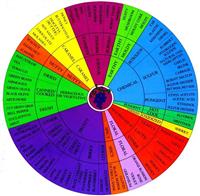
Another wrinkle on the oumensgesigte of traditional winespeak is highlighted by David J. Duman in the Huffington Post: language is a living thing and descriptors change over time. Take the famous Wine Aroma Wheel developed by Professor Ann C. Noble at UC Davis in California in the 80s. David comments “because the Wheel is so much a product of the 1980s California wine world, it's about as useful for describing the aromas of wine in 2011 as a 1958 World Atlas is for naming countries in Africa or Eastern Europe. For instance, the Wheel has none of the now common mineral or saline descriptors used to describe the white wines of Galicia or the Adriatic and the tropical fruit category lists pineapple, banana and melon, but not guava or papaya. The list of now oft-used descriptors missing from the Wheel goes on: tarragon, graphite, pear, gooseberry, lime.
The descriptors missing tend to be the ones commonly used to describe un-oaked/non-malolactic white wines and lighter bodied red wines, styles not commonly available, discussed or analyzed when the Wheel was developed, but now some of the most rapidly proliferating wine styles available.”
With winespeak competitions the flavour of the month (the SA Wine Writers Award is being judged at the minute while Leopard’s Leap have a 60 word conservation back label competition running on LitNet) perhaps a progressive brand like Obikwa or Two Oceans will step up to the palate and sponsor a CAT. For Culturally Appropriate Tasting-notes are the first step to expanding the wine drinking sisterhood, and that can’t be a bad thing.