Fakers are out of flavor as China cops hit the bottle


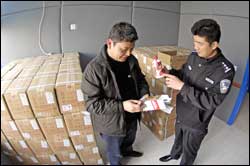
Imbibers of the mainland's most famous spirit, Maotai, could find to their dismay that they are raising a glass that is something other than what the label says.
In a spirited crackdown across 14 cities including Beijing, Tianjin and Chongqing and Shanxi and Sichuan provinces, police arrested 483 people and seized 134,000 bottles of fake spirits that were destined for various overseas markets.
Besides Maotai, fake Wuliangye, Erguotou and various grape wines were found in raids conducted by the Ministry of Public Security's Economic Crime Investigation Bureau.
Deputy director-general Gao Feng said that the fake alcoholic drinks included inferior wine that was in bottles with top-brand labels. The problem was at an "intolerable" level, he said.
"A large unknown quantity of fake spirits have been found in supermarkets and even high-end hotels," Gao added.
The ministry had deployed 2,500 officers on March 23 to seek out fake drinks, and 40 cases were uncovered within two days.
The haul from illicit distillers and winemakers included more than 13 million bottles apparently to be filled with fake drinks under false labels.
If sold on the open market, Gao said, the fakes could have netted a profit of around 2 billion yuan (HK$2.37 billion).
The Hong Kong Sommelier Association's founding chairman, Thomas Chung Kam-ming, who is also the director of Tsim Sha Tsui's Vine to Wine Cellar, which imports wines from countries including China, said fake drinks are rarely seen in Hong Kong.
That is because it is a relatively small market - unlike the mainland.
"Even if fake wine was to be produced in Hong Kong, most would be destined for the mainland," Chung said.
Many mainlanders who drink these spirits and wines may not be knowledgeable enough to distinguish the real from the fake, he added.
But people who know something about wine, Chung added, would usually check to see whether caps and corks have been been tampered with and whether trademark chops and labels are correct.
"We check the smoothness and texture of the printed labels and also the level of wine in bottles," he said.
"But nowadays many wine `experts' know how to make things look real, making it even harder to distinguish between real and fake products."