Wine in Bordeaux


The city of Bordeaux is gleaming after a makeover and the region's conservative vineyards are casting off their haughty image and welcoming visitors
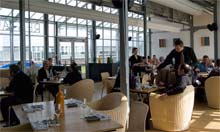
La Winery signals a change from Bordeaux's traditional wine industry
Bordeaux's wine industry has been typically slow to welcome visitors. Max Bordeaux (14 cours de l'Intendance, +33 (0)5 57 29 23 81, maxbordeaux.com) is a wine shop with a couple of spartan black and white rooms and almost nowhere to sit down. But you can drink some of the most expensive vintages in the world here on a relative budget: they serve it in 2.5cl thimblefuls. A scant sip of Mouton Rothschild is �15, and Lynch Bages and Château Margaux's second wine are both only �4. It's a cracking idea – borne, perhaps, of a sudden realisation that the world is threatening to overtake Bordeaux, that lazy reliance on history and standoffish tradition might no longer do in a future of cheap long-haul and boxed Rioja.
Driving through the gnarled and corrugated vineyards of the Médoc, you can feel Bordeaux's persistent sense of entitlement or noblesse oblige. Prim, privileged chateaux sit like dowager aunts behind forbidding iron railings and old stone walls, staring with miserly joy at the writhing lucre of the vines. Billboards of the most famous names in the wine world flick past: Latour, Lafite, Margaux, Pichon Longueville. The signs could just as easily say "Keep Out: visiting these places is almost impossible for ordinary people".
So it's exciting that a few of the younger chateau owners are beginning to open up to visitors. The "tasting room" of Château La Tour de Bessan (Route d'Arsac 33460 Cantenac, +33 (0)5 56 58 22 01, marielaurelurton.com) is a rusty old telegraph building that somehow Tardises into a sleek, elegant space. They teach people how wine is blended here, letting visitors mix tannic and complex cabernet sauvignon with hot, boozy merlot. One rather grand chateau, Gruaud-Larose (33250 St-Julien-Beychevelle, +33 (0)5 56 73 15 20, gruaud-larose.com), even holds cookery courses alongside its wine tastings, while a wing of Château Marojallia (marojallia.com) is now a comfortable hotel.
Perhaps the most innovative recent development is a place called, in bolshy Franglais, La Winery (Rond-Point des Vendangeurs 33460 Arsac, +33 (0)5 56 39 04 90, winery.fr). It's run by a family of Algerian winemakers who came to Bordeaux in the 1960s. La Winery is a gigantic greenhouse branded in Trainspotting orange, its crystal panes in stark, intentional contrast with its forbiddingly opaque neighbours. They sit you in a bright room and you answer a series of questions to determine the wines you might prefer. The quiz asks whether you prefer pizza or curry, for instance, or the smell of "honey and apricot" over "loose tobacco and undergrowth". A person working there told me, rather unsurprisingly, that they faced scepticism and hostility from the old Bordelais winemakers. La Winery's approach might seem dumbed-down or gimmicky, but it makes a refreshing change from the esoteric babble of much of the wine world, and its very existence signals a partial shift from the reactionary model of the established Bordeaux wine industry.
Outside the ludicrous prices of its most famous wines, Bordeaux faces a difficult task: how to retain its relevance against increasing competition from the rest of the world, a currency situation making export difficult, and a perception that it's fusty and overpriced. But most Bordelais know they can ill afford to jettison the heritage that is the source of their fame. The true winners in this debate are visitors to the region, who can both experience a newly gleaming city and inspect those few vineyards that have opened their gates.