Mataro's marvellous rediscovery adds variety to wines


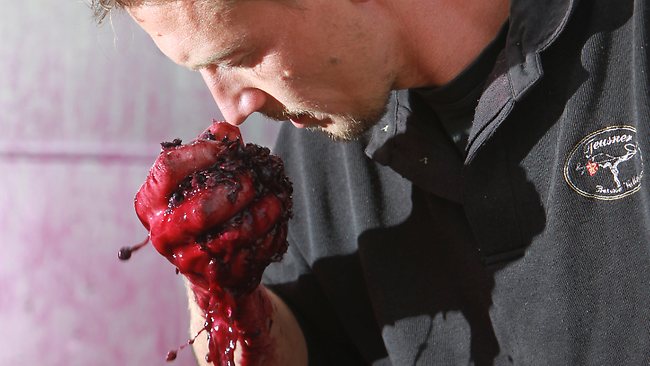
Kym Teusner, Barossa based winemaker Picture: Dean Martin Source: National Features
ONE of the first fleet of grape varieties to settle in Australia is finally making a name for itself, and some of the Barossa's most progressive winemakers have taken it on as the next best thing to come out of the region.
Mataro - the M that has sat for years in the GSM red blend shadows of shiraz and grenache may just be the answer for many looking for signs of life beyond shiraz.
That's the word from winemakers like Kym Teusner, Dean Hewitson, Tim Smith and Dave Powell, who have been crafting an increasingly fascinating collection of wines from the variety.
The trouble is, there's a bit of a name game going on with the M grape that needs to be sorted out. You may call it mataro, but the person sitting nearby may prefer to say mourvedre. Meanwhile, someone who leans towards Spain as a cultural guide could call it monastrell.
End of sidebar. Return to start of sidebar.
Whatever name it goes by on a multitude of labels, the grape deserves the respect due an elder Barossa statesman.
Kym is bemused at least by the elevation of mataro to new-kid-on-the-block status, given it has been growing in Barossa dirt for more than five generations.
"It's been here forever,'' Kym says. "And now people are looking at it like it's a new variety.''
Dean, who stands firmly in the mourvedre naming corner, knows this better than most. He steers one vineyard of 1853 plantings into a highly regarded flagship varietal wine named after its source block, the Old Garden.
Its bush vines are considered the oldest of their variety in the world.
Showing his commitment to the variety, he has embarked on a project to take cuttings from this block over the past 14 years and generate new vineyards in the same bush vine style that mataro relishes. He calls them his Baby Bush blocks and makes another, more consumer-friendly (and price-friendly) wine carrying the same Baby Bush name.
He considers the Barossa and mourvedre have a special affinity, the grape being one of the latest-picked varieties in the warm-climate region, usually benefiting from long summers and warm, dry autumns.
"The variety is in sync with the valley,'' he says. "The valley is perfect for it.''
And it's not just a few mavericks who have appreciated such special qualities of the Barossa mataro. Many others won't say it too loudly but small doses of the variety have been added to many shiraz-badged wines (you're allowed by law to include up to 15 per cent if not mentioned on the label) to give a little bit of its unique muscle-and-spice character. They're often tiny quantities, but with a genuine impact.
It has, you might say, been a vital part of the fabric of the region, but has never received the public accolades it perhaps has deserved.
If Kym has his way, mataro may be the hero of the region as opposed to the more famous shiraz. And he's certainly put his money where his mouth is, making three straight varietal Teusner mataros under the names The Independent ($20), The Dog Strangler (around $28, with the name reflecting another of the variety's more quirky synonyms), and the big gun Righteous ($110).
"I see it as the one variety in Australia that we can make in a style that has earthiness and savoury characters, as well as some fruit sweetness,'' Kym says.
The first thing he looks for in its tasting profile is a lifted Asiatic spice on the nose cloves, pepper, anise, he notes, with blood, foresty floor, meat and game all swirling around in its aromatics.
"It's just extremely complex,'' Kym says.
More telling is his assessment of the grape that rules the Barossa roost.
"Shiraz is an instant-gratification wine,'' he says. "It's a big mouthful of sweet stuff and it's as boring as hell.''
To be diplomatic, he agrees it is the Barossa's bread and butter, and admits he probably loves the blends of it, grenache and shiraz even more. His own range includes the Avatar and Joshua.
Similarly, Dean produces several shiraz brands (with varying doses of his beloved mourvedre): Ned & Henry's, Miss Harry, and Private Cellar. The mourvedre, he says, twists shiraz's flavours and gives it further dimension.
Kym agrees mataro can add a distinctive complexity to shiraz attractive spices, then with age, earth and game, and true "character''.
"It just makes interesting wine all the way through its life,'' he says. "I can't understand why the Barossa hasn't promoted that kind of blend. Shiraz and mataro - we can really do that. It should be the premier thing out of the region.''