Canadian producers target world’s biggest wine market


 BEIJING— From Friday's Globe and Mail
With China’s elite scooping up chateaus in Bordeaux and buying rare wines for record prices at auction, it’s no wonder the world’s lesser-known wine-producing regions are trying to get in on the action.
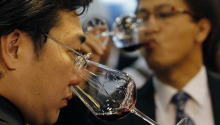
Among them is Canada, with several ambitious importers flying the maple leaf among represented nations at a Beijing wine exhibition this week.
“China is exploding into wine left, right and centre, so everyone’s trying to get into it,” said Trevor Scott, a Canadian who is executive chef at Beijing restaurant Vin. “I think China is on its way to being the biggest consumer of wine in the world.”
China is already the world’s leading market for luxury goods, and fine wines are no exception. China, including Hong Kong, became the world’s largest consumer of Bordeaux wines in 2010, importing some 33.5-million bottles at a cost of $475-million. The country now imports more than $1-billion worth of wine annually, a number that has quadrupled from about $250-million in 2004.
Canada already enjoys a niche with its ice wines, which became a valued luxury drink in China thanks to their availability to Chinese travellers at duty-free shops. Canadian wine imports to China have grown exponentially in the last five years – from just over 78,700 litres worth $815,000 (CAD) in 2005 to 462,000 litres for $9.15-million last year.
Now a small group of Canadian vineyards is trying to branch out and teach Chinese wine drinkers that Canadian wines are not limited to the sweet dessert variety.
“Bordeaux would be most premium, if you ask most Chinese people interested in wine. France in general would come in second, and Italy would be next. Canada is not top of mind, so it’s up to us to educate them,” said Peter Wille, export director for Okanagan-based Mission Hill Family Estate Winery, which is focusing on premium table wines for the Chinese market.
The winery’s exports are handled by a Chengdu-based company which runs a wine shop in that northwestern city and a wine-focused restaurant in Beijing, both dedicated to showcasing some of the wines the company’s proprietors discovered while exploring Vancouver’s culinary scene.
“There’s too much French wine here, both good and bad,” said Tan Yali, general manager of Sichuan Jin Cheng Yi He Industrial Co. “North American wine does not get enough publicity here in China. We are filling a void in this area.”
Mr. Scott, a Vancouver native whose previous employers have included Chateau Whistler and Le Crocodile, was hired as executive chef for the company’s flagship restaurant Vin, and arrived here last July after a crash course in oenology in California’s Napa Valley and the Okanagan. Now, along with designing Vin’s wine-friendly menu, he is running seminars for Chinese wine enthusiasts.
There is a lot to learn, given that the usual drinking traditions around Chinese
banquet tables involve tossing back glasses of potent baijiu, a clear grain alcohol often compared to vodka, as fast as the host can refill them.
“Have you seen how they drink wine here?” Mr. Scott asked, motioning with his hand to show the typical gan bei, dry-your-glass toast. “That hurts! Red wine doesn’t go down that fast. We try to teach them how to let the wine breathe, just little things, let them enjoy it rather than just pounding it.”
The strategy has not been adapted by all Canadian wineries selling their wares to China. Inniskillin, which in 2001 was among the first to introduce its ice wines to Chinese consumers through sales at duty-free shops, is sticking with that tried-and-true strategy.
“We looked at the duty-free market as a way of creating a category, and we positioned it as a luxury item, beside the cognac and Hermes scarves,” said Randy Dufour, export director for Vincor Canada, which owns Inniskillin. “It’s nice and small, it comes in a really nice gift box, and once people taste it, it’s – wow, what is that? … It became known as something prestigious to give.”
He is skeptical about other firms’ plans to turn Chinese on to Canadian table wines. “Honestly we’ve dabbled in some of our table wines, but our overall strategy is really focusing on ice wine,” Mr. Dufour said. “For us, if our core strategy is ice wine, does it make sense to have a $10 bottle of table wine and a $100-bottle of ice wine side by side? If I have to be known for something, I’d rather be known for what I do best.”
But other vineyard managers say they fear Canada’s wine industry could be pigeonholed by too much international focus on ice wine.
“Canada is known for ice wine … but once you get tagged with that, it’s hard for other sectors of wine to get a foothold,” said Ian Sutherland, founder and chief winemaker at boutique winery Poplar Grove, which now sends 1,500 of its 12,000 annual cases of production to China. None of it is ice wine, he said, adding: “The reality is the Okanagan produces stunning reds and whites. If you are really interested in the wine business you’re probably not only focusing on ice wines.”