Grape expectations at harvest time


A warm, wet harvest has resulted in a vintage that will test Nelson winemakers' skills, writes Peter Watson.
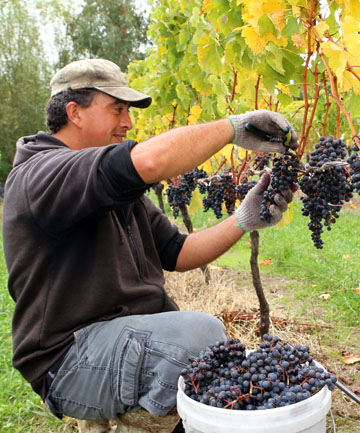
PICK OF THE BUNCH: Chris Wright handpicks merlot grapes at Golden Hills Estates vineyard.
Nelson winemakers will be thoroughly tested by this year's vintage, with warm and regular wet spells throughout the harvest raising the risk of disease.
Nelson Winegrowers Association chairman Mike Brown described this season's harvest as "problematic" after "dream" conditions in 2009 and 2010, when he said it was relatively easy to make good wine.
With 90 per cent of the harvest in and only some late white aromatics and reds other than pinot noir left to pick, Mr Brown said wineries and growers had had to battle humid and changeable weather, particularly in recent weeks.
While those who harvested early had largely avoided problems, others had faced disease pressures, he said.
Botrytis had become a problem in the past week or two, although not on the scale it was in 2008, and some pinot noir crops had been affected by slip skin and acetobacter, a bacteria that turned grapes acetic or vinegar-like, which was "very unforgiving", Mr Brown said.
"There will still be some great wines made, but there will be some lesser wines – it will depend on how the grower and the winery read the conditions and when they harvested.
"With white wines you can do a certain amount in the winery to ameliorate any difficulties with the fruit, but with reds you need perfectly clean fruit – which means if you are handpicking you can pick off the goodies, but if you are machine harvesting you need to take that diseased fruit off before you harvest."
Botrytis was not so much an issue with whites, particularly aromatics such as riesling, pinot gris and gewurztraminer, where it became part of the style of the wine, although it was not so good for sauvignon blanc, which needed to be harvested earlier to capture the flavours from a hot season before disease became an issue, he said. The vintage would be a good test of winemaking skills, which would produce wines of a much wider range of quality than the past two years.
Mr Brown said the Nelson crop was likely to be closer to the 7740 tonnes picked in 2009 than the 5963 tonnes produced last year, although about 5 to 10 per cent would not be harvested, either because it couldn't be sold or growers had exceeded yield caps imposed by wineries.
Such surplus grapes would be picked and left to rot on the ground, which was the right thing to do when the market was oversupplied, he said.
"You only harvest what you know you can sell."
With the world oversupply situation expected to take between three and five years to disappear, grape prices would remained depressed – which meant growers would continue to find the going very tough as wineries took a "very cautious" approach to selling and kept their stock levels tight, Mr Brown said.
There had been no rise in the number of Nelson vineyards on the market, but Chinese buyers had shown some interest in vineyards in Hawke's Bay and Marlborough because they had the money, the market and recognised it was a good time to buy, he said.
Jeff Marr, owner of Golden Hill Estates, one of the region's largest contract growers, said grape prices "suck, but that's farming".
They had managed to sell all their grapes – about 500 tonnes of grapes from 70hectares of vineyard – to the likes of Waimea Estates and Kahurangi Estate, which was a good effort in the current climate but would barely break even "at the best", he said.
"Our only advantage is economies of scale, because for Nelson we're big and that allows us to be cost-effective."
The company had worked hard to limit its crop to just 5 per cent more than last year, although what was happening in Nelson was "pretty irrelevant" because it was Marlborough where almost 80 per cent of the grapes were grown that had "to pull its head in".
The harvest had been tough with rain at the wrong time and more disease, around which had meant more time trimming and managing the crop, but the quality remained "pretty good", Mr Marr said.
Along with some sauvignon blanc, Golden Hill still had to harvest its merlot, dolcetto and syrah, which would be left to the end of the month to "raisin up".
While there was a risk leaving it so late, "they are looking fantastic and we like to harvest them at very high brix", he said.
Lars Jensen of Richmond Plains said it too still had some reds to pick.
"It's a good job we had an early start to the season and are ahead of things, otherwise ourselves and others would be a lot more pressured getting the grapes in because there has been disease out there."
However, the winery's biodynamically managed vines were much hardier than those conventionally run and more resistant to disease, he said.
Mr Jensen said although the quality of his grapes were good, he wanted to see the wine in the bottle and taste it before passing judgement on the vintage.
Waimea Estates was less guarded, saying it was delighted with both the quality and quantity of this year's harvest, which started on March 1 and was all picked by April 3, the earliest ever by the company.
A dry, sunny summer combined with more leaf removal had meant fruit free from disease and with intense ripe flavours was delivered to the winery earlier than normal, general manager Ben Bolitho said.
Meanwhile, most grapes in Marlborough have been harvested and winemakers are hoping for a good end to the vintage despite heavy rain last week. Constellation New Zealand viticulture and winemaking manager Darryl Woolley said the company expected to finish after Easter.
Mr Woolley said this late in the season canopies were shutting down, so dilution of flavours by vines taking up moisture from the soil should not be a problem.
Lawson's Dry Hills senior winemaker Marcus Wright said the weather was ideal for later pick pinot noir, gewurztraminer and late harvest riesling. He hoped the moisture would encourage botrytis which caused grapes to shrivel, concentrating honey and stonefruit flavours.