In black and white


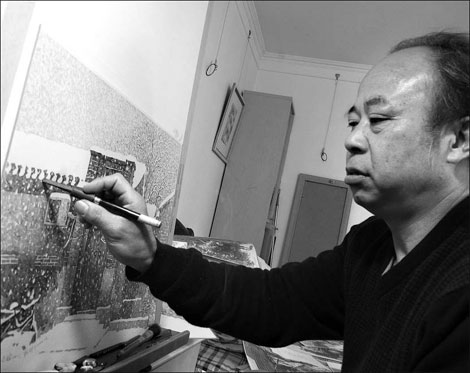
Over the past 20 years, Kuang Han has been capturing Beijing's hutong in his pencil drawings. Zhang Zixuan / China Daily
Jiangxi native pours his love of capital's hutong into his classic, wide-stub pencil drawings. Zhang Zixuan reports.
Looking at the vivid pencil drawings of Beijing's hutong, or traditional alleys, it's hard to believe the artist behind these beautiful sketches is not a Beijinger, but a southerner from Yifeng, Jiangxi province.
For the past 20 years, 50-year-old Kuang has been capturing the poetry of the hutong's gray-toned historic architecture - from the bicycle-repair shops to the classic eaves of courtyard houses hiding in the shadow of mammoth trees - in his pencil drawings.
Kuang's love of hutong developed slowly. When he moved to the capital in the early 1990s, the art school graduate was not at all happy to be squeezed into a 9-square-meter room with his wife and newborn son at a siheyuan, or courtyard, in Beixin Hutong. Queuing to use the public toilet and doing the cooking outside also embarrassed him.
However, his warm-hearted neighbors soon won him over. The southerner says he was never once made to feel like an outsider.
"Being in a siheyuan is like being in one big family, chatting, cooking and washing clothes together," Kuang says. "At dinner time, I often had to go looking from door-to-door for my son, who would be playing or watching TV at neighbors' homes."
As Kuang's intimacy with the hutong grew, he began to record its unique life in his drawings.
He recalls with affection how the first sentence his son spoke was - "Beer, soda and Erguotou!" - the call of a hutong vendor.
Unlike pencil sketches by other artists, Kuang's drawings are marked by the use of his signature wide-stub pencils.
Borrowing the techniques for oil painting, he uses surfaces instead of lines to express the spirit of hutong.
However, drawing with wide-stub pencils is hard work. Each drawing takes Kuang easily a month to complete.
"Every stroke needs to be pressed onto the paper and involves much exertion," Kuang explains.
He used to rest every other hour while working, but now Kuang says he needs to rest every 15 minutes or so, and slap pain-relief plasters on his shoulders.
Although pencil is not the only drawing tool that Kuang has mastered, he insists on using it for his hutong drawings, saying, "The hardness and grayness of the pencil is best suited to drawing hutong's typical characteristics".
To make the picture more lively, Kuang sometimes adds small aesthetic touches, such as a birdcage or a stray dog at the entrance of a siheyuan. But he never compromises the authenticity of a hutong, saying being truthful to his subject is more important than artistry.
To record the look and feel of a hutong in different seasons, Kuang makes repeated visits to the sections he wants to draw. For example, he visited his favorite Yandaixiejie, or Pipe Street, more than 10 times, merging into the hutong scenery.
In winter, the southerner is armed to the teeth as he ventures out in his cotton-padded clothes and pants, 1.5-kg shoes, three pairs of socks, two pairs of gloves and a woolen cap that covers his whole face, save his eyes.
His outdoors gear is the loving work of his wife, Jian Hanli, who shoulders all the housework so Kuang can concentrate on his drawing. "We used to quarrel a lot about it. But seeing him wrapped in a quilt in winter, drawing, I began to understand his persistence," Jian says.
In 1997, after six years, Kuang and his family moved out of Beixin Hutong to a high-rise building. But he continued recording the stories of the hutong through his drawings.
In 2008 Kuang published his second album of pencil drawings, called Fading-Away Hutong, featuring 113 hutong in Beijing. Unlike his first album published in 2003, Kuang placed a photograph of the changed landscape of the hutong besides each drawing, revealing the dramatic contrast.
Shu Yi, former head of the National Museum of Modern Chinese Literature and son of renowned Chinese writer Lao She (1899-1966), has called Kuang's album a historic record.
Kuang says his albums are the best textbooks for later generations, presenting a history that goes beyond words.
"If only the Forbidden City survives, our children will wonder where ordinary people lived," he says
When asked about the new look of the hutong he used to draw, Kuang is silent for a while.
Slowly, he says that while he is happy that hutong residents can now finally use central heating, have access to a private toilet and a kitchen in high-rise buildings, the loss of the beauty of old Beijing pains him.
He says the breakneck speed of development in Beijing leaves him with a great sense of urgency. If a hutong were to be pulled down before he can draw it, Kuang feels like he has failed the hutong.
"It's like a senior family member has died before I can draw his or her portrait," he says.
In 1996 Kuang realized that his pencils could not keep pace with the bulldozer and began to take photographs of every hutong so he could refer to them in his drawings. He now has more than 10,000 hutong photos and plans to devote the rest of his life to preserving them on paper.
"I wish I could do more to keep hutong alive," he adds wistfully.

A view of Beijing's Dongsi Batiao Hutong in winter by Kuang.