Childress Vineyards employs technology


Packaging, marketing innovations keep winery on cutting edge
By Vikki Broughton Hodges
Childress Vineyards in Lexington is embracing new technology to create more sustainable products that will appeal to younger, tech-savvy consumers.
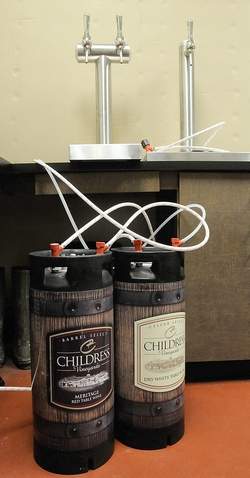
Two remote wine kegs, one for red wine and one for white, use nitrogen for pumping top-quality wine into stainless steel taps that were built by Richard Childress Racing machinists for Childress Vineyards. Each keg holds approximately 26 bottles of wine and eliminates wasted wine and discarded bottles and corks for restaurants and caterers who use them. Buy photo
The winery recently introduced a wine keg that is geared to enhance the quality of wine-by-the-glass programs in restaurants and bars as well as high-volume venues such as catered events and sporting locales.
Donnie Roberts/The Dispatch
A stainless steel wine keg uses similar technology to a beer keg, except that nitrogen is used to push the wine out rather than the carbon dioxide commonly used in beer kegs, explained Mark Friszolowski, winemaker at Childress Vineyards.
What that means is the last glass of wine from a wine keg, available in 15-bottle and 26-bottle equivalents, tastes just as fresh as the first because there's no risk of oxidation, which occurs when bottles are opened and the wine is exposed to air. Friszolowski noted a lot of wine goes to waste in restaurants when a glass is poured from a bottle that sits for days before another is poured and will eventually have to be thrown out. Even worse, re-corked oxidized wine that has gone stale may be served to consumers who aren't aware the quality of the wine has been compromised. He said vacuum pump systems, sprays and even expensive cruvinets can't really preserve wine well once it's opened.
Another bonus to the wine keg is the major reduction in packaging from bottles, labels and corks, which fits in with the winery's sustainable agricultural practices such as composting and using organic fungicides,Friszolowski said, adding each wine keg can be sanitized and refilled as many times as desired.
“The consumer wins because you're getting better quality wine, the restaurant wins because they reduce their waste, and the environment wins because there's much less packaging,” he said.
“We're a pretty traditional industry. This is the first thing I've seen in 20 years in the wine business that's generated a buzz. There's a little bit of what I'd call a ‘wow factor.' People say I want to try a tap wine by the glass.”
Julia Kiger, director of marketing for Childress Vineyards, said younger consumers are also more interested in eco-friendly products.
“Today's generation demands sustainability,” Kiger said.
Friszolowski said some European countries, such as Germany, have used wine kegs for years, but it never caught on in the U.S. market until recently when innovations in the keg technology allowed for better grades of wine to be marketed in the stainless steel kegs.
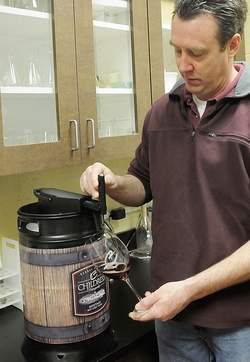
Friszolowski said two types of systems are being sold, a mobile, self-contained fresh keg that can be picked up and moved, which is suitable for catered events, for example. The other is a more traditional tap system like those seen on bars for beer with the kegs underneath the countertop. He noted the Richard Childress Racing Shop in Welcome has designed and fabricated a stainless steel wine tap system that can be affixed to the top of a bar counter for those who don't want to run it through an existing tap system. RCR also made the wrap for the stainless steel kegs that looks like an oak wine barrel.
The kegs, which now offer either a dry white blend or dry red blend, are first being sold and installed in restaurants that have carried Childress wines and emphasize North Carolina wines, he said. Distribution will eventually be across the state and possibly Charleston, S.C. He said he's even received some calls from New York.
The wine keg was recently introduced at the Proximity Hotel in Greensboro, which includes the Print Works Bistro, because of its national leadership in sustainable practices. Friszolowski said a number of restaurants, brewpubs, such as Foothills Brewing in Winston-Salem, area ballparks and the Charlotte Speedway Club will also buy the wine kegs.
“We think it's going to open up a lot of doors that otherwise weren't open,” he said.
Friszolowski, the chairman of the N.C. Wine and Grape Council, said the wine keg innovation is just part of an overall effort to keep promoting the quality of North Carolina wines.
Childress Vineyards winemaker Mark Friszolowski demonstrates a pour from one of the self-contained wine kegs developed at the winery. The wine keg is portable for easy use by caterers or businesses that do not have space for taps. Buy photo
Childress Vineyards is also using new technology to help market its wines, Kiger said. Its newest wine labels for the newly renamed Muscadine Wine, formerly Scupperdine, feature a Quick Response tag on the back label. A QR tag is an encoded matrix barcode that connects the user to information, entertainment and interactive experiences through a free mobile app on their smart phone. For example, on the new Muscadine Wine, if you hold an iPhone over the tag, the phone takes a snapshot of the tag and goes to YouTube, where a short video of Richard Childress plays talking about the wine, followed by information about the winery.
Donnie Roberts/The Dispatch
“People can find out more information on the product on the fly,” she said. “And they don't have to type in a long URL to get to it.”
Kiger said the information available through the app can include anything from a video, such as the one featuring Childress, to Friszolowski discussing the attributes of the wine or a link to suggested food pairings and recipes.
“It's fairly new to the wine industry,” she noted. “It's just on the muscadine now, but we'll start putting in on all the labels.”
Friszolowski said the N.C. Wine and Grape Council is also planning a wine industry app that would include information on wineries across the state, complete with directions and tasting room hours.
“You're just missing a whole group of people if you don't do it,” he said. “That's how a lot of people find their way around these days. And there are so many things you could link to it.”
The winemaker said these technological innovations give Childress Vineyards a competitive advantage.
“Just because we're a winery in Lexington, N.C., doesn't mean we can't lead the industry,” he said.