Monty has a nose for the biodynamic way


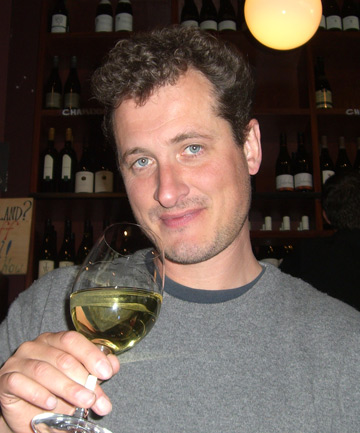
BIODYNAMISM: Monty Waldin sniffs the bouquet of a Marlborough sauvignon blanc.
Monty Waldin turns his head sideways. "Do you see that nose?" he asks. It is slightly bigger than average, but he is no Cyrano de Bergerac. "That is the reason I'm in the wine business. I was a schoolboy sent to Bordeaux to improve my French when I discovered my big nose meant I was quite good at wine-tasting."
The bouquet of a wine anticipates the flavour and, presumably, the bigger the nose the more olfactory sensors it has. But Mr Waldin doesn't stop to explain. He is in full flight.
He is explaining how he first encountered biodynamic winegrowing. It was in 1993 in Bordeaux, after six years of working in vineyards in France, Germany, California and Chile.
"This vineyard was completely different to the others I had seen. It had finesse, aroma, an inner vibrancy. I put my hands in the soil and I could smell the earth. The vines looked like they really meant business. It was almost like they were saying, 'What are you doing here; this is our place, not yours'."
Intrigued and excited, he visited more biodynamic vineyards. He discovered they were self- contained farms, each with their own cows to provide fertiliser and compost for the vines, herbs and crops for fertiliser, compost and anti-pest and fungal treatments, and bees for vine pollination.
"Each is a self-sustaining organism - that makes sense to me environmentally. And it has its own expression of its place in the world, which makes the wine unique."
It is clear he is passionate about biodynamics, but his voice also has the assertive edge of someone used to fending off scepticism, even derision.
The scepticism is not surprising. Biodynamics is far from the mainstream, using compost and manure fertiliser nurtured in buried cow horns and following the phases of the moon and planets in planting and harvesting crops.
The derision has been immortalised on film. In 2007, when Mr Waldin, by then a well-known writer for the British wine magazine Decanter and the author of several books on wine, decided to grow his own biodynamic wine in France, the experience was captured by a documentary team.
The resulting series, Chateau Monty, was shown on New Zealand television last year.
Scoffing the loudest was Bill Baker, a London wine wholesaler. "Barking mad! Organic wine, pah!" he was shown as saying.
But he drank his words a year later when he tasted the wine. "It's got good fruit and should soften up without losing that gutsy, southern French character that will make it very popular in restaurants."
Ad Feedback Chateau Monty, the wine, appeared on merchants' racks for three years but Mr Waldin barely covered his costs and handed back the leased vineyard last year to work on a just-published guide to biodynamic wine that profiles 1500 certified organic and biodynamic vineyards world-wide.
Still writing for Decanter, he is also a biodynamics consultant and is in New Zealand to see how its organic and biodynamic winegrowers are developing. New Zealand has four biodynamic vineyards, with three more close to certification, with the biggest being Milton, at Gisborne, and Seresin, in Marlborough. Organic vineyards are spread through the country, with 123 BioGro-certified and covering 1600 hectares.
The target is to have 20 per cent of the country's 30,000ha certified organic or biodynamic by 2020 and Mr Waldin says that, judging by progress he has seen, that could be reached as soon as 2015. "I predict a very green future for New Zealand wine, and I say that with sincerity and with pleasure," he says.
"Wine producers thought initially that going organic would be difficult because of weeds and fungal diseases in the damp climate, but you've got some incredibly talented organic consultants here who know their science, their soil and their viticulture.
"Once people have the tools and can see it works they want to be part of it. They can see it will give them a point of difference in marketing, but also in terms of quality, with more consistent yields.
"Also, why would you want to send all of those hard-earned kiwi dollars out of the country to American corporations selling weedkiller and to German and French corporations selling fungicides, herbicides and soluble fertiliser?
"Why don't you put those dollars into your local community, hire a few extra workers, spend more time in your vineyards admiring those weeds and learning what they do for you beneficially."
He laments the loss of local climate and soil characteristics in wine, saying they are being destroyed by use of chemicals.
"A biodynamic grower will say, 'what I put in my soil is out of my own cows that eat grass in my own fields and I make compost from my own fields'. Surely, anybody with half a brain will see that guy has a better chance of making a site-specific wine than the guy trucking in stuff from all over the world."
The biodynamic grower also has more than just grapes. "They've got their own cows to make compost, they grow their own plants to make herbal teas and mixed crops and they have beehives for pollination, so they're making milk, cheese, vegetables and honey."
Planting by the moon is an essential part of biodynamics. In Chateau Monty, the two weeks between the full and new moon were high work times and he was seen pruning vines during a descending moon cycle to keep vines strong at a time when sap was descending to the roots. "You talk to an old-time farmer; that's how they were doing it. They're not nuts."
Wine drinkers are becoming more interested in organic wines and writers' scepticism has changed to respect, he says.
"The proof is in the pudding. If the wines were no good, people wouldn't stay with them."
Despite his own experience, when he pitched his bottle prices too low, the good growers were making money. "You spend the same amount of money as a conventional grower, just differently.
"But the best thing is that, as a human, you're much more in contact with your vineyard. As a biodynamic grower, you're treating the vines with something you could drink, like nettle and chamomile solutions.
"When I worked in a conventional vineyard it was masks, goggles, white suits and you're not allowed to enter the vineyard for three or four days.
"I don't want to drink a wine from that kind of vineyard."