New blood at Laurel Glen


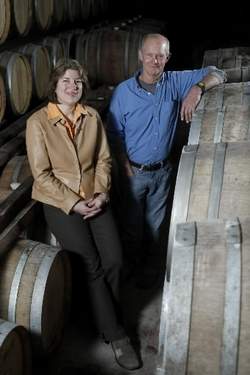
Bettina Sichel recently bought Laurel Glen vineyards and winery from Patrick Campbell. BETH SCHLANKER/ PD
Patrick Campbell of Laurel Glen Vineyard came to Sonoma Mountain in the 1970s to help farm a vineyard at the Sonoma Mountain Zen Center. The mountain, 2,463 feet above the town of Glen Ellen, already had a reputation for growing good grapes, in particular a 3-acre patch down the road from where he was living known as Laurel Glen.
He bought it and planted cabernet sauvignon vines in 1968. He added to his vineyards over the years and released his first wines in 1981. The entire acreage is now planted 100 percent to the Laurel Glen Cabernet Sauvignon Clone, a UC Davis-certified clone.
Thirty years later, after building a reputation for making classically elegant, balanced cabs that were able to age, he's moving aside to let others take over both in the winery and in the vineyard.
“Laurel Glen is something that needs 100 percent concentration and I was out of focus on it,” Campbell said. “I wasn't giving it 100 percent of my focus.I have the Lodi and South American stuff plus the whole company to run. It just didn't get the full attention it deserved.”
Indeed, over the years Campbell has launched two Lodi brands, REDS and ZaZin, as well as ventures in the wine regions of Chile and Argentina, where he makes Terra Rosa malbec, among other wines.
As a result, the now 16-acre estate Laurel Glen vineyard and its wines were sold in February of this year to Bettina Sichel, who will continue to produce Laurel Glen Cabernet Sauvignon (roughly 1,300 cases/year), which retails for about $60, and Counterpoint Cabernet Sauvignon (700 cases/year), which retails for $30, both of which are sourced from Laurel Glen. She hopes to increase production
A sales and marketing specialist who helped launch the vaulted Napa Valley cab brand Quintessa, Sichel aims to revitalize Laurel Glen's reputation in the minds of consumers, who, she believes, may have lost track of Laurel Glen's quietly consistent wines over the years.
“What attracted me to Laurel Glen is the pedigree, the history,” she said. “I want to take that and brush it off and restore it to the place it was at its peak. Laurel Glen was a very celebrated wine in the late 1980s and early 1990s. My philosophy is I don't want to make big changes, I want to make tweaks.”
To that end, she's brought in viticulturalist and in-demand consultant Phil Coturri, who himself lives and farms on Sonoma Mountain, as well as winemaker Randall Watkins and consulting winemaker David Ramey, another guy in big demand. Sichel feels the new blood will still respect a lot of the old ways.
“In the vineyard, Phil feels small changes can yield interesting and meaningful results,” she explained. “David Ramey feels small changes in the winemaking techniques and style could yield interesting and meaningful results. Everyone is committed to the fact this is an east-facing vineyard so we'll never produce huge, fat cabernets — ‘fatso cabernets,' as Patrick likes to call them.”
Campbell will not be officially involved in production or in the vineyard, instead describing his role now as support story-teller for Sichel on the road, there to provide color commentary.
The time is right for their story, as consumers appear to be increasingly interested in more balanced, restrained wines.
“People tell you what they want is authenticity, (they) want wines more moderate in alcohol and higher in acidity and more food friendly and voila, here we have it,” Sichel said. “For the people who were fans and have sort of forgotten about Laurel Glen, I'm trying to remind them they're just as good as they ever were.”
Though the mountain's conditions can vary greatly depending where you are and how you face the sun (there's pinot and chardonnay being grown on Sonoma Mountain's western flanks, too), Campbell's spot has worked for cabernet precisely because it is east-facing, so it gets plenty of sun throughout the long growing season, typically mid March to the end of September.
Campbell explains further that it's also because the vines are about 1,000 feet up and at the end of the mountain. This means they aren't shadowed by the mountain's peak during crucial times of the day when the grapes need as much warmth as they can get to ripen.
“This place really holds the acidity,” he said. “Our average day of picking is late September, that is a long period of time on the vine, particularly because they bud out early here. You can get fully mature grapes at a little bit lower brix than you can in a lot of warmer locations.”
Recently, Campbell and Sichel have presided over tastings spanning Laurel Glen's 30-year history, to remind people of the wines' ability to age.
“I'm always gratified tasting the older wines,” said Campbell. “It's a very balanced vineyard, it yields a very balanced wine. We never tried to go overboard on overly toasty oak, jammy, opulent, name your term-type wines; the idea was express the vineyard, it's a remarkably good vineyard and a very unique vineyard.”
Sichel adds how she was struck by how consistent the character of the vineyard was throughout each of the 30 wines.
“A few very ripe years (it was) a little more muted, but you saw very clear threads and to me that's what makes this so interesting,” she said. “I love the acidity in this wine, I love the gout de terroir.”
The 2006 Laurel Glen Cabernet Sauvignon is the current release. A 2007 Counterpoint Cab will be released May 1. Both may be found locally at such retailers as Bottle Barn, or very soon tasted by appointment at Laurel Glen's tasting room in Glen Ellen's Jack London Village, slated to be open by Memorial Day.
Virginie Boone is a freelance wine writer based in Sonoma County. She can be reached at virginieboone@yahoo.com.
“People tell you what they want is authenticity, (they) want wines more moderate in alcohol and higher in acidity and more food friendly and voila, here we have it,” Sichel said. “For the people who were fans and have sort of forgotten about Laurel Glen, I'm trying to remind them they're just as good as they ever were.”
Though the mountain's conditions can vary greatly depending where you are and how you face the sun (there's pinot and chardonnay being grown on Sonoma Mountain's western flanks, too), Campbell's spot has worked for cabernet precisely because it is east-facing, so it gets plenty of sun throughout the long growing season, typically mid March to the end of September.
Campbell explains further that it's also because the vines are about 1,000 feet up and at the end of the mountain. This means they aren't shadowed by the mountain's peak during crucial times of the day when the grapes need as much warmth as they can get to ripen.
“This place really holds the acidity,” he said. “Our average day of picking is late September, that is a long period of time on the vine, particularly because they bud out early here. You can get fully mature grapes at a little bit lower brix than you can in a lot of warmer locations.”
Recently, Campbell and Sichel have presided over tastings spanning Laurel Glen's 30-year history, to remind people of the wines' ability to age.
“I'm always gratified tasting the older wines,” said Campbell. “It's a very balanced vineyard, it yields a very balanced wine. We never tried to go overboard on overly toasty oak, jammy, opulent, name your term-type wines; the idea was express the vineyard, it's a remarkably good vineyard and a very unique vineyard.”
Sichel adds how she was struck by how consistent the character of the vineyard was throughout each of the 30 wines.
“A few very ripe years (it was) a little more muted, but you saw very clear threads and to me that's what makes this so interesting,” she said. “I love the acidity in this wine, I love the gout de terroir.”
The 2006 Laurel Glen Cabernet Sauvignon is the current release. A 2007 Counterpoint Cab will be released May 1. Both may be found locally at such retailers as Bottle Barn, or very soon tasted by appointment at Laurel Glen's tasting room in Glen Ellen's Jack London Village, slated to be open by Memorial Day.
Virginie Boone is a freelance wine writer based in Sonoma County. She can be reached at virginieboone@yahoo.com.