Constellation takes long-view approach


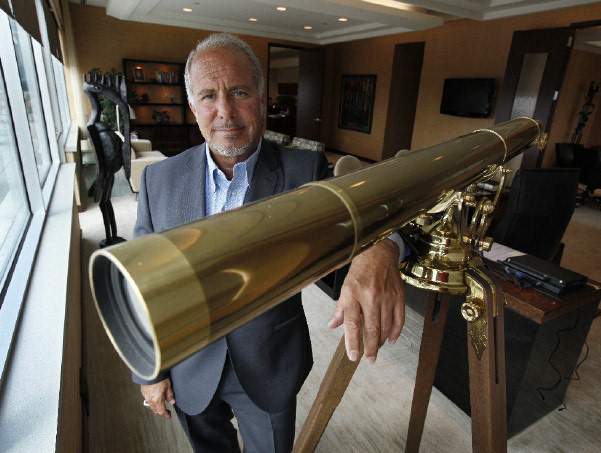
CEO Rob Sands has used a light touch to change directions at Constellation Brands, putting a brake on acquisitions in favor of cutting debt and building cash flow. CARLOS ORTIZ/STAFF PHOTOGRAPHER / Carlos Ortiz/staff photographer
On the surface, Constellation Brands Inc., the huge Victor-based wine, beer and spirits merchant, hasn't changed much.
It has a deep portfolio in wines, especially the Robert Mondavi labels. Its partnership with Mexican brewer Grupo Modelo continues apace, with an exit date not expected until 2016. There have been no dramatic changes in leadership, nor overt cuts in workforce.
But Constellation has reached the end — a satisfying end, CEO Rob Sands said — of what may be the company's most thorough and far-reaching shift in direction in years.
For a long time, Constellation was on an acquisition tear, moves that made it the world's largest wine company. It has subsidiaries in Australia, New Zealand, the United Kingdom and Europe.
It was selling all kinds of wines and spirits — low-end, high-end and in-between — on a major scale. Its distribution and sales systems were large and complex. Debt was accumulating along with new businesses. It was a business model based on volume and it was global in scope.
Rob Sands, whose father, Marvin, built the local company from humble beginnings, put the brakes on, using a feathering touch more than a heavy foot, when he took over as CEO from his brother, Richard, more than four years ago.
The acquisition-minded Constellation became the cut-debt, build-cash-flow Constellation.
It was a gradual but steady process. Internally, the sales force and distribution model were streamlined, reducing overhead and making it easier to get products to market. Constellation divested some of its value or low-end brands.
Last year, it sold the Widmer winery in Naples. In January, the company sold its majority interest in British and Australian wine companies to a private equity firm for $230 million.
Through these and other deals, the company's worldwide workforce has dropped from about 10,000 to 6,000, though staffing at the Victor headquarters and Canandaigua facility has remained about 600. Constellation is a local company that has gone through a major downsizing without the attendant hue and cry.
"You call it downsizing, but it is and it isn't," Sands said. He sat down last week for an interview in his office at Constellation headquarters, atop a hill in Victor. Looking south from his office, Sands has a view of a portion of the Finger Lakes wine country where the company began.
"We've been very successful in restructuring the company," he said. "What we've done more than downsize, though, is uncomplicate the business, consolidating activities, identifying functions that were not contributing to the profitability of the company. The Australian and U.K. businesses did $1 billion in sales but they added far less to our bottom line."
Sands said there really wasn't a eureka moment when it came to reconstituting the company. "We just reached the point where we felt we had to go in a different direction, and we're at the end of that process now. We saw that we had gotten all that we could get out of the acquisitions.
"We decided then that we needed to look at three things: distribution, sales and portfolio. There's an old adage in business that says that you get 80 percent of your profit out of 20 percent of your business. We want to maximize that 20 percent."
The numbers, both the company's and Wall Street's, back up the contention that Constellation made the right call. On Friday, the stock hit a 52-week high of $23.19 before settling at $22.71 — more than double the low point of $10.80 in 2008.
The company has consistently outpaced analysts' estimates of earnings, and it turned a $560 million profit in fiscal 2011. Only two years before, it had lost $300 million.
"What the charts show me is that, while analysts are still on the fence, investors like the stock and like what the company is doing," said Francis Gerham, vice president of investments for Westminster Financial LLC in Pittsford.
Sands said the response from the investment community has met his expectations. "They were in a wait-and-see mode, but that's understandable. They want to see concrete evidence. But they've seen the success."
Much of the work Constellation did in reshaping the company came during the recession. For a time, sales took a hit and losses were evident. But the company continued to pay down debt and build cash flow.
"We stuck with what we were doing," Sands said. "I'm happy about that. We could have pulled back and stopped investing in the business. That would have been dangerous. But we didn't overreact."
At the recession's depths, wine, spirits and beer sales at restaurants and bars fell. But people continued to buy for home consumption.
And it didn't hurt that Constellation, through its joint venture with Grupo Modelo, benefited from the success of the Corona beer brand. Sales of Svedka vodka have soared and it is now one of the company's hottest sellers.
"The fact is, sales for this sector aren't that recession-sensitive," Gerham said. "If things are good, you celebrate. If things aren't, you drown your sorrow."
Sands said the Modelo deal has been good for both sides. "We had a small legal problem but that's been resolved. We're a long way from having to negotiate an extension but we've been happy with the relationship."
Now that the restructuring has run its course, the strategy is to capitalize on brand strength, stick with a portfolio of premium wines and maximize a more efficient sales and supply network.
"It's organic growth, meaning we will build from what we have," Sands said. He professed no concern that, in terms of sales volume, Constellation has ceded its place as the world's largest wine company to E.&J. Gallo Winery. "I don't think that's something the public cares about. That's not why they buy or don't buy."
Constellation's quiet transformation may be reaching a new stage, as Sands said, but the process has been smooth throughout at the retail level.
"This company has really strong products and the reps are in here all the time asking if there's anything more they can do," said Michael Palmeri, owner of Marketview Liquor in Henrietta. "That's the way it's been for years. That hasn't changed."