Defenders of slow culture


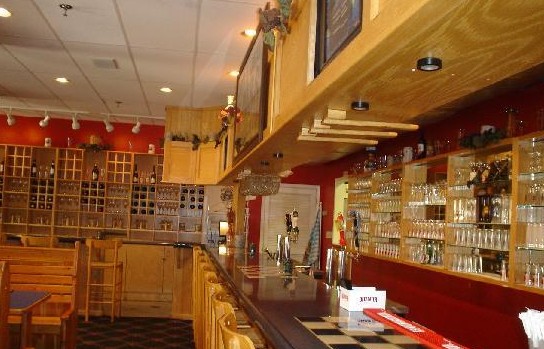
THERE'S a hutong brew pub in Beijing where owner and patrons drink cheerfully under Blitzkrieg-like conditions. They are making a stand on the front lines of beer culture, in the back alleys of a high profile, low-tech hutong heritage neighborhood. The Great Leap microbrewery and taproom suffers from "orange-outs" daily, owner Carl Setzer explains, but they're not quite as bad as power brown-outs, and nothing the fermentation process can't ride out. When the uninsulated water pipes froze, he and his wife Liu Fang had to coach their local plumber how to build them a bypass so they could stay in business. Then there's the persistent threat of development. The traditional domestic Chinese architecture around ancient Beijing's cultural north pole, the Drum and Bell Towers, is being tarted up and many ancient alleys have already been reduced to rubble. The young couple has a 10- year lease on the premises but Setzer says the fact is, "We could go home on a Tuesday, come back on a Wednesday and it could be destroyed. Little old ladies drop by when they see us making modifications to the bar and ask 'why bother? You'll just be torn down in five weeks, or five months or five years'."
Why bother indeed? Hanging out the proprietor's shingle is risky enough anywhere, but doing it in a foreign country would seem to up the ante considerably. Nevertheless, a growing number of foreigners are doubling down on the vision of being their own boss in China. Owning your own business seems to have perpetual allure, despite the difficulties. Two young independents, a brewer and a tea exporter, are doing it by selling slow culture in the heart of China's headlong dash into modernity.
With no formal background in the art of brewing, Setzer struck out on his own for all the usual reasons. Even before he and his business partner-wife were expecting their first child, the desire for a quieter life, more time together, and more control of their environment was beginning to get some purchase with this successful young couple. What started as a sideline to their regular day jobs became Great Leap – Beijing's first microbrewery. It took some doing: consider that they spent nine months just looking for a suitable location for their brewpub, then continued to work full time while the hutong space they found was being renovated by contractors. More than once they came home to check on the place only to find nothing had been done since the last long discussion. After burning through two construction crews, the hutong house and its walled, tree-shaded courtyard were finally ready, but the challenges weren't over by any means.
"There's many a slip twixt cup and lip," as the old saying goes, and Carl Setzer would agree. Things started out well. Setzer has been working for the man since he came to China seven years ago, apart from two half-year stints back in the U.S. to complete his Masters in International Affairs. He was the classic "white guy" hired by Chinese businesses in those days, a jack of all trades who polished English-language communications, helped with purchasing, or negotiated with English-speaking outsiders. Then he got a scholarship to National Taiwan University in Taipei to polish his slowly accumulating Chinese language skills and entered in earnest the busy wheeling-dealing world today's China offers. Along the way he met and married colleague Liu Fang. Liu is one of two women in China since 1947 who have been to the bottom of a deep-shaft coal mine – as part of her work for a mine security company; it speaks to her gumption. It was Liu who actually suggested they start a microbrewery as a hobby of sorts after Setzer introduced her to British ales on a vacation they took in Laos. To hedge their bets awhile, they kept their day jobs.
An American, from Cleveland, Ohio, he says, "In the U.S., if you want to start a brew pub you go to one supplier to get yourself set up, and after that you deal with maybe a handful of suppliers." Here in developing China, a microbrewer must deal with 28 different ones on a regular basis, because not only are the pots, hoses, taps, kegs, fittings, pipes, and valves all handled by different people, so are the regularly required sundries, everything from the hops to the cleaning fluid. Many of the necessary components had to be sourced and re-purposed. "Explaining to the workmen how to place all the containers and how to connect them up was simply comic because they had no concept of what we were doing" was the stoical comment from Carl, and everything else was trial and error too. "Even now we are constantly challenged to see what we can do with local products, or source around the difficulties."
Beer is technically a simple beverage to brew, compared to making wine or spirits, but the haggling over the final nature of deals, which is all a part of Chinese business culture, had an exponential quality. Venders the couple dealt with during the set up would assume the fair-haired Setzer was Liu Fang's foreign boss and would try tempt her to propose deals that undercut him; it happened with every supplier, and for Setzer that went "from cute, to interesting, to frustrating to infuriating." When the divide and conquer tactics were thwarted, the publican sighs, it turns out "There are no set prices; everything is different every time and it makes it nearly impossible to establish budgets," a situation which was partly eased by developing solid relationships with critical venders.
Last month he was an IT consultant; this month they are self-employed. After their soft opening in October of 2010, they swiftly decided the status and income their corporate jobs allowed them was no great loss. Had they had even a hint of doubt, he says, they wouldn't have taken the leap. How they did it counts for as much as what they did. "We didn't want to cut any corners, we did it piece by piece; we wanted to make this into a scalable business without killing ourselves." There were other reasons for going to all the trouble: he wants to be loved. Beer is one of those great social equalizers.
Setzer sleeps much better at night, and emphasizes that even for the swift and the brave office jobs are stressful, whereas "Great Leap wasn't a race to win, just a puzzle to solve." They had no investors to satisfy, nor pressure to change the business plan. Now they just have customers to please, and they represent a wide demographic. Setzer brewed test batches at home before the pub space was ready and the publican is still enjoying his freedom to experiment with brews and make up the names. The taps at Great Leap dispense pints of delightfully potent ales in chocolate and pumpkin flavors with two to three times the kick of standard Chinese fare. British ales are their specialty but there's a decidedly un-British Honey Ma Gold infused with Sichuan spices and best imbibed with that cuisine; nearby restaurants deliver when the taproom's customers get peckish for something more substantial.
The clientele doesn't come for the food anyway. Great Leap is tucked away in an alley far enough away from the action of a touristy hutong makeover, as Setzer points out, to guarantee that "people won't just drop in here because it's handy. Tired shoppers and casual partyers are not going to be wandering the hutongs looking for us." The beer is about to find its way to the fans however. Setzer's second brew pub will be near China's best known tourist destination. The Great Leap of the Great Wall will open in the fall of 2011, equipped to produce 250-gallon batches and gleefully awaited by local eating and drinking establishments with whom the couple have cut deals.
It is both an act of defiance and of acceptance to lounge in the Great Leap's walled garden or in its cheeky Pre-Reform China interior décor. On the surface everyone's there because they like quality beer and a taproom atmosphere, but pub culture, as a version of "slow culture," is reason enough. Even in winter customers pick their way through the snow and along the narrow alleys to hunker down in the Great Leap. "The government has made living in this area fairly comfortable, the water, the natural gas, the electricity are all subsidized, because for the most part residents here are property rich, cash poor," Setzer points out. But there are elements intent on total modernization, including those who would replace real hutongs with convenience-bolstered replicas or worse: opposing them are many different international and local groups desperately promoting preservation, and a handful of local politicians who have a different version of progress. "It's an exciting place to be and an exciting time to be here," the brewer admits, "but that's the biggest risk."
Charlene Wang is another American brewster who beat her organizational dependency, in this case for the pursuit of the perfect leaf. Her new company's opening pitch, "distractingly good teas," is actually the core of her story, and, like Carl Setzer, the writing was on the wall before she quit her day job. She admits while working at the American embassy in Beijing, "In the middle of a Foreign Affairs Dept. meeting all I could think about was, gee, this is really great tea." Wang had studied international development at all-female Wellesley College, and after graduation joined the US Foreign Service. Her career eventually brought her to China's capital, but by 2005 she already knew that all bureaucracies dampen creativity and dynamism. One last hurrah came in 2009 when she took a dream job she'd worked hard to get with the State Dept. in Washington. She is grateful for all she learned with her employer, but lasted only eight months before realizing she wanted to be back in Beijing, and on her own terms. The 30 year old actually has a trinity of motives for being an entrepreneur; it's the tea, her social enterprise ambitions, and that greatest of plan-spoilers, love.
An extremely early convert to the beverage, she admits to being nerdy enough by age 10 to subscribe to Victoria magazine, a glossy for the 40-something demographic in the grip of high nostalgia. Her Chinese-American parents accustomed her to other aspects of Chinese food culture. Personal travel and professional development in tea culture consisted of fact-finding trips to tea-producing regions of Sri Lanka and India, and master classes at the World Tea Expo in Las Vegas. "Tea is about where it is grown, how it is prepared, how it's consumed," says Wang who today has a characteristically Chinese tutoring arrangement – unstructured but intense – with a local tea master.
When she tasted some of the best teas China had to offer, the questions were obvious: why are all the famous gourmet teas French, British, Japanese and German, when none of these are tea-growing regions? Why do Chinese hotels offer low-end foreign teas in the suites? Kudos to the Starwood Hotel chain (think Westin) for carrying good Jing brand teas, but why a British brand in their Chinese properties? Wang had her China mission cut out for her: build a company that would showcase Chinese teas. Wang has hunted down teas and producers of quality: a white for its subtle sweetness and storage practices; an organic green for the fidelity of the producer's definition, a fall-harvest oolong, a black for its richness and depth, and a Pu'er for the wild 700-year-old trees that yield it.
Tranquil Tuesdays is her business and she buys, packages, brands and sells these exquisite teas for the foreign gift, corporate gift, and custom-labeled markets, and carries related ceramic ware. Like Setzer, she has embraced an ancient beverage for its slow culture qualities. Kung Fu Cha, using the same descriptor as the martial arts school, means "focused" tea drinking; a whole afternoon may spent over a bottomless teapot, in boundless conversation. And like Great Leap, the private showroom and offices are in a hutong setting with the same perennial challenges: Wang buys bottled water in winter to get around the old neighborhood's frozen pipes.
Before moving here with the State Dept. her experience of China consisted of a summer interning at the Legislative Council in Hong Kong the year the 2008 Olympic bid was won, and volunteer English teaching in a minority village in Guangxi. Wellesley alumna Wang was sensitized to women's issues, and had an interest in "social enterprise" before it got the clever title. But she had become disillusioned with the regular channels of bringing relief: grant writing for funds and report writing to justify how you spent them gobbled up eternities. However, work in remote areas of China re-awakened her interest. She hopes the tea and teaware business will become a revenue source for an entity that trains and employs rural women to develop their own potential. Wang has started by hiring a rural woman who came to Beijing to work as a casual domestic, and the new hire was soon handling orders and shipments when Wang was out of town, and has integrated afternoon English language classes into her duties.
Women's empowerment issues have left room for romance in the life of the tea maven. "Tea is also about the places it brings you," she says, and that was back to China and her boyfriend – now fiancé – Tony Chen, an independent tour operator whom she had met only months before that last big job offer from Washington. "I realized I wanted to be with Tony," she smiles, "and I had made friends here when I worked with the embassy; China is where I wanted to be if I was taking a big risk."