Castles and clams, beaches and beer


Text and photographs by Lin Dihuan
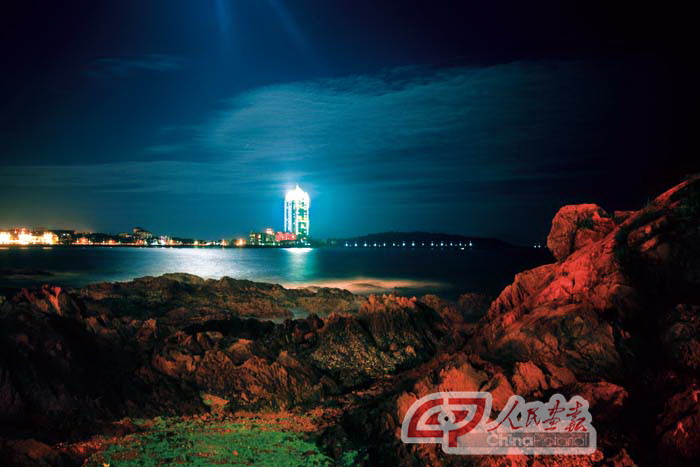
The coastal city of Qingdao is ripe with romance, fueled by its sandy beaches, quaint streets, and deep blue seawater. Because of its seaside location, the city enjoys a year-round mild marine climate. For most of the month of July, while inland cities are sweltering in heat, Qingdao remains relatively cool. It’s no wonder the city has long been a favorite summer resort in China.
Stroll Through the Past
Liang Shiqiu, a noted 20th century Chinese writer, developed a deep love for Qingdao when he spent a couple of years there teaching and writing. He wrote of the city in many essays, one of which describes the city as “embraced by ocean in three directions, with red-tiled buildings hidden under the shade of thriving trees. The climate is pleasant, the landscape picturesque, and more importantly, the people are hospitable. At first sight, I could already tell the city was a suitable location to live – both in terms of climate and geography and with respect to community relations. Although a native of Beijing, I never considered the capital an ideal abode. I have traveled to a dozen provinces, from Liaoning in the north to Guangdong in the south, but the place that has impressed me most is Qingdao...”
Soon after its port was opened for trade, Qingdao witnessed rapid development, especially in manufacturing and shipping, and became the economic hub of the eastern province of Shandong. In the first half of the 20th century, many celebrated scholars flocked to live here, leaving behind a bounty of historic relics.
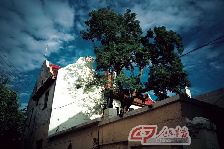
An examination of relics may start with a stroll along Zhongshan Road, a commercial street in the old urban district. From afar, one can see the spires of St. Michael’s Cathedral, which is the largest existing Gothic structure in the city. Near the cathedral is a Christian church, which seems straight out of a fairytale with its yellow stone exterior. Several tree-lined alleys connect the old district, sloping up and down.
In the autumn of 1917, Kang Youwei, a prominent political reformer who led the movement to establish a constitutional monarchy in the late Qing Dynasty (1644-1911), arrived in Qingdao. Immediately after suffering a political failure, he found comfort in a city which became so easy to adopt as a home. He described it as featuring “blue ocean, green mountains, thriving trees and red-tiled residences,” along with “pleasant climate and convenient transportation.” In 1923, Kang revisited the city and bought a Western-style building at No.5 Fushanzhi Road. He named the building “Celestial Tour Garden,” and spent his remaining days there until his death in 1927.
Lao She, also a noted Chinese writer, spent three years in Qingdao during the 1930s. In a tranquil courtyard in the city, he completed his magnum opus, Rickshaw Boy. Wen Yiduo, a prestigious contemporary Chinese poet, served as president of the Literature College and dean of the Chinese Language and Literature Department of Qingdao University. His former residence – a two-story building located in today’s Ocean University of China – was named Yiduo Building. The city’s well-preserved old district is home to many such former residences of historic celebrities.
Colonial Remains
In 1897, Germany began occupying Qingdao by force. The city was a German colony for the next 17 years. Many historic artifacts from the colonial era still remain, including the Qingdao Cement Fort.
The former German Governor’s Mansion, which took six years to build, was the official residence of the colonial era’s top German official. The mansion was designed entirely like European royal palaces. It is so extravagant, in fact, that the German governor-general was impeached by parliament for building the lavish abode.
The Badaguan (Eight Passes) area is so named because it includes eight streets named after eight great passes of ancient China. The area is famous for its historical diversity, as home to buildings featuring architecture from 20 different countries around the world. A stroll along the eight streets is like flipping through a picture book of European architectural history. The buildings are noted stylistic examples because some designs have even become extinct in their origin countries. Today, the area has become a favorite location for many film and television crews, and to date, more than 60 movies and television programs have been filmed there. The trees planted along the eight streets are also interesting. For instance, Shaoguan Road is lined with flowering peach trees, Zhengyangguan Road with crape myrtles, Juyongguan Road with mono maples, Zijingguan Road with cedars, and Ningwuguan Road with crabapple trees.
The most famous and representative building in the Badaguan area is the Huashi Villa, located at No. 18 Huanghai Road. It is a European-style castle with facade decorated with round and polygonal patterns and cobblestones, featuring granite-covered exterior and interior walls. Several celebrated historical figures once called the structure home, including Chiang Kai-shek and Chen Yi.
Badaguan’s unparalleled fairytale ambience created by the diverse exotic buildings even attracts many couples to use it as the backdrop for their wedding pictures.
Beach and Beer
The Zhan Bridge, a symbol of Qingdao, lies at the southernmost end of Zhongshan Road. Facing Qingdao Bay, it was constructed in 1892 as a military dock during the Qing Dynasty. After reconstruction in 1931, it was expanded from 220 to 440 meters in length and 10 meters in width. It stretches into the sea, and at the end is a traditional Chinese pavilion with double upturned eaves, which stands out against the European buildings on the shore. Near Zhan Bridge lies Lute Islet. In the 1940s, a dyke was constructed to link the islet with the mainland. When night falls, the islet’s lighthouse glows to guide ships into the harbor, causing locals to dub the sight as “Light Floating on Lute Islet.”
Qingdao boasts a lengthy coastline, but walking along it seldom causes boredom because of the abundance of scenery. Tourists often enjoy meeting elderly locals who chat leisurely next to fishing poles along the shore.
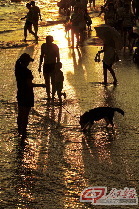
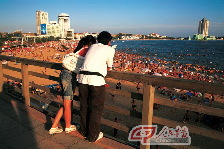
Of course, the city features many swimming beaches, which rival China’s top coastal resorts of Hainan Province in terms of water and sand quality. In summer, the sight of residents and visitors across town wearing only bathing suits is not uncommon, as they cross the streets to reach the beach. Because the beaches are usually crowded, many people change suits at home or in hotels before walking to the beach. The more conservative will sometimes cover up with a jacket during the trip.
Many foreigners may not know the city of Qingdao, but often guzzle Tsingtao Beer. The German colonists of a century ago brought with them genuine Munich brewing techniques, which stirred up beer fever throughout China.
Most beer is sold in traditional bottles, but buyers can also find bulk beer sold by weight. It is frequent to see someone carrying a plastic bag of beer in the streets of Qingdao. Since the 1930s, beer drinking has become an inextricable part of everyday life for many Qingdao locals. Since Tsingtao Beer has become a world-famous brand, the city has earned a reputation as China’s “beer capital.” Though today there are many breweries throughout China producing Tsingtao Beer, enthusiasts insist that the best beer comes only from the original city because brewers use mineral water from nearby Laoshan Mountain.
In Qingdao, beer often washes down seafood. Clams, which locals call “gala,” are common on tables because of their affordable prices. Residents claim that their indigenous clams contain less sand and taste more delicious than those produced elsewhere. Additionally, razor clams, crabs, prawns and sea cucumbers also go great with beer. They are cooked in Qingdao style, which is a branch of Shandong cuisine. Qingdao residents will be the first to tell you that on a summer night, it is delightful relaxation to swig sour, bubbly beer while enjoying the coolness brought by the sea breeze.