Red tourism in China


Over the nearly three decades from its establishment in 1921 through the founding of the People’s Republic of China in 1949, the Communist Party of China (CPC) marched down a “red” road of revolution. It was a road of hardship, passion, romance and glory. Today, increasing numbers of Chinese with an interest in history are enthusiastically revisiting former revolutionary bases and landmark sites. This is “red tourism.”
In December 2004, the Chinese government formulated the General Plan for the Development of Red Tourism (2004-2010). The plan defines the 12 major red tourist areas which best represent the progressive phases of revolution in China. Following are what are commonly considered to be the most important of those officially designated sites.
Jinggang Mountain
Nestled in southwestern Jiangxi Province, Jinggang Mountain boasts a well-preserved ecosystem featuring precipitous cliffs and dense bamboo forests. Historically, few humans settled in the area due to limited means of access. On October 7, 1927, Mao Zedong led his troops to Maoping, Ninggang County, where he established the Red Army and the Jinggang Mountain Revolutionary Base. The conditions were rugged and the going tough. Later, during his meeting with American journalist Edgar Snow, Mao recalled the suffering time on Jinggang Mountain: “The troops had no winter uniforms, and food was extremely scarce. For months we lived practically on squash. The soldiers shouted a slogan of their own: ‘Down with capitalism, and eat squash!’ — for to them capitalism meant landlords and the landlords’ squash.”
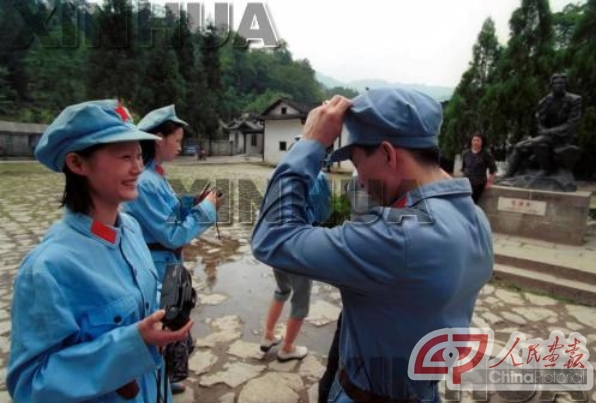
However, attacks from Kuomintang troops were a threat fiercer than low temperatures and starvation. To shatter the seeds of communism in China, from November 1930 to September 1931, the Kuomintang government launched three “annihilation campaigns.” Despite the harsh environment, Mao and his comrades soldiered on, carrying out land reforms and beating back the attacks of Kuomintang troops. In the course of its painstaking struggle, the CPC realized that peasants, making up the overwhelming majority of China’s population, would play a vital role in the Chinese revolution. In his essay A Single Spark Can Start a Prairie Fire, Mao set forth a strategy by which the CPC would shift the focus of its effort from the cities to the countryside and establish revolutionary bases in the countryside by mobilizing and relying on peasants. In this way would be launched a long-term revolutionary war with peasants as the backbone, developing and expanding revolutionary forces, and finally capturing the cities and achieving a nationwide victory.
Today Jinggang Mountain is popular with fans of red tourism. Here they can experience the hard life that Red Army soldiers endured: Wearing coarse clothes, eating brown rice and pumpkin soup, and trekking along mountainous paths while learning of their stories. Today, increasing numbers of tourists are flooding into the mountain. In 2003, the mountain received 3.7 million tourists, including 60,000 foreigners, and realized tourism revenues of 2.6 billion yuan. The great potential of its tourism market has attracted many investors. For instance, the US-based hotel group, Days Inn, plans to open a five-star hotel here.
Zunyi
Its prior annihilation campaigns beaten back by the Red Army, the Kuomintang troops launched an even fiercer attack on the Jinggang Mountain Revolutionary Base. In his book The Cambridge History of China, Professor Llord E. Eastman described: “But not until the fifth annihilation campaign of 1933-4 which Chiang employed about 800,000 troops, was advised by German and Japanese advisers, and augmented his military offensive with a stringent economic blockade of the Communist areas – did he gain a nearly decisive victory over the Communists. The Communists, defeated militarily and suffering incredibly from shortages of food, summoned their last reserves of strength and courage, broke out of the Nationalist encirclement, and in October 1934 commenced what was to become the Long March.”

The Long March was a milestone event in contemporary China. Professor John K. Fairbank, a leading scholar in modern and contemporary China studies, proclaimed the Long March as being almost a miracle, more documented than Moses leading his Chosen People through the Red Sea. The marchers covered 6,000 miles in a year, averaging 17 miles a day. However, this miracle was conceived under extremely harsh conditions. Southwestern China’s terrain is incredibly rugged, with precipitous mountains, deep valleys and rushing rivers. There are no plains.
Thanks to Mao’s military acumen, the Red Army finally routed the Kuomintang troops. From January 15 to 17, 1935, the Political Bureau of the CPC Central Committee held a conference in Zunyi, a small city in Guizhou Province. Here Mao’s military strategy was acknowledged as being correct and his leadership over the Party and the Red Army was formally acknowledged.
Under Mao’s leadership, in 1949 the CPC liberated the nation and founded the People’s Republic of China, one of the most important chapters in the nation’s history.
A gifted leader, Mao rescued the Chinese revolution from near-failure and defeated an enemy previously thought to be undefeatable. He thus became an everlasting legend in human history.
A city hidden deep in the mountains, Zunyi is a popular tourist destination. Today, at the site of the Zunyi Conference stands a memorial hall. The building remains original in appearance, and the streets and lanes in front of and behind the building are paved with stone planks. Also, in order to maintain harmony with the memorial hall, the surrounding buildings were all reconstructed into low structures with the architectural style of northern Guizhou of the early 20th Century. In addition, other memorials of the Long March, such as the Memorial Hall of Crossing the Chishui River Four Times and the Observatory in Loushan Pass Scenic Resort, have been restored and well preserved.
The areas around Zunyi have also long been renowned for liquor production. When passing by Maotai Town, near Zun-yi, during the Long March soldiers of the Red Army drank Moutai liquor and found that the potent elixir had curative properties. “Local residents presented homemade liquor to welcome us when we arrived at Maotai Town,” recalled Zhu De, then commander-in-chief of the Red Army. “Soldiers applied the liquor to their wounds and feet and found it could relieve pain and diminish inflammation. They also drank it to treat diarrhea. It was a great help for those of us who suffered an extreme shortage of medicine at that time. Thus, our success in the Long March was partly attributed to Moutai liquor.” After the founding of the People’s Republic of China, Moutai liquor was designated as the alcoholic beverage for state banquets. During his 1972 visit to China, former US president Richard M. Nixon spoke highly of the beverage.
Yan’an
The Long March ended in northern Shaanxi Province, on a dry loess plateau that lacked rainfall and suffered from severe desertification. It was on this land that the Red Army created a new miracle.
American journalist Edgar Snow was one of the first Westerners to look for greater insight into the Red Army and the CPC in northern Shaanxi. Due to many years of assaults and blockades on the part of the Kuomintang government, the life the CPC and the Red Army really led remained unknown to the outside world. Snow explained: “The fact was that there had been perhaps no greater mystery among nations, no more confused an epic than the story of Red China.” To understand the true “Red China,” Snow came to northern Shaanxi.
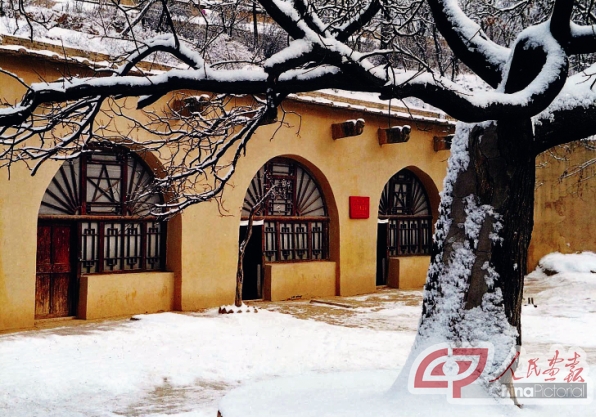
Based on the trip, Snow wrote the famous book Red Star over China, in which he depicted the tremendous changes brought by the CPC to northern Shaanxi. Yan’an was a poor, inanimate township populated by only 10,000 residents when the Red Army arrived and made it the administrative capital of the Shaanxi-Gansu-Ningxia Border Region. The arrival of the CPC, however, injected the small town with warmth, happiness and passion, transforming it into a place admired by people around China. People here led a life of spiritual abundance although the area still suffered from material scarcity. At that time, subsistence was the primary consideration, and top CPC leaders personally led local people to open up the wasteland and weave cloth. According to Snow, due to arduous living conditions in northern Shaanxi, many high-ranking CPC leaders endured gastric ulcers and dental disease. The CPC leaders who lived a simple life were in strong contrast to the corrupt Kuo-mintang officers.
In northern Shaanxi, however, the CPC and its army faced an even more difficult situation. On the one hand, they continued the war against the Kuomintang troops; on the other hand, they battled against Japanese invaders. Under the leadership of Mao Zedong, the CPC mobilized peasants to consolidate the revolutionary base and overcame all difficulties along the road to final success. In 1945, Japan surrendered. Then, in 1949, the Kuomintang, headed by Chiang Kai-shek, fled to Taiwan. After nearly three decades of arduous struggle, the CPC led the Chinese revolution to final victory.
From 1937 to 1947, Yan’an served as the capital of the Shaanxi-Gansu-Ningxia Border Region, the seat of the CPC Central Committee, and the command center and home front of the Chinese revolution. Thus, it has long been reputed as a holy land of Chinese revolution. Here are preserved many historic sites, including Phoenix Hill, Yangjialing, Zaoyuan and Wangjiaping. Many tourists pilgrimage to Yan’an each year. The revolutionary sites – whether the Treasure Pagoda on Phoenix Hill or the cave dwellings in Yangjialing – remind visitors of the past hardship endured by the CPC.