Petite Sirah research takes shape


Bogle donation enabled planting at UC Davis; more funding needed to determine clonal differences and wine sensory factors
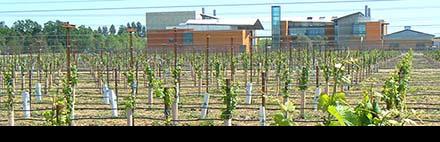
Petite Sirah Vineyard Block (foreground) is within the Winery Production Block at UC Davis. Robert Mondavi Institute complex, and research and teaching winery in background. Photo: Jon Tourney
Davis, Calif.—A research vineyard block planted to compare characteristics of traditional California Petite Sirah clones is in its second growing season at the University of California, Davis. The first small crop is anticipated for evaluation in 2012. The 1.1-acre block is part of a 12.5-acre vineyard adjacent to the UC Davis Department of Viticulture & Enology offices as well as a new teaching and research winery at the Robert Mondavi Institute.
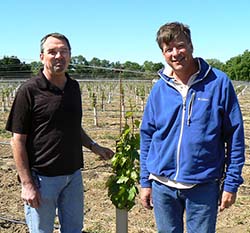
UC Davis viticulture extension specialist Dr. Jim Wolpert and research viticulturist Mike Anderson manage the project. The late Patty Bogle of Bogle Vineyards in Clarksburg, Calif., a major Petite Sirah producer, donated $30,000 in seed money for planting and project startup. Through her involvement with the Petite Sirah advocacy group P.S. I Love You, Bogle also organized a fundraising event that provided another $6,000 in project funding. “This would never be here without Patty. She’s personally responsible for every dollar donated to date,” Wolpert said.
P.S. I Love You executive director Jo Diaz, who considers Bogle “the godmother of Petite Sirah,” is organizing a campaign to obtain donations and sponsorships to provide long-term funding for research and to erect a sign at the vineyard in honor of Bogle. Diaz said, “I want a sign there that says ‘Patty Bogle Petite Sirah Heritage Vineyard.’ This was her passion, her baby; it deserves to have her name.”
The project was originally envisioned to be similar to the Zinfandel Advocates & Producers Zinfandel Heritage Vineyard. However, as Wolpert explained, “We looked at older Petite Sirah vineyards, and most had material that was already at UC Davis Foundation Plant Services (FPS).” The original Zinfandel Heritage Block was planted with old clonal material direct from growers’ vineyards. Half of this was later found to have viruses, which compromised the trial’s data and presented the danger of spreading virus to healthy vines.
Learning from that experience, the Petite Sirah block is planted exclusively with virus-free, registered selections from FPS. Any potential new Petite Sirah clones will first go through virus elimination and registration at FPS.
Rootstock for the trial block, 420A, was planted in 2009. Five FPS clones were grafted onto the rootstock in spring 2010. All five clones are in each row, and the block has five replicated trial plots of three rows each, with 47 to 52 vines in each row. The block is drip-irrigated and on a modified vertical-shoot-positioned (VSP) trellis with T-top stakes to provide the option of spreading the canopy at the top for sun protection in Davis’ Central Valley climate.
AKA Durif UC Davis viticulturists Jim Wolpert and Mike Anderson are managing clonal research trials for this 1.1-acre Petite Sirah Vineyard Block, now in its second year of growth. Photo: Jon TourneyPetite
Sirah is officially listed as Durif by FPS. It was originally propagated and introduced as a new Vitis vinifera variety by Dr. Francois Durif in France in 1880. DNA testing has revealed its parentage as a cross of Syrah and Peloursin. It found its way to California in the late 1800s and was commonly planted as a field blend with varieties such as Zinfandel, Peloursin, Barbera, Carignane and Syrah. It became known as Petite Sirah in California.
Historically, these field blends were bottled as red table wines. Varietal-labeled Petite Sirah was not produced in significant amounts until Concannon Vineyard in Livermore released varietal Petite Sirah in the 1960s. Statewide planted acreage peaked in 1976 at about 14,000 acres, and reported planted acreage as of 2009 was 7,591 acres.
Currently, Diaz has identified 826 brands producing one or more Petite Sirahs, and P.S. I Love You has 80 winery members. Petite Sirah is still used significantly for blending, often to add color to varietal red wines, red blends and generic wines.
“We bowed to industry tradition by calling it the Petite Sirah Vineyard, but the vines are actually Durif,” Wolpert said. The federal Alcohol and Tobacco Tax and Trade Bureau currently has a rulemaking under way, supported by industry and P.S. I Love You, that would recognize Durif and Petite Sirah as synonymous names for wine labeling purposes.
The five FPS clones in the block are:
• Durif FPS 01: Originally from Larkmead Vineyards in Napa County, came to FPS around 1960.
• Durif FPS 03: California vineyard, source and date unknown,
• Durif FPS 04: Came to FPS in 2001 from an old field blend vineyard of Durif, Peloursin and Syrah at the St. Helena Public Library as part of a project to collect old vine selections of Petite Sirah.
• Durif FPS 05: Sourced from UC Davis Department of Viticulture & Enology, date of arrival unknown.
• Peloursin FPS 01: St. Helena Public Library Vineyard, same as Durif FPS 04 above.
Anderson said, “We included Peloursin in the trial because it’s part of the Petite Sirah tradition.” A study of Petite Sirah vineyards in California in the 1990s by UC Davis professor emeritus Dr. Carole Meredith, using DNA sampling, showed that a majority of the vines were Durif. However, a smaller percentage were Peloursin, which in most cases the growers also called Petite Sirah.
Anderson, who is also a commercial winemaker and co-owner of 3,500-case Berryessa Gap Vineyards in nearby Winters, Calif., makes a 100% varietal Durif from his winery’s estate vineyards. The vineyard is also planted with blocks of traditional field blends of Durif, Peloursin, Zinfandel and Syrah, from which a Petite Sirah-labeled wine is produced. Based on his experience, Anderson said, “You’d be hard-pressed to tell the difference between Peloursin and Durif vines in the field.”
Accommodations have been made to add and graft additional clones as they become available in the future. FPS has three clones with provisional status that are future trial candidates—Durif FPS 06, 07 and 08, donated in 2004 by Stags’ Leap Wine Cellars (80,000 cases) winemaker Robert Brittan.
Trial protocol
The trials will compile viticultural characteristics and data as in other clonal trials such as shoot numbers, clusters per shoot, pruning weights, clusters per vine, cluster weights, berry weights, yields, etc., to compare potential clonal differences. Berries will undergo chemical analyses, and wines will be made in the UC research winery and later evaluated by both laboratory and sensory analyses.
Wolpert said, “We want to start collecting data in 2012, but it will take additional financial involvement from the industry to fund the research, winemaking and lab and sensory analyses that all come with bills.” He added, “Ultimately, we want to produce wines from each clone that we can present to the industry to help people make planting decisions and wine blending decisions based on these trials.”
An advantage with this trial compared with previous trials is that the researchers now have a state-of-the-art research winery to produce wine samples under replicated processing regimes with more precision than ever before. In addition, the recent donation of nearly $2 million in new analytical equipment from Agilent Technologies for wine and berry chemistry offers more sensitive and specific analysis with smaller samples. This provides the ability to better measure potential varietal and clonal character differences. Anderson said, “If the differences are subtle or minor, we now have the tools to actually measure those differences more accurately.”
One issue of interest is that Durif, introduced in 1880, is a relatively young variety compared with other vinifera varieties in commercial production that have been studied in clonal trials. As Wolpert explained, “It raises the question, if the variety has only been grown since 1880, is that enough time for it to develop significant clonal diversity?”
Wolpert summarized, “The data will be interesting either way. Whether we find differences, or don’t find significant differences, this tells us something that the industry can apply. So it’s a no-lose situation.”