Canal break cuts water to placer vineyards


Wet winter led to canal rupture in California; thousands must conserve
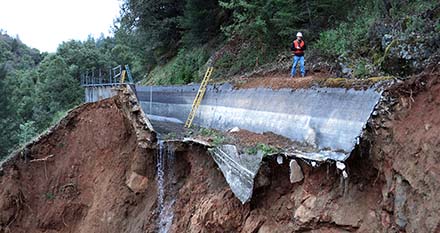
A segment of Pacific Gas and Electric Co.'s Bear River Canal failed April 19, causing water flows to be cut to the Agency and its customers. Photo source: Bill Williams/PG&E
Colfax, Calif.—Thousands of customers in Placer County, including wineries, are dealing with water-use restrictions following the collapse of a major irrigation canal below the Rollins Reservoir near Colfax on April 19. Owned by Pacific Gas & Electric (PG&E) for decades, the Bear River Canal had served as the main water supply for residential and irrigation use, pouring 400 cubic feet per second into this Sierra Foothills county.
Dave Carter, media representative for Placer County Water Agency (PCWA) and Nevada Irrigation District (NID), said the Bear River Canal was the only direct source of water for agency customers. “None of that is coming through,” although limited supplies are being diverted or pumped through other channels, he told Wines & Vines this morning.
Carter described the ruptured section as a “concrete bench flume.” Saturated by this winter’s long, heavy rains, soils supporting its side and bottom had slipped, causing a 40-foot-by-40-foot break. He noted that, although upgraded over the centuries, the water system was adapted from the Gold Rush era, adding, “This canal was in use for many years.”
The saturated soil and remote location of the rupture are delaying repairs, Carter said. “PG&E owns the canal and has made it a top priority. We expect them to announce this week or next exactly what their plan is for a temporary bypass and permanent repair.” He estimated that the system won’t fully be repaired for “a couple of months.”
NID supplies irrigation water to some 800 customers in Placer County; PCWA to about 4,000, including vineyards. During the current crisis, NID is routing some of its supply to PCWA users and, Carter said, “Neighbors are helping,” including water districts in Roseville and the San Juan Water District in Granite Bay. “PCWA has a water source on the American River,” he reported, but from there, water must be pumped 300 feet uphill. “That’s expensive,” he noted, estimating that the process cost $100,000 in electricity during the first week of the outage.
“Supplies are tight,” Carter said. “We are going to use rotations—on a day, off a day—on the canals.” NID applies strictly to irrigation, not treated residential water, “But canals also serve water treatment plants,” he noted, so all customers are being asked to conserve. PCWA is also planning rolling water outages. “We’re hoping no one will be out of water, but everyone will be limited,” Carter said. Ground water levels are high, and those with wells are encouraged to use them.
Shortages in the vineyard
Mt. Vernon Winery in Auburn does have a well, but according to Lynda Taylor, who owns the 4,000-case facility with her husband Jim and winemaker son Ryan, it produces only enough water to maintain the 31-acre estate’s elaborate landscaping.
Normally, Taylor said, the vineyards are dry-farmed throughout the growing season, except for an intensive fertigation application soon after bud break. This year, bud break occurred just two weeks ago: immediately after the canal break, delaying the nutritional soak indefinitely.
Taylor is most worried, though, about some 250 Pinot Noir vines planted last year. “They have got to be watered, or they’re going to die” she said. She estimated the new vines represent an investment of $8,000-$10,000.
Mt. Vernon is an NID customer. “We pay a huge amount of money to get the ‘ditch water’ so nothing dies,” Taylor said. “We’ve put a fortune into landscaping. We’ve heard nothing from NID,” she said.
Lone Buffalo Vineyards, a 1,000-case winery in Auburn, also is feeling the effects of the break. “They have been rationing our water, on and off,” said Jocelyn Maddux, who conducts sales and marketing for the winery. “They notified us by email.” Lone Buffalo’s 2-acre vineyard is dry-farmed, “but lots of others are affected,” Maddux said, reflecting that, at the end of the bottling cycle, the winery doesn’t need as much water as in other seasons. “It’s not so bad yet.”
Extension agent advises farmers
“I don’t think there’s cause for panic,” said Cindy Fake, Placer County horticulture and small farms advisor. She urged growers to think rationally and plan ahead how they can conserve water during what is expected to be a temporary shortage. “Treated water is different,” she pointed out. “The main (supply) cuts are to ‘ditch’ water, not treated water. For wineries, there may be rolling outages in the Auburn area.”
Some farmers (including those with crops such as rice and livestock, including cattle) may be asked to reduce irrigation orifices by 50%, she said; another may receive irrigation flows three days on, three days off.
“The differences in the impact will be based on soil differences,” she said. “Decomposed granite does not hold as much water. A lot of people don’t irrigate until June in a normal year, and this year we’ve had late rainfall. Clay soil is still wet a few inches below the surface. Grapes are fairly drought-tolerant.”
Using irrigation water for frost protection is common in many California vineyards, but Fake was not aware of any growers in her area using the practice since the canal rupture, despite temperatures that dropped to 37°F last Friday.
Her recommendations for affected grapegrowers: Mow cover crops frequently to keep them and their water demands low; mulch between vineyard rows to conserve water. Plan ahead to accommodate interruptions in irrigation schedules. Develop a water storage plan for when your water is on.
The situation, Fake said, “is potentially serious, but everyone is taking it seriously.” She noted that the outage is costly for the utilities PG&E, PCWA and NID. “They are interested in getting it dealt with, and making all efforts to move ahead.”
Above all, she advised, “It’s not productive to get too upset without thinking it through.”