Tasting wines and wineries of Priorat


|
The beauty and uniqueness of the soil and vineyards of the Spanish Gem Priorat was quite impressive as I tasted for three days wines from various wineries and then followed up by visits to a few select wineries to try to reach inside the minds and philosophies of several owners and winemakers, writes Subhash Arora who participated in Espai Priorat, a maiden attempt by the DOQ Priorat to bring in the specialists and taste the difference. | |||||||||||||
|
At the risk of being termed elitist, one had to start tasting the wines and meeting the iconic producers like Alvaro Palacios whose l’Ermita 2010 was brilliant (emotional as Alvaro described), Finca Dofi 2009 a smooth talker and Gratallops Vi de la Vila 2009 simply too sexy for words (Alvaro termed it as sensuous). One had a tasting at Clos Mogador with the Barbier family, Clos Figueras with Christopher Canaan , and Torres with Mireia Torres. Fortunately the ‘Queen of Cult’ was also there just for a day on the second day and chatting with her about her cult wine Clos Erasmus, which I tasted and then drank, was an equal pleasure . But to me, visiting the vineyards and winery and tasting in those environs was far more interesting and important. I did not mind spending an extra day visiting wineries on my own, thanks to the wonderful efforts of Salus Alvarez, the humble President of the DOQ Priorat, who is also the General manager of Vall Llach owned by the well known Spanish singer from this area- Lluis Llach. Wineries Visited 1.Torres Priorat
On second thoughts one also wonders how Torres chose to enter the region. He is used to making wine in big numbers in Penedès and Chile. The quantity possible here is rather small. But Miguel is also known to perpetually plan to bring out better quality wines and ‘Perpetual’ from Priorat fits the picture frame even though they produce less than 10,000 bottles and the quantities are never going to increase much. The 70 hA vineyards in the Llicorella (schist-slate) filled land make high quality wines. Till recently, they were using a make-shift winery but last year the state-of-the-art winery was inaugurated. In keeping with Miguel Torres’s resolve to have eco-friendly operations, solar panels are being used for energy and a water treatment plant. ‘Salmos’, a young crianza and ‘Perpetual’ are the only two labels- 2008 was outstanding; 2007 was even better in the glass. Both are Grenache and Carignan blends. Salmos is being already imported into India through their JV, Prestige Wines. Perpetual would be really exciting for the connoisseur with an evolved pocket and palate, in the duty free restaurants. 2. Vall Llach
During harvest, Lluis spends time tasting the grapes personally for complete ripening. He also believes that the grapes are ripe when birds start eating them. Grapes are harvested in several parts from mid-September to mid-November. Around 90 wines are made individually first as micro-fermentation before blending, according to the winemaker Salus Alvarez, who is also the President of the DOQ (DOCa in Rioja). Blending is done after 15 months and during Full Moon. Lluis Lach is a poet who likes to maintain the history of the place. The winery is still at the old place where they started. The cellar is at another building about 150 m away and across a small nullah (water stream). Wine is pumped using pipes through the public streets and over the nullah because he likes to keep the old winery productive, thus keeping the history alive, though the volumes of production have gone up and the process is more expensive. Embruix (89), Idus ( 92) and Vall Llach (92) are 3 labels, all with an alcohol content of 15%. The label is very popular in the US due to the robust character and Michael Mondavi –owned Folio is importing the wines. Germany and Switzerland are other important importing countries. 3. Clos Mogador
Clos Mogador led the new wave that brought Priorat on the world map as the Spanish wines with character. Though the vineyards are not easily accessible, the unique personality of the wines is a characteristic of this winery. Senior Barbier believes a lot in long maceration – 40 days for the estate wine that is the only DOC single vineyard wine accepted by the European Union. Nelin is a delicious mineral and spicy wine with racy acidity-based on a blend of white Grenache (54%) and several other grapes including Viognier. René’s son argues that a few local varieties of white varietals have been identified and will be used in the region in the future, countering my suggestion that perhaps Viognier will be a more prominent plantation in the future. The winery plans to stay at the steady quantity of around 45,000 bottles although the young Barbier has grown vines of Carignan and Grenache with his wife Sara Pérez and the grapes are being fermented and blended in this winery for younger drinking wines. 4. Mas d’en Gil Estate
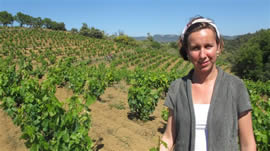
‘We ferment grapes from 43 small parcels individually and choose the best for the Mas den Gil Estate Wines’, says his daughter Marta who looks after the production and took me around to show me some of the vineyards divided in 4 valleys- El Sas, La Coma Clot de l’Oliver and Esmoler. They believe in biodiversity- no vine should be more than 50 meters away from some fruit trees like almond, hazelnut or olive, says Marta. They have a bank of old Grenache and Carignan vines that were planted by the previous owners and also keep on replenishing the old vines with other grape varietals like Cabernet Sauvignon and Shiraz. In a region where white wines are hard to come by, Mas d’en Gil produces two white wines-primarily from White Grenache. Come Blanca is a blend of equal parts of Grenache and
They have a few other labels- Clos Fontá is their signature wine in which they use the local varieties of Grenache- 30% Grenache Peluda and 25% Grenache Pais with 25% cabernet and only 20% Carignan. A rich, powerful and mineral wine (92), the alcohol level is as high as most other estates-15%, though with good balance. Gran Buig is a full blooded, pure Priorat with 60% Grenache and 40% Carignan- full of fruit and minerality. Mas d’en Gil is negotiating with a couple of Indian importers and should be available soon in India, hopes Marta. 5. Clos Figueras Font de la Figuera White is an interesting wine made from 85% Viognier, 10% Grenache Blanc and 5% Chenin. Christopher gleefully admits that his supplier in France sent him Viognier in stead of the 2000 Cabernet Sauvignon plants he had ordered. Of course he received the replacement but he planted Viognier anyway and today his wine is quite spicy and aromatic. Font de la Figuera Red is made from young vines and is a blend of the favourite Grenache (60%). Serras del Priorat is a younger version, a fruit forward wine with soft tannins that make it suitable with white meats and vegetarian dishes, making it an ideal choice for India. Christopher also owns Europvin, exporting multi-country wines globally for over 30 years, including India through Brindco. Clos Figueras is the delightful estate wine that ages for 15 years and would be a perfect choice for exclusive serving in a 5-star hotel with national presence. Wineries for Future
Priorat is an interesting region where the vines are old and wines are expensive but as Alvarez says, ‘ it is a difficult land where production costs are higher and the yields are lower. Therefore the prices have to be higher. We need to compete in quality and not in price.’ This is a region with unique terroir and territory. One needs to go deeper to understand and appreciate the region that potentially will be the best winemaking region of Spain one day, though the wines will always be in limited quantities. |