Washington wineries, grape growers give WSU facility $7.4 million boost


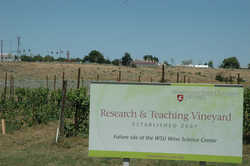
Andy Perdue/Wine Press Northwest
The WSU Tri-Cities teaching vineyard is near George Washington Way and Sprout Road. The site of the WSU Wine Science Center is in the background.
RICHLAND -- Winemakers and grape growers think Washington State University's Wine Science Center is so important, they are contributing $7.4 million to get it built.
The $23.25 million center, to be built on George Washington Way adjacent to WSU Tri-Cities in Richland, is being hailed by industry leaders as one of the most important projects in the history of Washington wine and a cornerstone for propelling the state into a globally recognized world-class wine region.
"It will help the industry tremendously with research and education," said Ted Baseler, CEO of Ste. Michelle Wine Estates in Woodinville, whose company produces more than 60 percent of the wine in Washington. "When you have an institute like this, it draws people from around the world. It would be a draw not only for the Tri-Cities, but also Washington wine country."
On June 10, the Washington Wine Commission approved funneling $7.4 million to the project. The money would come from increased assessments on wine and grape production. Currently, wineries turn over 6 cents per gallon of wine produced and $10 per ton of grapes crushed. They would increase this to 8 cents per gallon of wine and $12 per ton of grapes. The wine industry actually approved the increased assessment in 2007 but never took the full amount.
John Bookwalter, owner of Bookwalter Winery in Richland and outgoing chairman of the Washington Wine Commission, said the unanimous vote was the most important action it has taken in his seven years on the board -- and perhaps ever.
"This will go down as one of the real watershed moments in our industry," he said. "The Wine Science Center will become a beacon for new investment potential. It will become a lightning rod for a lot of things."
Washington is the nation's second-largest wine-producing state, though it is dwarfed by California, which makes 90 percent of all U.S. wine. The University of California, Davis, has been the nation's center for winemaking and viticulture education and research for the past century. In fact, many of Washington's top winemakers earned their degrees at Davis. Baseler said WSU can do for Washington what Davis did for California.
"Nobody will have self-interest for Washington as much as people from Washington," he said. "Davis' primary interest is California -- as it should be. Every great wine industry in the world has a cornerstone institute for research and education. It's time for us to close the gap and move into the 21st century. We're so excited the industry can catch up with California in terms of research capacity."
The wine commission's decision does not come without challenges. An assistant attorney general who advises Washington's commodity associations believes that a state initiative requiring a two-thirds vote of the legislature to increase taxes stands in the way of the wine industry taking full advantage of the assessment it approved in 2007.
The Tim Eyman-led I-960 was passed by voters in 2007 and repealed by the Legislature in 2010. Then voters passed I-1053 last fall to reinstate it.
Kristen Mitchell, assistant attorney general in Olympia, believes the wine commission will need to either go to the Legislature or its own membership to approve the assessment.
"On its own, the board can't increase the assessment," she said.
Industry leaders don't agree, saying the wine industry already approved the assessment but never actually began collecting it, choosing to wait until it had a project it wanted to fund.
"I don't think there is a problem," Baseler said. "One way or the other, we'll get it straightened out."
That is not the only hurdle. Funding and building the Wine Science Center cannot actually go through WSU. The center is not on Pullman's capital project list, so it cannot be built on WSU land, nor can the money come through the university. But community leaders think it is too important to allow it to languish.
"Waiting 20 years is not acceptable," said Diahann Howard, director of economic development for the Port of Benton, which is providing 3.52 acres adjacent to WSU Tri-Cities for the project.
Funding and building the Wine Science Center will go through the city of Richland, which is forming a public development authority, or PDA. PDAs are government-owned corporations that have been used extensively to fund projects in Western Washington. Howard said they differ significantly from a public facilities district because they do not have authority to assess taxes. Rather, they are a conduit for money raised elsewhere.
Gary Ballew, business and economic development manager for Richland, said the city council is going through the process of forming the PDA.
It had a few questions and issues on how it gets created, how a no-cost lease with the Port of Benton would work and other agreements. The city council plans to take a second look at the PDA during its July 19 meeting.