Winery land-use bill passes out of legislature, reeks of vinegar to some


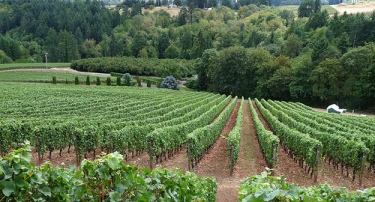
Photo by Ethan Prater/Flickr.com
SALEM—For Cricket Hill Winery owner Duane Bowman, House Bill 3280 represents a bad batch of wine.
The measure, which passed out of both chambers Monday, sets statewide requirements for wineries on exclusive farm-use (EFU) land, land pre-designated for agricultural purposes. Other non-EFU lands are not subject to the same requirements.
Specifically, the bill limits the number of ancillary events – such as weddings and concerts – that those wineries can host.
Click here to hear the audio report by Kacie Yearout.
Legislators supporting the measure say it’s designed to prevent wineries from operating predominantly as event centers on EFU lands.
Rep. Mitch Greenlick, D-Portland, voted against the bill because he thought it didn’t go far enough, referring to a “pseudo-winery” in his district that often held “loud” concerts and weddings.
“We don’t need to provide these event centers masquerading as wineries in our rural areas,” he said.
Bowman, on the other hand, takes umbrage with the bill’s classification of wineries into two camps, which he simply describes as small or large. The measure divides wineries based on acreage and volume of wine production.
“I think that it (House Bill 3280) creates class discriminations within the wineries,” he said. “It grants rights to larger wineries that it doesn’t grant to smaller wineries.”
According to Bowman, the bill hampers the ability of small or fledgling wineries to enter the industry, while larger, more established ones can continue with business as usual.
And as Bowman says, “That means Daddy Warbucks is going to be funding this.”
His Applegate Valley-based winery qualifies under the “small” classification. But it doesn’t host more than 25 days worth of events in a year, a restriction in the bill for all wineries.
In fact, the bill won’t change much of anything about how Cricket Hill operates, thanks to a grandfather clause.
It allows for any operations legally performed by a winery preceding the bill’s passage to be continued.
That’s good news for Zenith Vineyard, which is located near Salem and like Cricket Hill lies on EFU lands.
Owner Tim Ramey, who lobbied for the legislation, says Zenith holds far more than 25 ancillary events a year and receives more than 25 percent of their gross income from such events, another limitation of the bill.
Ramey also acknowledged the inherent advantage the grandfather clause presented to his winery.
“It (House Bill 3280) will mean no other facility like Zenith Vineyard can ever be built in Willamette Valley,” he said. “Or in Oregon.”
According to Ramey, a “large percentage” of wineries are located on EFU land like Zenith.
And the bill’s sponsor, Rep. Paul Holvey, D-Eugene, says the land-use statutes governing those wineries date back to the 1980s.
Rep. Hovey stressed the importance of updating land-use codes for such a fast growing industry during floor debate in the House Monday.
He said the Oregon wine industry now contributes $2.6 billion annually to the state’s economy, up from $1.4 billion in 2004.
Rep. Phil Barnhart, D-Central Lane and Linn Counties, says the bill could even bring more money into the state, although he acknowledged that it wasn’t “perfect.”
“It is important for us to figure out…how to make this industry work,” he said. “That includes growing grapes; it includes making fabulous wine.”
Still, winery owner Bowman sees the legislation as a sort of Mason-Dixon Line across the state.
He says the north contains most of the large wineries, while the smaller wineries usually call Southern Oregon home.
“If you prohibit activities for small wineries you’re pretty much discriminating North to South,” he said. “And the wine industry in the South is going to be hurt more than the wine industry in the North.”
Bowman sees this discrimination – in a civil war of sorts – as a bad sign for the state’s wine industry.
He says Washington’s wine industry has grown faster than Oregon’s because its growth was accomplished “on the backs of these smaller wineries.”
“If we’re going to discriminate against our small wineries,” he said, “we’re going to inhibit our ability for this industry to grow.”