Spirited fight against liquor counterfeits


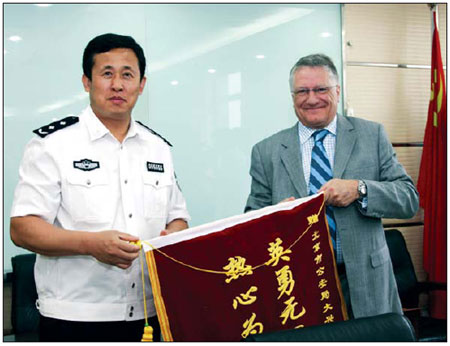
Pernod Ricard representative presents a banner to express appreciation for the Daxing Public Security Bureau's efforts in fighting counterfeits. Provided to China Daily
The Supreme People's Court recently announced the10 biggest infringement cases settled in China's courts last year for violations of intellectual property rights (IPR).
In the only major criminal case of counterfeiting foreign-brand liquor, defendant Liu Zhaolong was convicted, sentenced to four years in jail and fined 150,000 yuan ($23,160) for violating the trademarks of globally known brands.
The court found that Liu produced the counterfeit alcohol in 2009 in Daxing, a southern district of Beijing, and shipped it to neighboring Hebei province, the nearby province of Henan and even Gansu province in the distant northwest.
According to testimony presented at his trial, Liu netted more than 201,500 yuan from the illegal sales.
With assistance from the International Federation of Spirits Producers (IFSP), Daxing police found Liu's production site and arrested him in 2009.
International wine and spirits group Pernod Ricard and its brand subsidiary Chivas Brothers, the manufacturer of Chivas Regal Scotch whisky, assisted in the investigation and collection of evidence.
Industry leaders say the successful prosecution, a result of cooperation between legitimate distillers and government authorities, encourages importers to play a more active role in fighting counterfeits.
"Counterfeiting is not an issue unique to the alcohol industry or a single brand," Chivas Brothers CEO Christian Porta said at the close of the case.
"We are committed to providing positive customer experiences with all our brands, not only through offering premium quality products, but also by collaborating with authorities and industry stakeholders to protect consumers from counterfeit spirits.
"Brands like Chivas Regal - which secured the status of Well-Known Trademark in China from the State Administration for Industry and Commerce in 2009 - represent a significant investment and commitment by their owners," Porta said.
"So it is our responsibility to protect our reputation and help strengthen consumer confidence."
Participation
After the case was concluded, Pernod Ricard representatives visited the Daxing Public Security Bureau and district court to express their appreciation for their efforts in combating counterfeiting.
"Pernod Ricard is committed to protecting consumers and the legal rights of our brands," said Pernod Ricard Asia CEO Pierre Coppr. "We hope to further support government efforts in IP protection and anti-counterfeiting enforcement."
After the case was listed among the major 10 IP cases 2010, the UK Embassy sent a letter to the Daxing court in gratitude for its work to protect the Chivas trademark.
Daxing prosecutors also organized a seminar on IPR protection and invited Pernod Ricard to participate.
The IFSP and its members have joined government anti-counterfeiting efforts in several provinces and cities in recent years.
With the help of the IFSP, enforcement officials from the administrations of industry and commerce, alcohol market supervision and technological supervision investigated 22 large-scale cases of faked foreign-branded spirits between 2008 and 2010.
Seventy-one defendants were convicted of criminal offences and fined more than 5 million yuan.
Eight of those convicted were sentenced to four years or more in prison. The most severe sentence was six and a half years in jail.
According to industry watchers, criminal prosecution and punishment increases the risk for counterfeiters and helps to check the activity. It also demonstrates China's determination to crack down on fakes.
Crackdown
Premier Wen Jiabao and the Ministry of Public Security jointly launched a special campaign last October named Liangjian - or Draw a Sword - to fight infringement, further boosting law enforcement.
The move was widely acclaimed by the alcohol industry at home and abroad.
In addition to industry organizations and imported spirits companies, some bars and entertainment sites have also begun self-regulating initiatives as they realize protecting consumer rights is crucial to their reputation and long-term operation.
As more in the industry and its stakeholders join to combat counterfeits, consumers can be further assured they are enjoying genuine imported spirits, say industry experts.