A blessing from ancient times -- Snapshots of Chinese Dragon Boat Festival



Dragon boat players train for a contest in Zigui County, Qu Yuan's hometown in central China's Hubei Province, June 5, 2011. Local people made "zongzi", hung artemisiae argyi and raced dragon boat to celebrate the traditional Chinese dragon boat festival. The festival, which falls on Monday, arises from the legend of Qu Yuan, a romantic poet and minister to the king of Chu who drowned himself after he was forced into exile. (Xinhua/Zheng Jiayu)
BEIJING, June 6 (Xinhua) -- Palatable rice dumplings, fragrant herbal sachet, and ancient rituals for health, people across China celebrated Duanwu, or the Dragon Boat Festival, Monday to usher in the sizzling summer days with ancient blessings.
The Dragon Boat Festival, which falls on the fifth day on the fifth month on the lunar calendar, is believed to be designed to commemorate the death of Qu Yuan, a patriot poet during the Warring State Period (475-221 BC). Qu committed suicide by flinging himself into the Miluo River after the capital of Chu, his mother country, fell under the enemy attack.
Over the years, the festival has evolved from a purely mournful experience to a national holiday that features sacrifices to ancestors, family get-togethers, and rituals to guard away diseases and bad luck.
RECALL ANCIENT CUSTOMS IN HOMETOWN OF QU YUAN
Legend has it that after the drowning of Qu Yuan, local people along the Miluo River raced boats and threw packets of rice to distract fish from eating Qu's body.
In Zigui County, the allegedly final resting place of Qu in central China's Hubei Province, people still carried on the millennium-old practices and have made the festivities into a spectacle of the year.
On Monday morning, thousands of local residents, all dressed in white mourning clothes, gathered along a river and chanted ancient songs to summon the spirit of Qu.
Parades of lavishly adorned dragon boats then cruised along the river, resembling the scene when Qu's sister and local residents searched the water for his body.
A dragon boat race then followed. In many other places in southern China, it has developed into an exciting tournament that attracted tens of thousands audience every year.
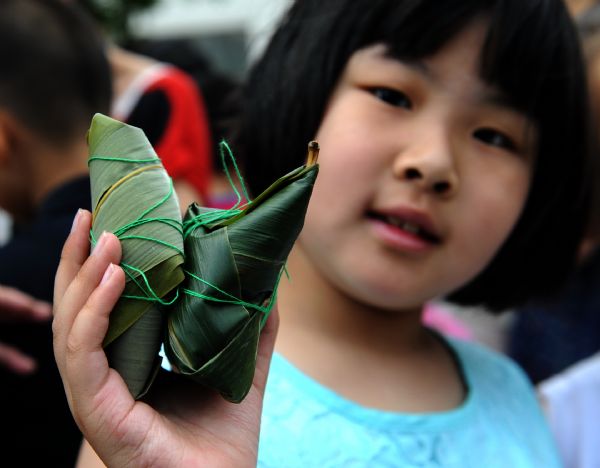
A girl shows zongzi she made in Feicuijun Community of Jinan City, capital of east China's Shandong Province, May 29, 2011. Zongzi is the typical snack on Dragon Boat Festival of a pyramid-shaped dumpling made of glutinous rice wrapped in bamboo or reed leaves. Residents attended a zongzi festival held in the community to greet the upcoming Dragon Boat Festival. (Xinhua)
GOOD LUCK AND NO DISEASE
The rice packets that were once dumped into the Miluo River are now called zongzi, the feature food of the Dragon Boat Festival. They are glutinous stuffed rice wrapped in bamboo or reed leaves and are offered at the family gatherings during the festival.
This year, as the Dragon Boat Festival fell one day before the National College Entrance Examination, the snacks were made to carry special blessings for the examinees.
Duan Peng, a citizen in the city of Hefei, prepared both zongzi and mung bean cakes for his son, who would take the national exams as of Tuesday.
"'Cake and zongzi' pronounce similar to 'pass the exam' in Chinese. We hope they could bring good luck to my son," said Duan.
Sachets containing fragrant herbs, which are believed to guard the carriers from evil spirits and bad luck, also saw a rebound in popularity. Apart from being an auspicious ornament, young fashionistas said they could also help insomniacs and keep away annoying mosquitoes.
In the southwestern border county of Duanxi, the festival featured a huge bazaar of herbal medicines, as locals believed the curative power of plants peaked at days before the festival.
"I've prepared half a month and picked from nearby mountains 800 kilograms of herbs, all for this big day," said Li Changjiang, a local farmer.
In this yearly pageant of herbs, farmers lined up the streets with rare plants and practitioners from ethnic Zhuang medicines offered free moxibustion treatment.
According to ancient beliefs, the Dragon Boat Festival was a day when poisons and diseases prevailed. Washing with moxa-leaf soup and spreading realgar wine were common practices to dispel the unhealthy elements.