Kusuda makes NZ wine his own way


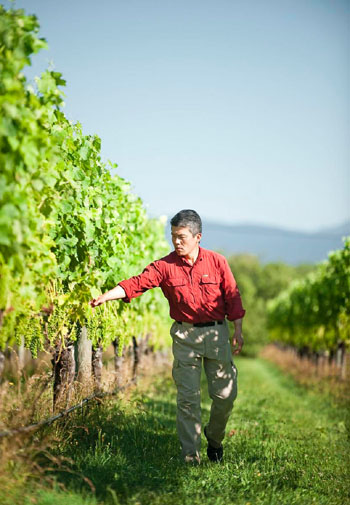 |
| Field of dreams: Hiroyuki Kusuda of Kusuda Wines tends one of his vineyards in the Martinborough region of New Zealand, where he grows Shiraz, Reisling and pinot noir grapes. MIKE HEYDON |
Working with only a shoestring budget, Kusuda has produced elegant, refined wines that have wowed critics. His G pinot noir garnered a five-star rating in international wine magazine Decanter back in 2006, and these days his wines regularly sell out on release.
These achievements are a testament to his willpower: To pursue his dream of creating superlative pinot noir, Kusuda quit his Sydney-based job at Australia's Ministry of Foreign Affairs and Trade just as he was on his way to becoming a diplomat at the age of 31. After studying German from scratch, he enrolled at the renowned Geisenheim Grape Breeding Institute, frugally supporting himself and his young family on savings.
"I just slowly came to realize that work, or whatever you call it, in a big company or organization does not necessarily suit my style of life. What would I think, say, when I reached 70 or 80, or when I died and looked back? Could I say I'm satisfied with what I've done with my life?" says Kusuda over the phone from New Zealand of his decision to devote himself to winemaking.
Kusuda's passion for wine, began in his student years and led him to take a year off in 1986 to go backpacking around Europe, visiting world-famous wineries. By chance, during that trip he came to stay with the Pusinelli family, who make wine at Weingut Troitzsch in the Rheingau region in Germany.
"Deai (fateful encounters) is probably one of the key words in my life, because I met this German family who would later help me through my four-year period in Germany."
While researching where to study, Kusuda found out that some world-class foreign winemaking institutes, such as UC Davis and Adelaide University, charged higher fees for foreign nationals; this was out of the question for Kusuda. This left a choice between studying in France or Germany; because of his links with Germany, he chose the latter.
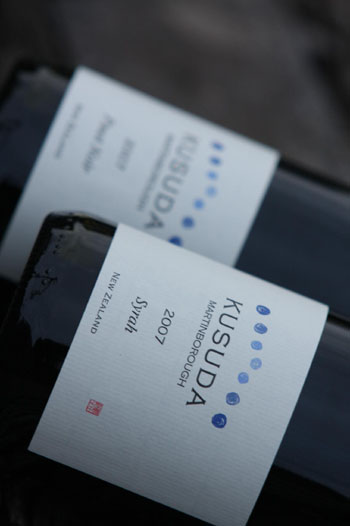 |
| Bottle it: Kusuda owns a block of Shiraz vines, and grows Reisling and pinot noir varieties on leased land. |
Despite having to learn a new language, his studies in winemaking progressed well at the Geisenheim institute. He even managed to pick up private sponsorship for his thesis in 2000.
"I got a big thesis sponsored by two companies — one Swiss, one German — and they sent me to New Zealand to do my experiment," he explains, referring to his thesis investigation into methods of clarifying grape juice.
There, another fateful deai occurred when he met up with Kai Schubert, who owned the winery where he was conducting his experiments. "I spent about a month with them, and almost every night we ate together and drank together and we somehow got on quite well," he says.
Schubert offered Kusuda the use of his winemaking facilities, and Kusuda went about finding financial backing to launch his own label.
"When I finished my studies in Germany, my bank account was almost empty. Then I somehow managed to find about 40 to 50 financial backers. I wouldn't call them investors: I deliberately discouraged those people who thought of investment, because with investment there is always a return. I couldn't promise any return."
Though this was not enough to buy land, in 2001 he began renting properties and buying in grapes. He's now at the point where he owns a block of Shiraz vines and rents parcels of land on which Reisling and pinot noir varieties are grown. But it hasn't been easy; lease disputes and bad weather have seriously impeded his progress. On the positive side, he's now less reliant on buying in grapes and is able to have more control over his pinot noir vines on leased plots.
"I spend a lot more time in the vineyard than many peers or neighbors in the town," he says of the Martinborough region in which he works. "You have to have a look at what the vine canopies — the shoots or canes with wires (used to train the vines) — look like. We have really windy days every summer, and after those days, the canopies look sort of disoriented. Many (winemakers) just leave vines down. I quite often go back to the vineyard and by hand I just reshape the congested area."
Though wine writers tend to surmise that this kind of attention to detail marks Kusuda out as a typically Japanese winemaker, he doesn't necessarily craft his wines for the Japanese market. Instead, he makes wines that please his own palate, his favorite attributes being "finesse and clarity."
He explains: "Some attributes, like complexity or body or weight, are frequently used as positives, but some of those are not my cup of tea. I've tried a lot of wines that win competitions, but quite often I find them too heavy or too tannic."
Kusuda is fiercely independent and keen to walk his own path, to prove what he can do under his own steam. He chose to make wines in New Zealand for this very reason, returning there after completing his thesis, as opposed to making wine for a wealthy patron in the Old World.
"What we see today (in the Old World) is the result of the work of generations of French or German or Spanish (winemakers)," he says. "This is people's work and observations and experiences. They found the best sites, then the best varieties and best ways to grow them ... (If I'd gone to the Old World), people could just say, 'Well, a Japanese just came and sat on top, with some cash.'
"I'm rather more inclined to go to a new place. New Zealand is one of the newest in the New World. If the final product was recognized as one of the top 40 pinot noir in the world, then I could say that even Japanese can understand wine, starting from the soil and sun and water and rain, through the vine and then to winemaking. I could 100 percent say, 'I can do it!' "