Canada still in its youth as a winemaker


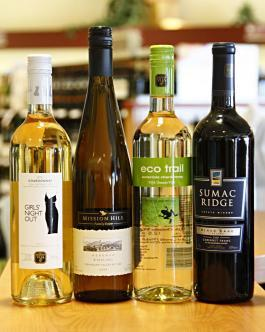
GREG AGNEW/TIMES & TRANSCRIPTFrom left: Girls Night Out Chardonnay, Mission Hill Reserve Riesling, Pelee Island Eco Trail and Sumac Ridge Black Sage Cabernet Franc.
If you took a poll around the world and asked people to name a wine producing country, you would get many different answers.
However, the vast majority of answers would be countries like France, Italy, the United States and Australia. There might even be good representation from Chile, Argentina, Germany, Spain, Portugal and even China (believe it or not, China is a Top 5 wine producer), but other than in this country, you might not get many responses that say Canada.
Why is that? It certainly is not quality, as we craft many superb wines here that get international accolades. The main culprits would have to be youth and volume.
When referring to youth, I am talking about the length of time that Canada has been producing wine. Many nations, especially the European ones, have been creating wine for thousands of years while the wine making industry in Canada is barely 200 years old. Wines began to be produced in the early 1800s to meet demand from settlers. The problem here was that Vitus Vinifera, the grape variety of European grapes (Merlot, Chardonnay, etc.), would not grow in this country. Unknown to the farmers, North American soil contained a pest called Phylloxera that ate away at the rootstock of these new vines, thus killing them. There were native grape varieties such as Concord, Baco Noir and Marechal Foch (Vitis Lambrusca and Vitis Riparia) that were resistant to this pest. Unfortunately, the Lambrusca varieties had an odd foxy flavour that transferred into the wine and the Riparia varieties had other issues that made it difficult to cultivate (at that time) for wine-making purposes. These other grape varieties produced decent fortified wines (thanks to the introduction of extra sugar and alcohol) and for many years this was the mainstay of the Canadian wine industry.
Much like our southern neighbour, Canada experienced a period of Prohibition in the early 1900s. That, combined with Temperance movements, two world wars and a consumer preference for sweet fortified wines, caused the Canadian wine industry to stagnate for much of the century. Change was in the wind, however, and throughout the 1960s consumer tastes began to slowly shift towards non-fortified and unsweetened wines. Much like the rest of the "new world" wine countries, several factors were swirling around that helped to facilitate a change in the industry. Better technologies for grape growing and wine making, increased access to finer grape varieties and disease-resistant clones, and the development of research centres all helped to advance the wine industry in Canada.
A major milestone was reached in 1974, when a nearly 50-year moratorium on new winery licensing ended with birth of the quality-oriented Inniskillin Winery in Ontario. In 1979, British Columbia got into the new winery act with Sumac Ridge leading the charge. New wineries began to spring up in Nova Scotia and Quebec, as well.
The 1980s was a development decade which saw three pivotal events occur in 1988. The first was the adoption of the US/Canada Free Trade Agreement. This stripped away much of the protection that Canadian wineries enjoyed, and forced them to produce better product in the wake of a flood of better U.S. imports. The second was an aggressive pull out/replant program that replaced many native varieties of grapes with European Vitis Vinifera varietals (the phylloxera problem had long since been solved by transplanting Vinifera grapes onto Vitis Riparia rootstock). The third and final event was the creation of a European-styled governing body for wine production standards called the Vintner's Quality Alliance (VQA).
It was not until the 1990s that the Canadian wine industry really began to take off. It was a decade marked by rapid growth as the number of wineries went from barely 30 to over 100 by the end of the decade. International awards were now being won. In 1991, Inniskillin's Icewine (1989 vintage) won the Prix d'Honneur at the ultra-prestigious VinExpo that is held annually in Bordeaux, France. The volume of quality wine being produced has also drastically increased with sales of VQA wines going from nearly zero to over 10 million litres by 2000.
Despite great advances in our technology, technique and the growth of new wineries, the volume of wine produced in Canada is nowhere near the other major wine-producing nations. According to data released for agricultural production in 2009, Canada created 53,000 tonnes of wine. Although that sounds impressive, that only puts us inside the Top 40 of wine-producing nations. By way of comparison, the volume leader of the world is Italy at nearly five million tonnes produced annually.
Here in Canada, even the internal consumption is not like other nations, and volume has quite a bit to do with this. Canada is one of few nations where consumption of national wines constitutes less than 50 per cent of the volume of wine consumed. This is despite the fact that, in a province like B.C., 80 per cent of the wine created there is consumed there. In general, we seem to be pretty good at consuming our own wine, as there seems to be little left for the export market.
As time moves forward, both of these issues will be addressed. New wineries are being opened every year and current vineyards are expanding. Knowledge, technique and technology are constantly improving, and even now we are crafting wines as if Canada was a nation with a much longer history of winemaking. We are catching up quickly. It won't be long until all of our wine exports are sought after by other nations, not just our Icewines.
Recommendations:
* Girls Night Out Chardonnay: This lighter style chardonnay is perfect for a get together with the girls. Don't worry about food pairing - just sit down and enjoy. VQA 750 ml $13.99 (Sale price for July)
* Mission Hill Reserve Riesling: This dry riesling is bursting with notes of tangerine, peach and pear, with a characteristic minerality that good riesling is known for. This is a specialty listing available in select stores like Vaughan Harvey. VQA 750ml $23.79
* Pelee Island Eco Trail: This blend of baco noir, chambourcin and cabernet franc sees notes of dried berry mixed with light notes of cherry. Medium-bodied with fine tannins, this wine provides a great complement for most things off the grill. VQA 750ml $12.99
* Sumac Ridge Black Sage Cabernet Franc: This specialty listing is unfiltered to optimize its fruit intensity. This dry, medium-bodied wine has significant mouth feel and a meaty texture. Nicely round berry flavours compliment a lingering finish. An excellent wine with red sauce pasta dishes and red meat from the barbecue. VQA 750ml $29.99
* In the Spirits was written by Jeff Budd, a product advisor at NB Liquor's Vaughan Harvey Blvd. store in Moncton.