SA wine — the perfect Chinese present


Almost all Chinese wine gifts consist of imported wines and buyers look for impressive packaging, writes Penny Haw
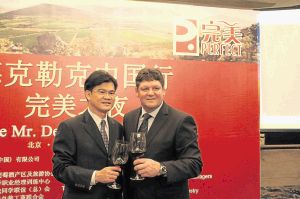
PARTNERS: Woo Swee Lian, the president of Perfect (China), and Hein Koegelenberg, of Leopard’s Leap Wines, have teamed up to export South African wines to China.
WITH the first 100 containers scheduled for shipping this month, a new wine brand, L’Huguenot, is set to make a bold (South African) statement in China before the year is over. By June next year, almost 2,9-million bottles of L’Huguenot will have landed in the People’s Republic, which is no small deal given that about 3,9-million bottles of South African wine in total were shipped to China during the 2010- 11 period.
L’Huguenot is the product of a joint venture between Chinese consumer products company Yangzhou Perfect, a division of Perfect (China), and Franschhoek-based Leopard’s Leap Wines. The new venture — Perfect Wines of S A — is 51% owned by the Chinese partner and 49% by Leopard’s Leap Wines. The latter is part of Hein Koegelenberg and Hanneli Rupert- Koegelenberg’s RK Portfolio of Wines, which includes La Motte and De Klerk Presidential Blend.
Although there has been a flurry of activity from the South African wine industry to capture a greater share of the giant Chinese wine market — expedited by increased wine consumption in that country and declining sales in other markets — Koegelenberg says the joint venture is due to a friendship rather than his company’s drive to grow business.
"About three years ago we identified Asia as an export destination for our wines. Leopard’s Leap in particular, which I developed as an export brand 11 years ago, has done really well in the UK and other parts of Europe, and with organisations such as Wine Intelligence reporting about 34-million Chinese could be drinking wine by 2015, we decided to explore exporting to the country."
Since then, annual exports of South African wine to China have grown from 1,2-million litres to 4,5-million litres. Figures released by South African Wine Industry & Information Systems showed volumes of bottled wines sold in China increased 60% for the 12 months to March.
Koegelenberg estimates that Leopard’s Leap and La Motte make up between 8% and 10% of SA’s wine exports to Asia. During his initial visits to China, Koegelenberg met the president of Perfect (China), Woo Swee Lian: "We struck up a friendship and played golf . About a year ago, he visited Franschhoek and I showed him around. Among the things he was most interested in was the Dennegeur village, its day-care centre, training centre, clinic and so on, which we constructed for our workers.
"Coincidentally, Perfect (China) has built 100 schools in poor areas in China. We realised then we have the same business philosophy of trust, respect and commitment to social responsibility. That’s when we began discussing doing business together."
The Perfect Wines of SA joint venture is, says Koegelenberg, in line with his long-standing philosophy on exporting. It’s a technique he learned from his late father-in-law, Anton Rupert, and focuses on developing brands by self-managing intellectual property and always being closely involved in distribution and network channels.
Furthermore, China — more than anywhere else — requires that you have an export partner who not only has your trust and shares your values, it’s also important that the organisation understands key regions and relevant channels.
"China is not an easy market," Koegelenberg says, alluding not only to the challenges of the language and the complex rules of business engagement that must be understood and respected . "The channels of distribution are unlike most we’re accustomed to. While 51% of wine sales take place at restaurants and hotels, and 49% in retail, at this point South African wine does not even feature as a category in retail. But there are other means of building a brand, such as golf days, wine-tasting dinners, airline listings and so on."
T he manner in which most L’Huguenot wines are to be distributed is an interesting study. Perfect (China) has 5000 outlets across the country. These outlets service and supply thousands of individuals who sell product via direct sales within their own communities.
Perfect (China) launched the first wine (from China) in its range at the end of last year . Woo comments: "We are satisfied with the market response, a nd I believe, through our network, we can offer more top-quality wine — this will now be a wine from SA ."
Gifting is important to Chinese consumers. Koegelenberg and Woo believe L’Huguenot wines will be particularly sought after by this sector of the market.
According to Wine Intelligence, more than half China’s wine consumption is associated with the Chinese new year and the mid-autumn celebrations, two events that see enormous spikes in sales because of the popularity of offering wine as a gift. Government officials and businessmen also typically buy wine as gifts for business contacts. Wine Intelligence’s research claims almost all wine gifts consist of imported wines and insists that buyers look for impressive packaging.
Koegelenberg concurs. "There’s no doubt that the Chinese market buys on perceived brand value. Because the French were the first to recognis e the potential of China, they have the edge with brands such as Pétrus, Lafayette and Mouton Rothschild."
There’s growing competition from other regions too. Australia, Chile and the US are as serious about shipping more wine to China as SA . And China is yet to see full production from large vineyard plantings undertaken itself in recent years.
The Perfect Wines of SA team is confident South African wines will continue to make inroads, helped by the Western Cape being an increasingly popular tourism destination for the Chinese. Cape Town was recently named "the most preferred tourist attraction for the Chinese in 2011" in the Global Tourism Thermal List campaign organised by the World Travel Broadcasting Union and Radio Beijing Corporation. Annual Chinese arrivals to the Western Cape doubled from 2008 (20724 ) to last year (41532 ).
Says Woo : "We see the potential of quality wine from SA . The base is small, but I want to be part of this growth. I think the ability to provide consistent supply at reputable quality is to the advantage of SA ."
The initial L’Huguenot range consists of a Shiraz, a Shiraz-Pinotage blend and a Chenin Blanc. The current demand in China is predominantly red, which is apparently a symbol of wealth and success. The main markets for white are women, who are increasingly electing to drink wine rather than beer. And, with more and more Chinese learning about wine by attending the increasing number of wine-tasting and education events, the consumer base is growing annually. Wine producers project that the country’s wine market will reach a value of $6bn by 2014. The hope that is more and more Chinese will elect to drink South African wines as they become available.