Ancient distillery transforms amid tourism boom


By Xinhua writers Zhang Chunxiao, Liu Xiangxiao
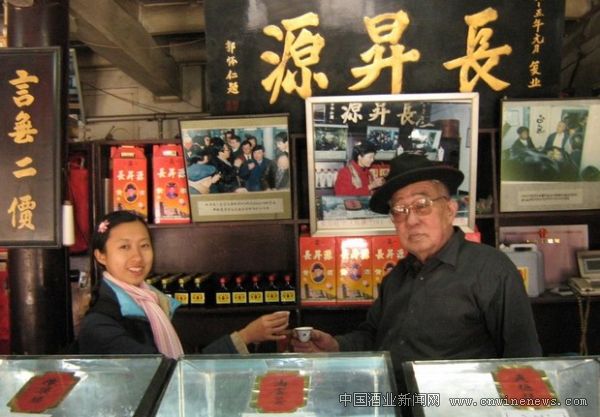
PINGYAO, Shanxi, Sept. 25 (Xinhua) -- Retiring at the age of 82 last year, Guo Huairen handed over the family distillery to his 24-year-old grandson Guo Jingjin without foreseeing any significant changes to the 400-year-old family business.
Spanning the last years of the Ming Dynasty, the entire Qing Dynasty and the Republic of China period and going all the way into the era of the People's Republic of China, the millet liquor, or "Chang-sheng-yuan," is a time-honored brand in the ancient walled city of Pingyao in north Shanxi Province.
A 500-milliliter bottle of newly made liquor, coke-like in color and sweet-flavored, costs 25 yuan (about 3.91 U.S. dollars), and a 10-year-old bottle of it, the oldest in the distillery, is priced at 150 yuan, according to Guo Jingjin, the eighth-generation owner.
The distillery, originally called "Ju-sheng-yuan," changed its name to the current one in 1900 after Empress Dowager Cixi (1835-1908) drank some of its liquor and replaced "ju" with the character "chang" that means "long-lived."
In ancient China, imperial families could change the name of any store and, if they did, the store owner would consider it a great honor to his family.
The distillery's weathered accounting books, passed on from generation to generation and recorded by brush and ink, date back to 1904.
Like many old-school businesses in China, Chang-sheng-yuan had been small scale and managed in a simple way -- a distillery of 300-plus square meters in the backyard and a tavern of some-50 square meters in the front.
But since Guo Jingjin took over, a new distillery has been under construction far away from the family's old shop.
"The idea of building a new distillery occurred to me because of the growing demand for our spirits in recent years," said Guo, a college graduate.
The walled city of Pingyao, first built in 1370, was listed by UNESCO as a World Heritage site in 1997 for being "an outstanding example of a Han Chinese city of the Ming and Qing Dynasties (14th-20th centuries)."
Since then, the ancient city of Pingyao has attracted a huge number of tourists, many of whom have become fond of Guo's spirits.
Last year, Pingyao registered 1.15 million tourists, generating 1.15 billion yuan (180.09 million U.S. dollars) in revenue, according to the Pingyao government.
"As our brand becomes increasingly well known among tourists, the current daily output is a far cry from meeting the surging demand," Guo said.
So last year, Guo persuaded his family to spend about 2 million yuan to lease land north of the walled city and build a new distillery.
With the new factory, the daily output is estimated to increase to about 500 liters from the current 100, according to Guo.
He also applied for a quality safety (QS) certificate from the provincial government so customers can know his spirits are up to standard.
The factory is scheduled to start operation next year, and Guo plans to recruit more workers.
"My grandfather and father agreed with the expansion plan, but they specifically asked me to preserve the traditional distilling technique," he said. "So in the new factory, we will continue to make our spirits by hand."
Guo has been receiving an increasing number of mail orders via phone calls from people in other parts of the country. Now he is thinking of supplying supermarkets and opening an online store.
He is also considering exporting the liquor to other Asian countries such as Japan and the Republic of Korea, for he has found tourists from these countries more interested in his liquor than those from the United States and Europe.
"I want people across the world to have easy access to our spirits," he said.
But Guo's plan of increasing the advertisement budget caused some heated discussions among the family.
Guo hired a team of elderly neighbors, who were unemployed, to perform folk songs and dance in front of the tavern during holidays to attract tourists.
The lyrics of the folk songs, such as "the liquor of 'Chang-sheng-yuan' enjoys a great reputation worldwide; Chinese and foreign journalists have tasted it; high-ranking officials from the United Nations know it; it is rich in nutrition and good for health, so hurry to buy it."
"Initially, my grandpa didn't like the idea. He thought it was a waste of money. He said reputation should be built on customers' recommendations," Guo said.
But the idea has been a success both for Guo's business and his neighbors, who now benefit from the employment.
Guo majored in design in college and plans to apply what he learned in redesigning the spirits' packaging.
The current packaging is too plain and has not changed over the past decade, Guo said. He is thinking of replacing it with a case made of lacquerware, also a well-known traditional handicraft in Pingyao.