Vino-volution: Can Shanghai become a fine-wining capital?



It has its challenges, but the growth of wine consumption in Shanghai is seeing it emerge as China's most dynamic wine market
“1988 was not a good year for wine, but that vintage sells extremely well. France keeps it for the Chinese market,” says Huser. The French might be on to something. Photo by Flickr user Alan Heitz
Jean-Marc Nolant, the master sommelier at the Park Hyatt

While Shanghai has never been an international destination for oenophiles, it just might be in the near future.
Beijing is still stuck in the vino dark ages, and Hong Kong, a matured market, is set in its drinking ways. With neighbors like these, Shanghai has been driven to drink, emerging as the most dynamic wine destination in the region.
Ripening
Shanghai is by no means without its wine flaws however. Two and a half years ago there were 30 Shanghai wine suppliers. Now there are 150 providing wine to legions of hotel bars, upscale restaurants and wine bars of varying quality.
But more isn’t necessarily better. Some 60 percent of imported wine is cheap rotgut bought in bulk and re-bottled as Great Wall, Dynasty (lovingly called “Dy-nasty”), Changyu or another local brands.
The flood of dismal wine is only one of the factors that has been keeping the growth of an international wine market in Shanghai in check.
“The [Shanghai] market has matured more slowly than the Tokyo market. When the Japanese like something, they go crazy for it. In China, wine is still considered a drink for special occasions,” says Jean-Marc Nolant, the master sommelier at the Park Hyatt in the Shanghai World Financial Center.
A 48 percent tax on imported wine also keeps the prices high and quality low.
Even with these drawbacks, with the increase in Chinese wealth and social mobility, Nolant has seen “a development of label recognition.” He pauses a moment before emphasizing that this isn’t synonymous with taste in wine or wine education. “The most expensive bottles are still being put on the table for mianzi, the face issue.”
Philippe Huser, the owner of Napa Wine Bar & Kitchen
However, this trend might be reserved for those who drink wine atop skyscrapers. Other sommeliers across town report a growing presence of middle-class drinkers with dynamic tastes.
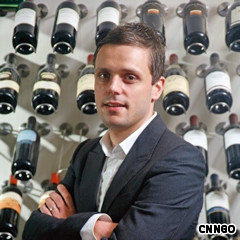
Philippe Huser, the owner of Napa Wine Bar & Kitchen, attests to the emergence of something new.
“It’s definitely happening here. [The growth of the wine market] is a trend all around the world, but in China it’s driven by the interest of local people.”
Ben Cracknell, in charge of the wine list at Osteria, agrees that the blossoming interests of the Chinese are what will guide the scene. The wine scene is “still new and very fresh. People’s tastes aren’t defined. The expats have more knowledge, but the Chinese are starting to explore. They also put more faith in my recommendations.”
New wine in new bottles
With wine drinkers on the rise in Shanghai, wine outfits succeed by differentiating themselves. Nolant describes his list as avant-garde. “It is massive, with 750 labels and 40 wines by the glass, but 80 percent is sustainable. The wines are either organic or biodynamic. I want to showcase the workers wearing jeans and muddy boots -- those connected to the terroir.”
While Napa Wine Bar’s wine list (which, at 51 pages, has a table of contents) is more traditional in its allegiance to Bordeaux wines, Huser's approach is slightly different.
“We like the term 'fine wining' experience,” says Huser. Napa is more of a restaurant and the emphasis is on pairing wine with the food, designed specifically for its wine-pairing qualities by the American chef.
Osteria’s wine list is much smaller, but Ben Cracknell takes pride in his eclectic mixture of 120 labels. The list is the winner of Wine Spectator's 2009 Award of Excellence, a first for a Shanghai venue. “I don’t like limiting or focusing on one region. We have a lot of small boutique wines.” Cracknell can do this because he isn’t locked into a contract with any distributor, a trait he shares with both Nolant and Huser and something seeminly now almost required for a competitive wine list in Shanghai.
Ben Cracknell is in charge of the award-winning wine list at Osteria
The Chinese palate
The future lies in the Chinese consumer. Forty percent of Osteria’s clientele is Chinese. Napa claims 60 percent, and the Park Hyatt serves between 50 and 90 percent Chinese.
“The balance is changing. We need to cater to the Chinese, not Westerners,” says Huser.
For instance, People don’t really drink white wine in China. “They don’t like cold liquid, says Nolant. “It displeases them.” This also goes for Champagne, which is a touch too acidic.
And any good sommelier should factor in local superstitions.
“1988 was not a good year for wine, but that vintage sells extremely well. France keeps it for the Chinese market,” says Huser. Perhaps the French are on to something -- an international wine market in Shanghai, but, as always, done the Chinese way.
Hunter Braithwaite is Shanghai-based writer. He has tended bar, worked as a librarian for the blind and written travel books for National Geographic.