A new wine with roots all over the world


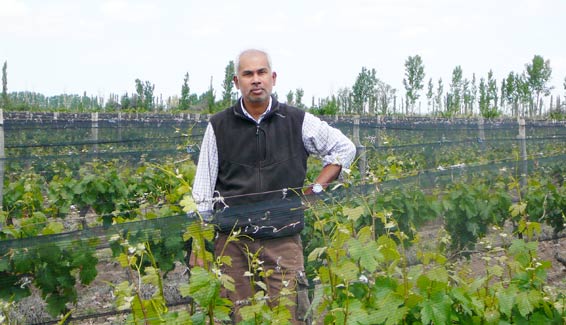
Global grower: Aziz Abdul in his vineyard in Mendoza
Even in a country built on immigration and where the signature grape was originally French, few Argentine wines can claim to pack as multicultural a punch as Château HANA.
Made by a Vietnamese-born Muslim who fled to southern India when Saigon fell and who learnt to appreciate wine while studying mathematics in Paris, its origins blend an eastern entrepreneurial energy, French savoir-faire and New World opportunity.
Its creator, Aziz Abdul, began thinking seriously about becoming a winemaker only five years ago, when the office treadmill got too much. Buying land in France, where he had moved in 1978, was too expensive. The same was true of India, the homeland of his Tamil father and half-Vietnamese, half-Indian mother.
But a chance holiday to Patagonia in October 2007 opened his eyes to the prospects of Argentina, whose Malbec has won a devoted international following that has helped turn the country into the world’s fifth-biggest wine producer.
So began Mr Abdul’s dream of making wine in the truly French artisan style, but with the “macho” characteristics that give Argentine wines their full-bodied personality.
“I never thought of myself as an entrepreneur,” says Mr Abdul, 52. “I’d wanted a career in maths and imagined myself thinking up some new theorem . . . But you don’t get very far on the salary of a mathematician.” Working in IT, which he fell into after graduating, was “an easy way of making money for me”.
Mr Abdul was raised to enjoy the culinary pleasures of Vietnam and India and though the family are Muslims, alcohol was never taboo. But it was not until he had a job as a summer camp instructor in France that Mr Abdul discovered wine.
His hobby morphed into his vocation in 2008 when a voluntary redundancy package provided the capital for a winery.
He turned to French cellar masters for tips. “They told me the aromas to avoid and how. I learnt that after harvesting the grapes, it was better to leave them intact for as long as possible as that imparts more character,” he says. “Some of their cellars weren’t all that modern and I found myself thinking, if I had my own winery, I would have bigger, shallower tanks to allow the solids to be in contact with the liquid for longer.”
Argentina’s booming wine industry – exports were $860m last year, up 13 per cent on 2009 – has proved a magnet for foreign investors and boutique outfits.
“There are thousands of wines in Argentina – why add another?” asks Mr Abdul. “You have to be distinctive. That’s terroir – it’s the land and the man together.”
After buying a property in Argentina’s premier wine region, Mendoza, from a US investor in April 2008, he hired a prizewinning local oenologist, custom-built his winery and set about making wines with the acidity he feels Argentine ones lack, sacrificing yields to achieve density.
Life as an early-stage entrepreneur is tough: he has invested $500,000 in the property and 85,000 litre capacity winery, and has no salary, despite Argentine inflation of about 25 per cent. Château HANA – the name comes from his initials, those of his Madagascan wife and his daughters – is pricey by local standards, but he has sold 300 cases so far, including to the Park Hyatt and Sofitel hotels in Buenos Aires.
To raise revenues, he plans to sell bulk grapes and wine and launch a second, cheaper label. He also hopes to export next year, targeting the US, China and Brazil. India remains attractive, but rich Indians are more likely to go for the snob value of a fancy French wine, he notes wryly.
“This isn’t an adventure to me. I’m doing what I’m passionate about,” he says. “I’m not a born entrepreneur. But if others can succeed, why not me?”