Vinters Global Resource finds successful niche selling wine bottles


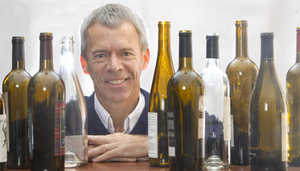
GORDON KING/YAKIMA HERALD-REPUBLIC
Andy Brassington is in the business of supplying bottles to vintners. He's visited 16 glass factories in Asia and North America for his company Vintners Global Resource LLC.
YAKIMA, Wash. — The walls of the downtown Yakima offices of Vintners Global Resource are decorated with wine bottles.
Bottles for syrah. Bottles for chardonnay. Bottles for ice wine and champagne.
For founder and president Andy Brassington, these bottles are the foundation of a business that generated $3.3 million in revenue last year.
And its rapid growth has been noticed. Last month, the Puget Sound Business Journal ranked the company No. 16 on its list of fastest-growing private companies. It reported a 214.29 percent increase in revenue between 2008 and 2010, and was the only entry on the list from east of the Cascades.
The company imports and distributes high-quality wine bottles at competitive prices to small- and medium-sized wineries using a network of manufacturers worldwide. Bottles are stored at the company's warehouse in Kent, which provides easier access to ports, before being shipped directly to the wineries.
For many wineries, locally and throughout the Pacific Northwest, Vintners Global Resource fills a niche that large-scale bottle distributors do not.
"These companies were either based out of California or based somewhere else and focused on the California wine market," said Ryan Pennington, spokesman for the Washington Wine Commission. "Washington was an afterthought."
Brassington's education in law and business came from experience rather than the classroom.
Instead of completing law school, he passed the state bar by participating in a law clerking program and working for a Yakima law firm for five years.
He didn't build his business acumen at an MBA program, but from jobs at Rainier Plastics, Lamb Weston and Holtzinger Fruit Co.
Through his work as chief operating officer at Holtzinger, he learned more about the growing wine industry, locally and statewide.
It was the early 2000s, and the company rented barrel storage space out of a warehouse in Prosser. Through this operation, Brassington built relationships with winemakers and winery owners.
From them, he learned that small- and medium-sized wineries faced issues in getting their wine bottles.
One of those winery owners, Phil Cline of Naches Heights Vineyard, shared how he would pay nearly $10 per case from larger distributors, quite a rub considering that larger wineries paid less with volume discounts.
Many smaller wineries faced the same issues, Pennington said.
"Just simply having availability was the primary concern," he said. "It was very difficult to find someone willing to supply bottles and corks to a small mom-and-pop (winery)."
When Brassington decided to leave Holtzinger and pursue his own business about six years ago, he focused on solving the issues the winery owners shared with him. He spent more than a year learning about the wine bottle business, talking to wineries and visiting manufacturers in the U.S., Europe and Asia.
Through that research, he learned that foreign manufacturers could produce a quality product, which was contrary to what he had heard. He also realized there weren't enough glass bottles being manufactured in the United States to supply all the wineries in the country.
With those insights, he and his wife, Jackie, started Vintners Global Resource in June 2007.
The bottles the company distributes come exclusively from a network of about a half dozen manufacturers worldwide.
Those manufacturers produce the bottles to the company's specifications. Vintners Global Resource has even made infrastructure investments to meet some specifications.
While the company has worked with firms in Europe and the U.S., most of the company's supply comes from two factories in China.
Brassington visits China several times a year to work with manufacturers on new product development and to check on operations. During the rest of the year, the company employs two people in China to oversee the day-to-day process.
There are still negative connotations with the "Made in China" label, especially during an economic downturn, but ultimately the quality of the product wins most people over, Brassington said.
Cline, of Naches Heights Vineyard, said that while he likes to source as much of his wine supplies locally as possible, ultimately the business needs to be sustainable.
Through working with Vintners Global for some of his bottles, he now pays $2 to $3 less per case than he did a few years ago.
"Andy is from the area," he said. "Even though he's sourcing product from China, he's trying to do a job that is supporting the industry in Washington. He sees it as a vibrant business like I do."
Providing backbone support for the industry is key, said Pennington of the Washington Wine Commission.
For example, Vintners Global's ability to store inventory is a plus, especially for smaller wineries, he said.
"If one of your suppliers is willing to operate on a just-in-time delivery model and you're not focused on having a facility for (the supply chain), then you can keep your overhead low and focus your resources in other places, like buying the best-quality grapes," he said.
As the statewide wine industry continues to grow, the opportunity for new ventures that offer ancillary services will also grow.
Many jobs in the wine industry are from businesses that supply the industry, such as Vintners Global Resource, rather than the wineries and vineyard themselves, said Amy Mumma, director of the World Wine Program at Central Washington University.
New business ventures catering to the industry can also bring much needed innovation in the industry as well, she said.
"We've been so traditional and hidebound in our tradition, we haven't moved forward as much as we could," he said.
While midsize and small wineries in the Pacific Northwest are the company's bread and butter, Vintners Global Resource is looking at new areas for growth.
One such area has been new distilleries in the region looking for an inexpensive way to bottle their product.
The company is also looking beyond the Pacific Northwest. Earlier this year, it opened a regional warehouse in Ohio to reach wineries on the East Coast.
And there are plans in the works to hire a sales representative based out of the nation's largest wine industry: California.
The same niche that helped his company gain business in the Pacific Northwest will also draw similar-sized business there, he said.
"We relate to those wineries because they're small family businesses trying to make a living," he said. "We're trying to do the same thing."