French chef and author Stephane Reynaud knows how to roast


The French chef Stéphane Reynaud just wrote a book on roasts, titled Rôtis: Roasts for Every Day of the Week.
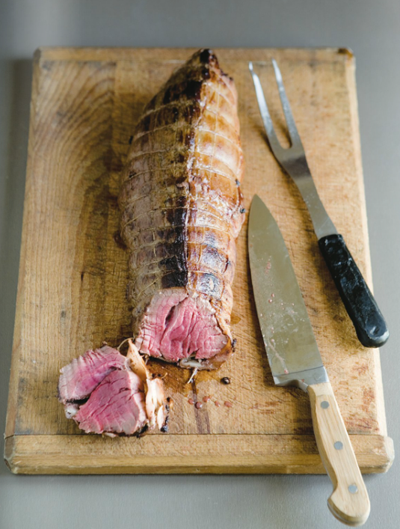
One of Reynaud's homespun rotis.
I have never eaten at Villa9trois, Reynaud's restaurant in Montreuil, just outside Paris, but his thick, fanciful book Pork & Sons, a grateful panegyric to the pig, is rather perfect. After that Reynaud wrote a book called Terrine, about cooking in the heavy, ceramic crocks called terrines. And another on French feasts. Each is so convinced of the pleasures to be had in its preparations, that it seems, in a market flooded with cookbooks, to have a purpose. He was in New York last week to promote his book.
In the season of our annual collective digestion of a monstrous roasted bird, it seems useful to consider “the roast,” which has something both symbolic and too brawny about it. Our most famous roasts are English or Yankee. They’re for Christmas or Sundays, and they are beef. I immediately liked Reynaud’s book because it is plainly, distinctly French, and I’ve always felt, with cooking anyway, that the French got there first for a reason.
So Reynaud and I met at the Chelsea Market so that he could help me buy a roast and tell me what to look for, what to think about, and how to cook it.
“Pork roasts are very common in France,” he said as we entered Dickson’s Farmstand Meats. They had thickly fatty pork belly, and pork shoulder, and a less expensive, enticing, big, beautiful piece of pork sirloin, which comes from just around the pig’s lower back. It was boned out and rolled and tied, with an-inch thick layer of fat carefully closed around its top half. I asked him if it would be better to get a leaner roast and wrap it in pork fat, as a diagram at the front of Rôtis illustrates.
“But no. Why?” he said, looking at me with a friendly, confused French frown. “Only if it needs it.” He perked up. “But a little bacon for lardons for the pan sauce, of course.” The man behind the counter wrapped up the roast and a long baton of uncut bacon.
“Always better too much than too little,” Reynaud said, when I asked for a little less.
The book’s cover is a matte, pretty red, with none of flaming bravura we usually see on the covers of books on roasting. Its chapter headings are in childish, loopy script. Its instructions all seem round. From a recipe for rôti de veau, tout simpelement, or roast veal, plain and simple: “Add the butter, cover, and cook for a further 10 minutes. Season with salt and pepper. Allow the roast to rest in its juices, covered, for 10 minutes before serving.” Rôtis has lovely photographs of food that’s been cooked, not styled, with a few instructions like that below them, but no other text. Its authority is in the cozy elegance of its author.
“Roast” is one of those strange cooking words, like “stew,” that has enough blur to it to keep you outside: “a stew” is a thick soup, to stew is to slow cook in liquid (though not always to make stew), and “stew-meat” can be turned into thick soup, and can be slowly cooked, but can just as well be chopped up finely into hamburger, or made into shepherd’s pie. So with roast. Samuel Johnson’s English dictionary defines “roast” as “to dress meat by turning it around before the fire” and “to impart dry heat to flesh,” as well as “that which is roasted.” “Roast” also refers to anything you intend to roast—and it continues to be a roast, whether you follow through with your plans or not.
But the word rôti is different. It ends amused, in a feminine smile, and Reynaud’s take on them is similarly welcoming. “You don’t need to do anything difficult, or make any decisions!" he told me. "How do you make a roast? You go to the butcher, you say: I have eight people, it is for Sunday, I have two hours. He gives you the right roast, you go home. Done!” He wiped his hands against each other, as though he was dusting flour off them.
“Now vegetables,” he said once we’d left the butcher shop. In the crowded Fruit Exchange, I again wanted to make sure I was following the roast principles in Rôtis. Did Reynaud want me to buy a whole array of root vegetables, wedge them, and cook them separately, then toss them in the pan juices, or to follow his no-nonsense recipe for putting whole peppers in the roasting pan after the roast is finished and returning it to the oven for them to cook?
“Why? We start with herbs,” he said. “This is French.” He chose big bunches of thyme, rosemary, and sage. “And you already have garlic, shallots.” I said I needed more, and he chose big, beautiful fresh onions instead of shallots. And the vegetables, I asked? “Obviously.” he said, and pointed at the Brussels sprouts.
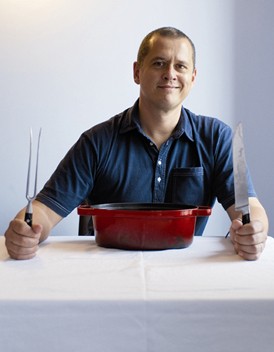 Though Reynaud is happy to speak English, listening him do it is a little like watching someone having to tear something into pieces that he’d prefer to fold. Cooking the roast with just a few herbs, and sweet onion, and the tiny choux de Bruxelles seemed in keeping with his overall gentle-giantness.
We sat down to talk about the cooking. “It takes twenty-four hours,” he said, sternly, but then laughed, and said it was mostly marinating.
I should go home and put the herbs, a cup of white wine, a little olive oil, smashed garlic, and a sliced onion into the roast’s plastic bag with it and leave it be. The next day I should brown the roast in olive oil in a pot, season the browned roast with salt—I interrupted him and asked if he wanted me to use big, flaky, French fleur de sel, at which he nodded vigorously, but kindly, glad he didn’t have to say it, not wanting to sound snobby, I think. Then I was to put all the herbs and onions around the roast and cook it in a very low oven—320 degrees—for 50 minutes.
Then, I should remove the meat and let it sit on a plate covered with aluminum foil, cut the bacon into the tiny lardons, julienne the Brussels sprouts into shreds, then cook both in the roasting pot, which would still contain the herbs, the darkened onions, and the roast’s happy fat on the stove top until the Brussels sprouts were just cooked through. “Still bright green,” he insisted, “with texture.”
We didn’t go into much more detail than that. I’m a professional cook, but I also wasn’t worried. French lardons, little cubes of cooked bacon, are always less crispy and determined than Italian or American bacon. I cooked mine for a few minutes first, then added the skinny ribbons of leaves. If I’d asked, he’d have smiled and frowned at once and said “Of course!”
What I understood about his book of rôtis, after our walk around the market, was that Reynaud's isn’t the “roasting” of grand banquets. It’s cuisine de bonne femme, tender, simple, home cooking, easy to apply to a big cut of meat because it means little work, and a meal for a family. There was no talk of the worrisome importance of a perfect sear, the excitement of flame. It all seemed understated and frankly maternal. “Don’t start with beef,” he told me to write, pointing at my notebook. “And remember that roasts are for family, for friends, for a big table. You prepare them ahead, then you eat.”
It seemed very unlike the tradition of roasting passed down in Charles Lamb’s famous A Dissertation on Roast Pig. Lamb’s essay traces the origins of roasting to Confucion China: “Mankind, says a Chinese manuscript … for the first seventy thousand ages ate their meat raw, clawing or biting it from the living animal.” And so roasting was discovered when a dimwitted pig-herd burned a pigsty down and tasted the damage. He tells others who disbelieve until they repeat the process. “Thus this custom of firing houses continued, till in process of time, says my manuscript, a sage arose, like our Locke, who made the discovery that the flesh of swine, or indeed of any other animal, might be cooked … without the necessity of consuming a whole house to dress it.”
That is to say something extreme, elaborate, more myth than truth.
But roast on every day of the week, as Reynaud’s title suggests? At the start of the day he’d told me that in France people were beginning to eat just a little very good meat, and a lot of vegetables, because it was better for man and beast alike. So many roasts seemed so American—or just overarticulately masculine.
“Oh no!” he said, clucking, and explained that the notion is from a French children’s rhyme, which he recited: “Lundi c’est ravioli; Mardi c’est ravioli; Mercredi c’est ravioli etc.…en Dimanche, qu’est-ce que l’on mange?” He loves his reference. It’s just his small way of saying: roasting is easy as pie, or child’s play, or a nursery rhyme.
I asked Reynaud what he thought of our Thanksgiving roast. He raised his eyebrows and shoulders and hands. He raised everything he could and exclaimed, “I’m always afraid by your big, huge turkeys!”
He said he’d prefer poulets de Bresse, which have gamey, pink meat and bright yellow fat, and are proudly raised on only certain grain, and pecking at only certain soil. But he said that if we wanted to cook our big huge turkeys better, we would “make slits all over the bird with a knife, and put in butter mixed with chives.” I agree that the monsters would probably be thus improved.
The best chapter of Rôtis is “Dimanche Soir il en Reste” (Sunday evening is for leftovers, though it’s translated as “all the rest”). This has twelve recipes for the most beautiful combinations of more fresh herbs, what’s left of any kind of roast, finely chopped and all mixed with good fat, and either stuffed into vegetables, rolled into meatballs, scraped into sandwiches. I didn’t have any leftovers from my pork roast with Brussels sprouts and herbs and lardons, but this reminder of how wonderful it would have been to will send me back to the butcher’s counter soon.
The idea, he reminded me, as I awkwardly put out my hand to shake his big, warm, Gallic one, knowing I should have neatly double-kissed, was “for everyday cooking for everyone. My pleasure is to enjoy the meal with my friends, so I wrote a book with easy food.” And he did.