Lakeside Shandong feast


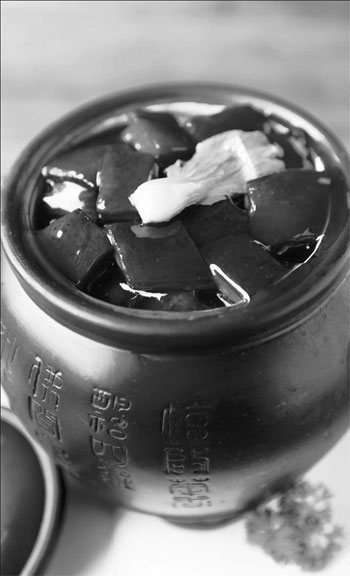
Store up some fat for winter with a rich feast of pork slowly braised with sweet chestnuts and quail's eggs. Provided to China Daily
Beijing
This was the first among many cuisines in the imperial capital. Now, the guardians of Shandong cuisine have chosen an idyllic location to show off their culinary mastery, as Li Jing reports.
It's a balmy autumn afternoon, with boats out on the wind-swept Houhai Lake, and waterside bars and restaurants spilling tables right to the banks. The ambiance is idyllic.
Gilding the lily is a meal at Qingyunlou where signature Shandong-style dishes take the limelight. Among them are the famous sea cucumbers, the beche de mer, done three ways, including being stir-fried with spring onions. The sea cucumbers are tender, hot and full of bite. There is also a chicken that has to be marinated in a secret home-made sauce for a week before frying, and sliced perch in rice wine sauce garnished with sweet olive, date and almond.
I am only now discovering Shandong cuisine or Lu cai, the only northern representative of the Four Great Culinary Traditions. The others are Cantonese, Sichuan and Haiyuan, the last a combination of Zhejiang and Jiangsu cooking styles.
As a southern native, I have not had the pleasure of sampling northern delicacies. Dezhou stewed chicken may be the only dish I know, it being peddled by itinerant hawkers on tricycles trolling the streets of Beijing.
Originating from Shandong province on the north-central coast of China, the cuisine emphasizes natural flavors and uses a vast variety of kitchen techniques, thus earning it the reputation of being China's haute cuisine.
The dishes I tasted at Qingyunlou used to appear on the tables of imperial families and officials. Royalty such as Prince Kong and Prince Rui were regular customers, as were famous Peking opera stars and curio and antique merchants of note.
More than 200 years ago in the Qing dynasty, Qingyunlou was the capital's premier Shandong restaurant until its former owner gave up his business. The building, a stone's throw away from Yindingqiao, was later made over and became a grocery store and a residence.
Fortunately, the historic building is as well preserved as the restaurant's many recipes. The current owner, a former resident, is also a master framer, and his work is now proudly displayed. The three-storied wooden building is strikingly adorned with ancient Chinese paintings and calligraphy works. On its third floor, the four treasures of the study - paper, ink, brushes and inkstone - are presented on a large desk, waiting for a satisfied diner's poetic creation inspired by good food and picturesque scenery.
Although it has nearly 400 seats, Qingyunlou avoids the "hangar" feeling so common in big restaurants by dividing up its main dining area with sculptured screens and ornate book shelves. Its panoramic wraparound terrace overlooks Houhai to the south, the Drum and Bell Towers to the north with a maze of hutongs fanning out at their bases.
Walking in the restaurant is like stepping into a time machine back to ancient times.
But back to the present, the seasonal dish you have to try now is the Diced Pork with Chestnut and Quail's Eggs. It is a rich dish that perfectly meets the traditional Beijing ritual for autumn - tieqiubiao, which translates to "the right nutrition for autumn, storing a little fat for winter".
All that good food can be washed down with a liquor and wine list that is broad in both varietal and geographical choices.