Bears out there: Looking back at 2011


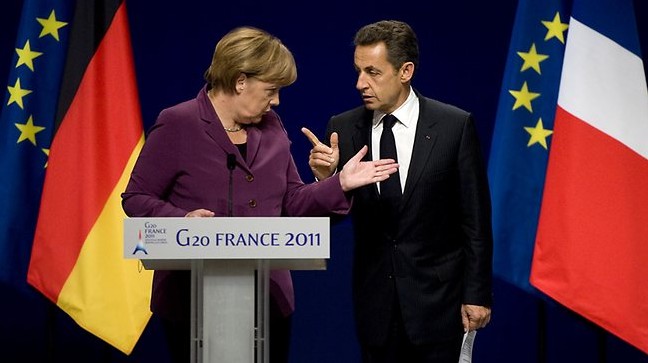
German Chancellor Angela Merkel and French President Nicolas Sarkozy at the G20 summit. Picture: David Ramos Source: Getty Images
IT has been one of those rare years in which almost every investment sector struggled to make a return - and many failed to outperform a cheque book.
Putting your money in cash in 2011 was safe, but falling interest rates made it less profitable as the year wore on.
The share market took one step forward and two steps back, rewarding those investors with strong enough stomachs to endure the volatility with a negative return of about 14 per cent for their trouble.
The long-favoured staple of bricks and mortar was patchy at best and steeply negative in a few areas as cautious buyers and obstinate sellers performed a slow and lacklustre dance that resulted in overall easing prices.
After several stellar years, commodity prices eased and even gold came off its highs as the European debt crisis morphed from a country-by-country drama into a chronic and potentially incurable disease afflicting the world economy.
And balanced superannuation funds, invested in a mix of local and overseas shares, some property and cash, produced another negative return three years after the even bigger GFC-inspired losses in 2008.
It is enough to make you want to take your bat and ball and go home and there is evidence some investors may have done just that.
Bell Potter research director Peter Quinton estimates the combination of the high and peaking Australian dollar and the need to grab profits when they are available has led foreign investors to reduce holdings in the Australian share market.
That selling pressure is one reason why it is not surprising the market has under-performed the rest of the world as cash flowed back to what has again become the ultimate safe haven -- the US dollar and US Government bonds.
Even the weak US economy didn't hold back its share market, which ended the year around square, despite high unemployment and comparatively weak economic growth.
Australia's underperformance may seem a little unfair given 20 years of recession-free growth and a continuing mining investment boom.
However, the outflow does offer the hope of some inflows returning and the possibility a falling dollar may make Australia look more appealing once investors renew their risk appetite.
Of course, there is not much chance of that until the European sovereign debt crisis is either solved through a catastrophic blow up or a successful rescue plan, or the international soap opera goes on so long everyone loses patience and starts to focus on the rest of the world out of tedium.
The European debacle will be studied for many years but it is a stunning example of how bad things can get with 27 political leaders in charge of what is a fairly standard sovereign debt and banking crisis.
They all knew how to end this crisis -- to allow the European Central Bank to stand in the market to soak up bonds as a true central bank of last resort and to start printing euros -- but none knew how to get re-elected once they had agreed to that nasty and costly medicine.
The result was an unedifying spectacle of a string of inadequate political rescue packages that tried to patch up problems bond markets had identified weeks and sometimes months before.
Whatever happens in Europe, the area looks destined for a weak recession at best and possibly much worse, should it all end in an implosion.
The one ray of sunlight is that it is in every member country's best interests to manage an orderly end to the required debt reduction and bank recapitalisation.
Locally, it was an unusual year in the market, with most of the takeover action from foreign raiders despite the high Australian dollar acting as a disincentive.
FOSTER'S Group was the highest-profile scalp, falling in a $12.3 billion bid from international brewing giant SAB Miller and leaving small, family-run Coopers as this beer-loving nation's biggest locally owned brewer.
It was a similar story in the coal sector, with predominantly Chinese and Indian groups keen to assure security of supply through takeover activity.
The biggest was Yanzhou Coal's $6.5 billion deal to grab Gloucester Coal after it had earlier snapped up Felix Resources for $3.5 billion but there were plenty of takeovers in the sector.
Evening up the ledger, BHP Billiton managed to complete a couple of offshore takeovers, making a $20 billion bet domestic gas prices would progressively rise in the US after grabbing the Petrohawk and Fayetteville shale gas assets.
It plans to back those investments with $60 billion of capital spending to boost onshore gas production.
Commodity prices were mainly weaker as doubts emerged about the strength of Chinese growth. Optimists think growth will resume at a strong clip later in 2012 once some Chinese Government stimulus filters through and the US recovery picks up pace.
That would be a positive for Australia given our connection to China and would make our under-valued market a bargain.
Pessimists think the eurowobbles will engulf the world in a recession, meaning our share market should be avoided.
I think the only honest approach is to admit that with so many moving parts and so much politics involved, it is too hard to predict the outcome and the wisest idea is to sit on the fence a while longer.
Sometimes doing nothing can be the right decision, as it was in 2011 when a series of false starts and savage dips left investors wearied and shell-shocked but not in a dramatically different position than they would have been in a year before.