A Chinese chef shows how it is done in Nanking — in nine courses


Ryan C. Henriksen
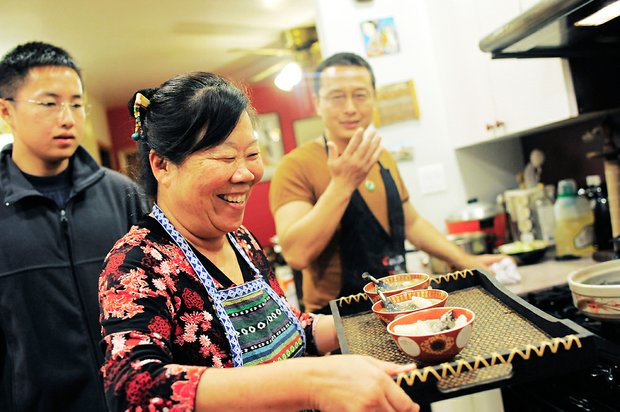
Hsiao-Mei Wiedmeyer carries a tray of black-bone chicken stewed with wild yam and goji berries to serve after Arthur Du and his son, Brendan, finished preparing the soup Nov. 12.
In March, Xinsheng “Arthur” Du came from China to Missouri. Since then, he has practiced his English and taught tai chi (Taiji) classes. In those months, he also has slowly built one flavorful stock for soups and other Chinese dishes. On Nov. 12, Du used some of his 6-month-old broth in his Nanking-style salted chicken wings for a multicourse dinner for eight in the home of Ray and Hsiao-Mei Wiedmeyer.
As good as it was, this broth was a little young, he said.
Du is from Nanking, Jiangsu Province, in southeastern China, where he knows of a brine preparation that is 100 years old. The stock, he said, is the heart of Chinese cooking. It is like gold. Each time it is used, something more also goes into it, so as the stock grows, the flavors within it become more complex.
Du also is building a new life. He wants to make Columbia his home and bring his wife here, so they can be near his only son, Brendan, 21, a student at the University of Missouri. When Hsiao-Mei met Du in July, she learned that in China, Du was a tai chi coach and a Chinese herbal expert. After he cooked for her, she was not surprised to learn he also was a “Class 1” chef and has managed five-star hotels in Nanking.
Hsiao-Mei, a retired chemist, grew up in Taiwan. She likes to cook Chinese food, and she holds on to many of the traditions. The ginkgo trees in her front yard were shedding their yellow leaves in November. She had just harvested the nuts and shared them with a guest. “The Chinese use these in cooking,” she said. “It is very mild and good for the memory.” When I arrived, Hsiao-Mei had been busy chopping garlic for Du. She was his cheerful sous chef for this meal.
Brendan also was in the kitchen, to help his dad and gladly sample any leftovers. He said he was happy to see his father finally doing what he loves, rather than supervising others who are cooking. Du enjoys teaching tai chi, and he also dreams of starting a sort of catered dinner-club business offering authentic Chinese dinners and — when called for — the narrative to go with them. After this meal, he found some avid fans of his cooking.
He had arrived in Hsiao-Mei’s kitchen on a Saturday, ready to spend the day cooking. He brought some of his stock, the sauces that had been simmering and his artfully carved vegetables that would serve as table decorations.
Most Chinese food in the United States is not authentic, Hsiao-Mei said as she followed Du’s instructions to chop the garlic and carefully line bitter melon slices and goji berries in the shape of a circle. Chinese-American restaurants adjust to American tastes, she said. Nothing wrong with that, she said. It just isn’t what the Chinese eat in China — or at home in Columbia, for that matter.
“The food must also look pretty,” she continued. “Color, smell, taste and presentation are all important.” Du picked up her bowl of carefully placed bitter melon, set a plate over it and turned it upside-down onto the plate, forming a gleaming green-and-red dome, which he topped with some minced garlic. It was very pretty, nearly as pretty as the chrysanthemum Du shaped from a daikon radish and the potatoes carved into roses. He used the edge of an aluminum Coke can to do the carving.
“He’s amazing; that’s all I can say,” Hsiao-Mei said as she watched her new friend cook, taste, plate, clean and clear the decks for the next dish.
Beauty and good health go hand in hand for this herbal expert. “The Chinese always have a good reason to eat a food — it is never simply for enjoyment,” Hsiao-Mei said, laughing. Du and Hsiao-Mei agreed good food is the best medicine for your body. And nothing beats “a good spirit and a good mental attitude,” Du added, via Hsiao-Mei. “Everything” in Chinese cooking “depends on the balance of hot and cold, the yin and yang,” she explained. “So it is important to eat in season, and the food should be as close to the natural and fresh state as possible.”
So why eat something such as bitter melon? It truly is bitter, reminiscent of the first time trying an aperitif such as Campari. “It is an acquired taste,” Hsiao-Mei said. Du advised — on the text of his menu — that eating this vine-grown fruit helps lower your blood sugar, strengthen the spleen, clear blood clots, improve eyesight and can fight cancer.
The goji berries in the dish serve as a nice counterbalance. They are mild and sweet — and, of course, offer a health advantage. “They are good for the eyes,” Hsiao-Mei said. “My husband says that goji tea helps his dry eyes.” Since Hsiao-Mei and Ray — who is not Chinese — came to Columbia in 1977, they have watched the Chinese community grow. They are both active members of the Mid-Missouri Chinese Association and the Columbia Friends of China, a cultural exchange program.
In fact, this “Eat Yourself Young” dinner was the result of a silent auction at the fifth annual Chinese Dumpling Festival, sponsored by Columbia Friends of China. Robin Remington purchased the meal by Du at the fundraiser and invited friends to join her.
After the guests were seated and the cold dishes were placed on the table, the couple offered their guests a small glass of Chinese rice wine. In Chinese culture, “when a family has a new daughter, they bury this wine in the jug,” Hsiao-Mei explained. “When she marries, they bring it out to drink at the wedding.”
The wine and many of these dishes proved a new experience to most of the diners.
And though some of the ingredients here — such as dried jelly fish — are not in mainstream markets, they are available in local Asian markets, such as Hong Kong Market and Chong’s Oriental Market.
Even then, certain items did not suit Du’s taste, so he improvised. “He thought the ducks were too fat in Columbia,” Hsiao-Mai said, so he substituted chicken wings for the 1,000-year-old recipe for salted duck — because he wanted it “tender and not greasy.” It was perfect.
Next, the diners tried the candy chestnuts with a very tender and thinly sliced roasted pork loin. And the health bonus? It said right there on the menus: “Proteins were good for Qi, or energy, sooth the digestive system and saliva production; reduce thirst and beautify skin.”
We were getting healthier with every bite.
The mixed black and white tree ears salad was a very tasty mushroom preparation and, apparently, a miracle food. The mushrooms improve kidney, lung, heart and brain function. “Black tree ear fungus is high in iron and great for people with anemia. It blocks fat absorption in food and is used in weight control. It can reduce the risk of stroke, cardiovascular disease and prevent gray hair,” the menu said.
Oddly, one of the “cold” menu favorites was the jellyfish and scallion. Having seen jellyfish in the Pacific, I was not keen on trying this dish. But this was dried jellyfish, so it took on a crunchy texture. In fact, it was a delicious, colorful salad that — by the way — “opens up blood vessels, lowers blood pressure, reduces intestinal bloat and aids digestion.” I was feeling great.
Master Du moved on to the hot dishes, beginning with the black-bone chicken that had been stewed for hours. It was served with wild yam and goji berries. The black-bone chicken is an actual chicken with very dark bones. And it is available at Hong Kong Market.
Guests raved over the flavor of this dish and the tenderness of the meat. In China, black-bone chicken is “known to contain essential amino acids and Lysine, which increase immune function. Wild yams invigorate the digestive system and strengthen the kidney function.”
The wok was getting a lot of kitchen time as it was utilized in both the stir-fry shrimp with a long-simmered red sauce and a sweet-and-sour perch with pickled mustard greens — my favorite combination. The crabmeat meatballs, or “Lion’s Head Yangzhou Style,” was prepared with a variety of ingredients, including ginger, green onions, pork and crab, which all simmered in broth for hours before the dish was served. It was melt-in-your-mouth good, and, naturally, Du noted, it was “reducing unwanted heat in the body, fortifying bone marrow, benefiting limb flexibility and aiding digestion.”
Even dessert was good for us. The tapioca and taro pearl ball in sweet rice wine would increase circulation and aid the spleen and stomach.
At the end of the meal, Du took a bow after his standing ovation. Then he returned to the kitchen to wash all those dishes.
Hsiao-Mei moved her guests to the living room and demonstrated the Chinese tea ceremony, in which two cups, a long cup and a short round one, are used. The hot tea is poured into the long cup and covered with the short bowl cup. Then the cups are flipped, and the tea flows into the short cup. The guests are invited to smell the fragrance in the long cup before tasting the tea. Hsiao-Mei showed her guests how to place the long, warm cup over the eye to soothe it. “Some people also roll the long, warm cup over the face to relax the facial muscles,” she told me later. “This is all part of the ritual to enjoy the tea.”
As Hsiao-Mei said, a great chef never measures; it is all in his taste and touch. Still, she did her best to translate and come up with recipes. Hsiao-Mei also makes the Chinese pork loin at her house. After consulting Du, she shared her versions of two recipes from the “Eat Yourself Young” menu.
CHINESE ROAST PORK LOIN
1/2 pork loin (about 2 pounds), cut lengthwise into 2-inch-thick strips
For the marinating sauce:
3 tablespoons soy sauce
1 tablespoon oyster sauce
1 tablespoon hoisin (seafood) sauce
2 tablespoons cooking wine
2 tablespoons sugar
1 clove garlic (minced)
1/4 cup honey
1/2 teaspoon salt
1 teaspoon five spice powder
1 cup water
Red food coloring (optional)
Mix all the ingredients for the marinating sauce in a small pot. Heat it until the sugar dissolves. Allow it to cool. Place pork loin strips in a container with a lid. Add 2 pieces of ginger root and 1 green onion, sliced. Pour marinade all over the loin strips; mix it so all meat strips are coated with sauce. Refrigerate overnight.
To bake: Preheat oven to 350 degrees. Drain the pork and reserve marinade. Line a long, rectangular cake pan with aluminum foil. Place the pork strips on a roasting rack above the cake pan — so there is air both above and below the meat. Roast the meat for 30 minutes. Turn it twice and brush the pork with honey mixed with 3 tablespoons reserved marinade. Roast 10 minutes and baste again. Roast 10 more minutes or until the meat is slightly crisp outside; do not overcook. Remove from oven and allow it to cool.
Serving suggestions: Slice pork strips crosswise and serve cold as appetizer. Cut the meat into small pieces and use it in stir-fry rice. Stir-fry sliced pork with green vegetables, such as pea pods and broccoli.
FISH IN CHINESE PICKLED MUSTARD GREEN SAUCE
1 pound of any firm white fish filet, such as perch, bass or cod
3 green onions
2 ounces ginger root
2 green peppers
2 eggs
1 cup frying oil
3 ounces pickled mustard greens (about 1/2 of a package; available in Asian markets)
2 tablespoons Chinese hot bean paste (available in Asian markets)
4 tablespoons rice wine (or dry sherry)
Cut fish filet into smaller pieces (about 3 ounces). Add 1 green onion cut in segments, 2 pieces ginger root, 2 tablespoons cooking wine, 1/2 teaspoon ground pepper and 1 tablespoon tapioca (or corn) starch. Marinate the fish for 20 minutes.
Sauté 2 tablespoons Chinese hot bean paste in 1 tablespoon oil. Add sliced pickled mustard greens, chopped green pepper, 1 tablespoon chopped green onion and 2 slices ginger root. Cook for several minutes, then add 1 cup water and bring the sauce to boil. Allow it to simmer for 30 minutes. Mix 2 eggs, 1/2 cup flour and enough water to make a dipping batter similar to the consistency of pancake batter. Dip the fish in the batter first, then in breadcrumbs. Pan-fry fish in oil until golden, about 2 minutes on each side. When the fish is ready, adjust the hot-and-sour sauce to taste. Add a pinch of sugar and ground pepper. Thicken the sauce with tapioca starch mixed in 2 tablespoons cold water. Pour sauce over the fish and serve immediately.