By Xie Chuanjiao and Wu Binbin
|
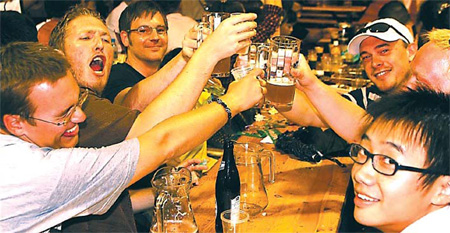
European tourists getting a sample of the city's beer delights during the Qingdao Beer Festival. China's entry into the WTO gave many cities and provinces a gentle push to increase their contacts with foreign countries. |
The city of Qingdao, Shandong province has made a historical leap in output and opening-up and has become an important regional center, 10 years after China's entry into the World Trade Organization (WTO), a city official told China Daily recently.
Most important, it is a manufacturing base and marine science and technology research center, as well as an Olympic city.
The city's gross domestic product (GDP) went from $20.7 billion in 2001, to $88.96 billion last year, and per capita GDP is expected to surpass $10,000 this year.
Liu Mingjun, director general of the municipal development and reform commission, has been a witness to the decade of changes, and explained to China Daily that, "The WTO entry injected new growth power into the city, bringing steady development. It also pushed our industrial adjustment and increased our competitiveness."
Foreign trade has been another beneficiary, with imports and exports worth $56.15 billion in 2010, compared with 2001's $12.36 billion, for an average annual growth rate of 18.3 percent.
The amount of utilized foreign funds reached $2.84 billion in 2010, almost twice the 2001 figure, and Qingdao is now working on projects with 80 global Fortune 500 companies.
Liu said that, despite the challenges China faced with WTO membership, it has faced some serious tests that in fact greatly improved its competitiveness with some international experience and more active involvement in global labor issues.
In the area of structural adjustment of its industries, the city has gradually shifted its focus from its labor-intensive textile and food processing to capital- and technology-intensive areas.
These include ship-building, automobiles, and trains as well as financial and science and technology information services.
To grow in the financial sector, it has worked more closely with other countries and brought in some foreign financial institutions.
By now, it has 24 foreign financial institutions, compared with only eight, 10 years ago. And, seven of its own enterprises have been listed overseas.
"We've closely followed global industrial trends in areas such as information software and service outsourcing," Liu added.
The city now has some major enterprises with great influence not only in China but abroad as well and is cooperating more with international companies. This has further improved the competitiveness of local companies in international markets.
Some of the cooperative relationships involve Haier and Sanyo; Tsingtao, Budweiser and Asahi beer; Hisense and Sumitomo; and the port of Qingdao and Maersk.
Tsingtao is now one of the top 10 brewers in the world, while Haier is China's leading manufacturer of white electrical appliances. At the same time, Hisense is the only Chinese company that holds three prominent trademarks.
"As we implemented a globalization strategy, we made full use of both Chinese and overseas markets and resources, and took innovation very seriously, building brands and developing a number of large transnational companies," Liu went on to explain.
One example of these results is the Haier-Luba economic cooperation zone, the first zone of its kind with a presence abroad. Then there is the Qingdao Construction Group, which ranks among the top 225 companies of its kind in the world.
And, MESNAC has built a rubber and tire research center in Europe, the first such effort for China, while the Double-star Group has 10 overseas branches.
From China Daily


