China opens wider to takeovers


Antitrust Regulators Clear Nestlé's Candy-Maker Purchase, the Latest Foreign Acquisition to Gain Approval
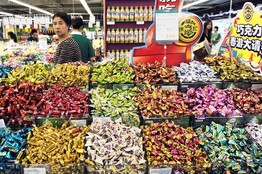
European Pressphoto Agency
Hsu Fu Chi snacks on display in a supermarket in northeast China
BEIJING—China's antitrust regulators approved Nestlé SA's $1.7 billion offer for candy maker Hsu Fu Chi International Ltd., in one of the largest foreign takeovers of a Chinese company.
It is another signthat China is open to foreign acquisitions.
The Swiss food and beverage maker in July announced plans to buy 60% of Hsu Fu Chi in a deal that valued the Singapore-listed company at 3.5 billion Singapore dollars (US$2.7 billion). Buying the stake helps Nestlé gain on rivals in a fast-growing confectionery market by opening new distribution channels and tapping directly into local tastes.
The approval came less than a month after antitrust authorities approved a plan by Yum Brands Inc. of the U.S. to buy hot-pot restaurant operator Little Sheep Group Ltd.
"China is now saying that it's open to multinational companies," said Frank Schoneveld, a Shanghai-based partner at law firm McDermott Will & Emery.
In the past, antitrust authorities have signaled that the closer foreign companies get to acquiring Chinese retailers or consumer companies, the more difficulties they will face, Mr. Schoneveld said. A bid by Coca-Cola Co. of the U.S. in 2009 to purchase juice maker Huiyuan Juice Group Ltd. was rejected on the assumption that Coca-Cola would crowd out smaller rivals and potentially monopolize the juice market, even though the two companies combined held only 20% of China's juice market.
But lately, a number of foreign takeovers have been approved. The Ministry of Finance and Commerce in September approved Nestlé's bid for a 60% stake in China's Yinlu Foods Group Co., a privately owned drink and porridge maker. Regulators in June approved U.K.-based liquor giant Diageo PLC's takeover of a top Chinese white-spirit maker, though the clearance came about 16 months after the deal was announced.
China's antimonopoly laws are no longer being used as a protectionist tool, said Marc Waha, a partner at law firm Norton Rose, who is based in Hong Kong.
"China's regulators are now attempting to present a level playing field for foreign and domestic companies," Mr. Waha said, adding that in the past month, Chinese authorities have a stricter stance toward the country's own corporations.
China's National Development and Reform Commission last month began an investigation of two major state-controlled companies over alleged monopolistic business in the market for broadband Internet service. The Ministry of Finance and Commerce approved a joint venture between General Electric Co. of the U.S. and state-owned China Shenhua Energy Co., applying conditions predominantly to Shenhua.
The Nestlé approval makes the food giant the second-largest confectionery company by sales in China, after Mars Inc. of the U.S., according to market-research firm Euromonitor. Nestlé, which already sells a chocolate-covered wafer bar called Crispy Shark in China, will be moving into less-familiar territory. Hsu Fu Chi, founded in 1992, makes Chinese treats: cookies flavored like cucumber, and sweet onion, as well as hawthorn- or lychee-flavored gelatin custards that are sold in cups the size of ping-pong balls and slurped by Chinese children.
Analysts said the deal will open Nestlé to new distribution that will help the company influence a small-but-ballooning candy market. China's 1.34 billion people ate 13.7 million metric tons of candy last year, according to Euromonitor. That is slightly more than half the 26.8 million tons eaten by the 310 million U.S. consumers.
Annual sales in China's confectionery market—including chocolate, candies and gum—climbed 63% to more than US$9.2 billion from 2005 to 2010, according to Euromonitor.
Nestlé plans to delist Hsu Fu Chi from the Singapore Exchange.
Hsu Fu Chi, which is based in the southern Chinese city of Dongguan, indirectly will hold the remaining 40% stake, the company said on Wednesday.