Wrapped up in China


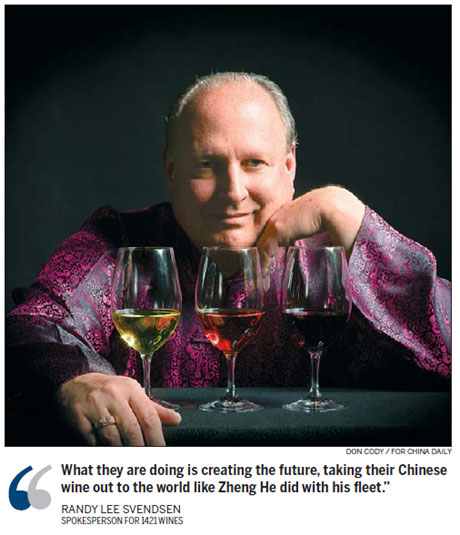
A Chicago bon vivant finds a new life in the Middle Kingdom's history and wine, Irene Deng reports.
Sipping tea in the lobby of a fine Beijing hotel, Randy Lee Svendsen stands out. In a setting full of Chinese businessmen in Western-style suits, the big Chicagoan sits back on a brocade sofa in his trademark Tang suit, blue with gleaming gold cuffs.
Svendsen, 61, wears his Tang suit everywhere in and outside China, even on this cold winter afternoon when he needs an overcoat on top.
"The Tang suit is my symbol, my trademark - I look slimmer in it," says Svendsen, proud of his collection of more than 20 of tailored Tang suits. The big Chicagoan is just back from Las Vegas, where he had packed up his possessions for a "move" to Beijing despite living here for a decade. "This time," he says, "it's forever."
Until now, Svendsen has been living in and out of hotels around China. He writes a column for a Chinese hotel magazine, contributing reviews of fancy hotels and restaurants.
That's a life his father used to give him a hard time about. "We are simple people," his dad said. "Where did all this fancy living come from?"
But Svendsen says he got his first taste of the high life thanks to his dad, a one-time fighter pilot who was stationed in Japan when Randy Lee was a youngster.
"I spent a lot of time in the officer's club," he says with a smile. The taste he developed for good food and drink then stands him in good stead now: Besides his writing for the hotel magazine, he is the spokesman for 1421 wines, dedicated to promoting the first traceable wine produced in China.
If that life seems like all about fun, food and wines ("I'm having a ball," Svendsen admits), his previous life has been a little more mundane. Graduating with a bachelor's degree in psychology, Svendsen started selling motorcycles until the age of 26, when his father talked with him seriously about his career plan. The young man then found work in military procurement, first buying missiles for the US Navy in Washington DC, and later procuring components of fighter planes, other aircraft and radar systems for a private military contractor.
"It was very exciting. We were always doing things that have never been done before. The technology was pushed by what we were doing - really fascinating," says Svendsen.
A four-nation business trip to Asia threw Svendsen back to this side of the world, 34 years after 9-year-old Randy Lee went to Japan with his father.
"In Singapore, after taking a walk around and hearing the Chinese talking, I realized I made a mistake in my life. I was supposed to be on this side of the world. I can't go back," says Svendsen, who says he found himself surprised to be engulfed in a physical emotion.
A six-day stay in China during a 1999 business trip to Asia solidified his thinking. He tried snake at his first dinner in China, and ultimately visited Shanghai, Wuhan, Chongqing and Beijing.
"I just knew I needed to be in a developing economy. Europe is done. The US is done. Japan is done. I need to be on the mainland," Svendsen says.
From then on, Svendsen tried his best to get transferred to China. He even went back to school, obtaining a master's degree in international management focusing on Southeast Asia economy at Rensselaer Polytechnic Institute at Hartford, Conn.
He struggled to get himself transferred to China, working for five different companies that could provide him an opportunity to China. All of them failed and finally he told himself, "I'm bringing myself to China."
Returning to the Middle Kingdom in 2003, Svendsen started studying Mandarin, Chinese art and Chinese history. He spent five years reading The Cambridge History of China, an ongoing series which has now published its 13th book. He is obsessed with Chinese history and still reads it on the long flights he regularly takes between China and the US.
"When I finished the Qin and Han dynasties, the next books in the series were not finished yet. I called the publishers and asked 'What I can do?', and they told me to jump ahead to the Sui and Han dynasties."
Svendsen said the same thing happened again later and he was told to move ahead to Song Dynasty.
He has also bought and read 12 books on Admiral Zheng He, who led a series of unprecendented voyages to the West during the Ming Dynasty (1368-1644). That made Svendsen's recent sign-up with the 1421 wine company a smooth move. The wine was named after the year the admiral started his grand voyages.
"What they are doing is creating the future, taking their Chinese wine out to the world like Zheng He did with his fleet," says Svendsen.
In his latest obsession with Chinese history, Svendsen has assigned himself a 10-year project: to have a female Chinese artist paint portraits of the 100 most famous women in Chinese history. He got the inspiration from the four beauties in China.
"It's a long-term project. I can't start it until I have the commitment to the artist. I have the money in the bank in case something happens to me, so she can finish it," says the 61-year-old.
Svendsen's decision to move his home here and live in China "forever" gets understanding and support from his family, including his two sons.
"I'm not here to seek fortune. If I can make a living in China, that's great. But I come here for more reasons," he adds.