One town's indomitable spirit


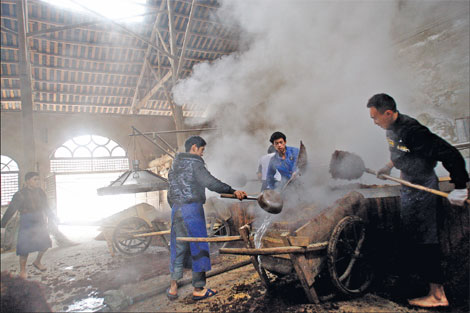
A large number of locals work for distilleries in Maotai. [Zhang Wei / China Daily]
More than half the population of remote Maotai produces the legendary national liquor of China
If Maotai, the clear Chinese spirit that is also the national liquor of China, ever needed a spokesman, 34-year-old Zhao Yingcong would be a shoe-in. "Every Chinese believes drinking the proper amount (of Maotai) is good for health," says Zhao, a resident of Zunyi in Guizhou province. "It may get you drunk, but you never have a headache the next morning."
Across China, drinkers are reveling in Maotai, classified as a sauce-fragrance baijiu (white spirit) because it has a soy sauce-like aroma that lingers in the mouth. There are more than 10,000 tons of the pure and mellow liquor produced annually. It has been the drink of choice in many historic occasions in China. In 1984, during the signing ceremony for the handover of Hong Kong to China, Deng Xiaoping and Margaret Thatcher toasted over Maotai.
But in a country of more than 1.3 billion people, what most drinkers around the world don't know is that more than a third of the output is made in a small town of about 42,000 aficionados of baijiu. Of the 42,000 residents in this town, half run a business that sells or produces the fiery spirit.
The town, of course, is called Maotai.
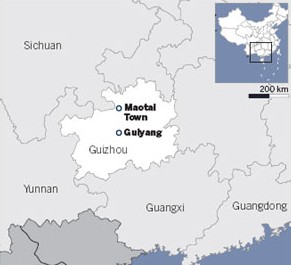
In this town, located in the city of Renhuai in the southwestern province of Guizhou, there are 144 licensed liquor manufacturers, says Ni Kelong, a press officer with the Maotai Town government. Because of the massive production of both Maotai and other types of baijiu, the town had a per capita income of nearly 7,000 yuan ($1,100, 840 euros) in 2011. That ranks higher than most towns in the province.
The main producer of Maotai that has contributed to most of the town's per capita has also somewhat taken the namesake of the liquor: China Kweichow Moutai Distillery Co. Most Chinese people, however, call the brand by (take a quick guess) Moutai.
The company distinguishes itself with a different spelling of the pungent liquor.
"More than 8,000 locals (in Maotai) are working for (the distillery)," Ni says.
Guizhou province has a very long history of producing wines and liquors but in the remote town of Maotai, locals have been dedicated to producing China's most successful baijiu for the past decade.
The current liquor culture emerged in Maotai in the 1930s, when the town was a transport hub for the trade of salt along the Chishui River that runs through the town. "Salt dealers from Shaanxi and Sichuan provinces traveling along the river found this wonderland, spread the liquor culture and even settled business here," Ni says.
The town is surrounded by three mountains with the Chishui dividing the basin into two parts. This valley produces the ideal humidity and temperature to make the liquor.
One of the reasons why this special type of liquor has become a favorite in China is because of the unique process involved in making Maotai. Sauce-fragrance liquor generally is produced from rough alcohol made with high-quality wheat, locally produced sorghum and water from the Chishui. The traditional method involves at least eight cycles of fermentation and nine rounds of high-temperature distillation under strict conditions before the batches are stored in jars.
Normally, producing a qualified batch of sauce-fragrance liquor needs at least five years - one year for production, three for storage and another year for storage after it's been blended. The liquor is always preserved in ceramic jars that weigh 15-50 kilograms each. The finished sauce-fragrance liquor is only allowed to mix with the same type of liquor but never with water or edible alcohol, like ethanol. This guarantees a consistent taste, especially when food security has become a top concern in China.
 With the production process perfected, the liquor industry has grown in recent years. The town's small- and medium-sized baijiu companies produced some 70,000 tons of the sauce-fragrance baijiu in 2011, nearly tripling the output of Moutai.
Ni says that 20 years ago there were only 20 or 30 producers in town that made the sauce-fragrance liquor. The number has since grown after 2000 and has increased by 40 percent annually since 2008.
The major producer in town, China Kweichow Moutai Distillery, has a market capitalization of approximately 194 billion yuan as of Jan 30. Its closest rival, Wuliangye Yibin Co, which also makes its own style of baijiu, has a market cap of 136 billion yuan.
In the first three quarters of 2011, Moutai's sales reached 13.6 billion yuan, 46 percent higher compared to the same period in 2010.
"Even Australian and South Korean tourists bought my liquor," says 26-year-old local dealer Yu Langhua.
According to the China Alcoholic Drinks Industry Association, sauce-fragrance baijiu makes up 20 percent of China's spirit market, with another type of baijiu, known as heavy-fragrance, dominating at 60 percent market share. But Chinese Wine News, a government-funded paper, said the market for sauce-fragrance baijiu will grow at 40 percent annually and will take up more than 30 percent market share in sales and profits by 2020.
"As long as your product's quality is good, it's zero-risk in managing the sauce-fragrance business as it will definitely appreciate in the market," says Yang Guangyong, 42, who came from Chongqing municipality and has benefited from the baijiu boom. He says many wholesalers from eastern Shandong and Zhejiang provinces have invited him to set up sales outlets in their regions this year.
Boosted by the strong demand and growth, investors, such as the Tasly Group (an investor in the medical healthy industry) and the Hubei Yihua Group, an investor in petrochemical companies, have established factories in or nearby Maotai to produce baijiu.
Outside investments have reached 10 billion yuan and it is estimated to surpass 50 billion yuan during the period of the 12th Five-Year Plan (2011-15).
"We are considering establishing a sauce-fragrance baijiu production zone to attract more tourists and public attention," says Zhao Shengchun, deputy Party chief of the town of Maotai.
The explosive liquor industry has not only boosted the town's economy but has also raised living costs in surrounding areas such as downtown Renhuai.
"We have limited land resources," Ni says. "You see vehicles running through and wealthy people working here, but the living environment doesn't match the business scale here."
Ni says many residents from older generations have moved to Renhuai, though the highway system between city and town has gradually improved. "People who have made money from the liquor business have sought a more comfortable life," Ni says.
Garment dealer Yu Mei, 41, who came from Luzhou, Sichuan province, 10 years ago, says she has seen the dramatic rises in costs of living in Maotai. "Labor cost was negligible in year 2000, but I have to pay 4,000 yuan per month for an experienced worker now."