China drinks in wine success


A surprising newcomer is challenging European supremacy in fine wines.
A Chinese wine was launched yesterday in Beijing for 900 yuan ($142) per bottle. Some already consider that price outrageously high, others woefully low. If the price sticks, this could mark the emergence of Chinese wine into the realm of fine, high-price wines, which are predominantly French.
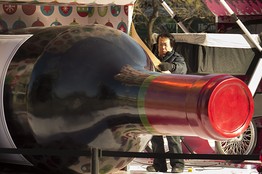
European Pressphoto Agency
The vintage in question, Jia Bei Lan 2009, last year shocked experts when it became the first Chinese wine to win an "international trophy" in Decanter magazine's World Wine Awards in London, and in a category for wines made with Bordeaux grape varieties, no less. Given the general global disdain toward wine from China, this not surprisingly resulted in suggestions the contest was either fixed by the magazine or the wine was fake—that is, a French wine in a Chinese bottle.
Never mind that Jia Bei Lan had won the regional Decanter contest for the "Middle East, Far East and Asia" last year, or that it then beat the other regional winners in a blind tasting in London. Or that chief consultant Li Demei studied wine in Bordeaux, interned at well-regarded operation Chateau Palmer there and has over 15 years of experience. Or that the winery responsible—Helan Qing Xue in Ningxia province, west of Beijing—has been making wine since 2005. (I have visited twice and tasted wines from 2005 on). It just seemed to be beyond belief that a Chinese wine could perform this well.
This attitude was at least partly due to ignorance. Few outside China have heard of Ningxia, let alone of Jia Bei Lan or the wine maker Mr. Li. Perhaps they also didn't know that while plenty of Chinese wines are subpar, some have done well in Decanter contests for years.
Even leading critics like America's Robert Parker and England's Jancis Robinson have favorably reviewed Chinese wines. Australian wine writer Jeremy Oliver tried Jia Bei Lan in Beijing a few months ago and gave it a tentative—because the official launch was yet to come—19 out of 20 points. Those who follow the wine scene in China, and have tried what worthy operations such as Grace Vineyard in Shanxi province and Silver Heights in Ningxia produce, were less surprised by Jia Bei Lan's success.
Another cause of the disdain and shock is pricing. It's true that Decanter listed the retail price of the wine at 130 yuan, one-seventh of what it is now being released. But more broadly, some think the wine should continue to carry a low price, or it risks ruining the feel-good story of a hard-working team in a distant Chinese region beating the odds and showing the world something new. There are also concerns a big price tag will make the wine inaccessible to most consumers, might lead to price increases for other good Chinese wines and, quite simply, looks crass. After all, as one distributor asked me last week, is any Chinese wine worth 900 yuan?
I empathize. Last December in Beijing, I co-organized a contest for Ningxia and Bordeaux wines that fell in a similar price range. The price we listed for Jia Bei Lan, which beat all of the Bordeaux wines, was 260 yuan. If I ran that contest again today, I wouldn't include it—it would be too expensive.
But that doesn't mean no Chinese wine is worth 900 yuan. For many people part of drinking a wine is its story, and Jia Bei Lan's will be the plucky outsider who challenged the international status quo. And things could get better: Mr. Li has three more projects up his sleeve.
There's also a supply issue. The distributor handling the launch, The Wine Republic, has just under 5,000 bottles, with the winery using the rest mostly for distribution in Ningxia. Wine Republic General Manager Campbell Thompson has targeted about 50 hotels, restaurants and retailers to distribute half of the wine. Since most of those bottles will be consumed on the spot, only a few thousands bottles are likely to find their way into the hands of collectors and connoisseurs. In a country of China's population, that makes this virtually a one-in-a-million wine.
In fact, given Jia Bei Lan's award and limited supply, it's surprising the price isn't higher. Last year, I visited a winery in Shandong and my jaw dropped when I saw a bottle of 2005 for 27,998 yuan. Why such a high price for a recent wine from a relatively unknown winery? Only 5,000 bottles were made, I was told. Given that case and that the first vintage of Yao Ming's wine is 1800 yuan or that a bottle of "special edition" Pabst Blue Ribbon is 300 yuan, is 900 yuan really so much for a history-making bottle of wine—one that in my humble opinion tastes good? No. Ultimately it will be too little. Don't be surprised to see that price double and then double again.
The big question will be finding a bottle. And that is the greatest irony: Where Jia Bei Lan was once the source of accusations of being a fake, it will now be the target of many counterfeiters who will seek to take advantage of its success.