Hidden Hong Kong


 When I first moved to Hong Kong, I was one of sixteen US university graduates sent to teach English at a tertiary institution. One night a friend and I, both from the American Midwest, a place known for corn fields, wide-open sunsets, and running barefoot, took a walk around our campus in the New Territories. We paused halfway through and peered down into a small village in the middle of low trees and brush. Behind us the dark mountains separating the New Territories from Mainland China were dimly lit by the light pollution from the rest of Hong Kong. A sharp dog bark echoed in the saturated air; a bonfire burned in front of a hut, adding to the all-enveloping humidity.
“It’s funny,” my friend said to me, gesturing to the wooded area below. “When I left for Hong Kong, my dad said, ‘Guess you’re going to miss a lot of things…like trees.”
It is a common misconception that Hong Kong is solely a mélange of flying skyscrapers, concrete slabs through which men in suits dart back and forth in their financial pursuits. In particular, since I have come to LSE, I realized the place it occupies in most people’s minds is the financial center of Asia, another place to work alongside London and New York. I do not blame them; the Hong Kong government is proud to tout it as “Asia’s World City” and the breathtaking night skyline from Victoria Harbour is a testament to cosmopolitanism that deserves to be admired in books, movies and on the Internet.
But the thing is, that is not all. After living there for three years, I realize my favorite thing about Hong Kong is its ability to be anything to anyone: remote beach town, nightlife hotspot, culinary destination, hiking paradise.
Most people do not realize Hong Kong is actually made up of four regions. The New Territories, the most northerly region, borders Mainland China; then going south there is Kowloon, home of the famous Victoria Harbour with eye-popping views from the Star Ferry and then Hong Kong Island, land of the Peak and, yes, skyscrapers, including the famous IFC 2 which Batman jumped from in the Dark Knight; finally the most southerly region are the Outlying Islands, where no cars are allowed, which are to the south and west of Hong Kong Island. With the efficient Hong Kong transit system, you are never more than an hour away from visiting any of these areas.
If you are ever in Hong Kong, I definitely suggest a visit to any of the Outlying Islands, which you can reach in as little as 35 minutes by ferry from Hong Kong Island. One of my favorites is Cheung Chau, a small island where a long line of al fresco eateries meets you right by the pier. These food courts, called dai pai dong, can either be outside or inside but on a beautiful day, you definitely want to partake in seaside dining. The surroundings are humble – plastic sheets over large round tables seating eight or so, plastic patio chairs and plastic orange bowls – but the food is sumptuous. Enjoy plates of steaming fresh oysters on a bed of green onions, tiger prawns and toasted garlic, served, of course, with a big bottle of Tsingtao beer with your closest friends as the locals happily chatter in Cantonese around you.
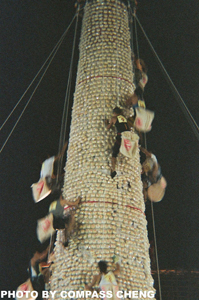
Afterwards, stroll around the quaint island which boasts two beaches. Cheung Chau is especially popular for the week-long Bun Festival in the spring, which commemorates the god Pak Tai ridding the island of plague during the late Qing dynasty. There are lion dances and parades and it culminates in a scramble to the top of a conical tower of Chinese steamed buns. This combination of nature, delicious cuisine, and culture is hard to beat.
After gorging on great food, you can walk it off on any of the breathtaking hikes in Hong Kong. One easily accessible and stunning trail is Dragon’s Back on Hong Kong Island. Start at the legendary Peak Tram and cross the ridges into Shek O Country Park. Suddenly you are overlooking the south side of the island with open views of Big Wave Bay, sheltered by verdant hills and fringed by a long strip of white sand. Similar vistas surround you at the trail’s end when you finish in fishing village Shek O, home to one of my favorite beaches.
If Shek O is too crowded for you, head north to the New Territories to find one of the most remote beaches in Hong Kong. Begin at the bottom of the MacLehose Trail, a 100-kilometer long trail through the region. You can either hike the 13 kilometers to Long Ke Wan, the deserted beach, or cheat and take a cab for ten of those kilometers. At the end of the road, hike some stairs over a mountain dotted with low bushes that shake in the wind as the sun beams down. As you turn a corner near the top, below you a sliver of white sand appears, enclosed by heavily wooded hills. The water can only be described as azure, and on a weekday there is most likely not a single soul on the beach. It is a welcome respite in a city with a population density of 6,300 people per square kilometer.
So, whether you’re an urban jet-setter or nature enthusiast, I guarantee Hong Kong has something to entertain you. And as I look back at my time in the city, I realize, yes, I had many fun nights going out in Lan Kwai Fong, blowing my budget in one of its multi-story, city-block-swallowing megamalls and dining at the endless buffets atop towering hotels. But three years later, what stands out in my mind are the cultural and natural surprises – the hidden back streets and winding trails that took me to another side of Hong Kong. Now, when I think back to that walk my friend and I took three years ago, I remember what I said to him as we looked down at the wooded village: “Yeah, “ I replied with a wry chuckle. “I miss trees too.”