Consumption of premium liquor on the rise in India


Bangalore: Mahesh Patel, a whisky collector, paid $94,000, or about Rs. 47 lakh, last week at a charity auction in New York for a bottle of Glenfiddich Janet Sheed Roberts Reserve, a rare 55-year-old single malt Scotch.
Some months ago, in separate instances, two Indians bought two limited luxury edition bottles of Dalmore 64 Trinitas, worth £100,000 each. Another connoisseur in India forked out a fortune on two bottles of Dom Pérignon of 1969 vintage for someone born that year.
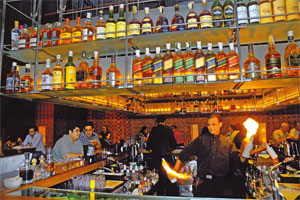
Lucrative market: In the first nine months of 2011, Scotch exports to India touched £35.3 million, according to the Scotch Whisky Association’s website.
Increasingly, bars at homes in India are seeing fancy, luxe brands added to the cabinet. Even liquor stores no longer stack just rows and rows of Bagpiper and McDowell, which are value whisky brands. Premium brands are prominently displayed, but luxury labels, considered a rung above, are found only at select liquor vends.
Aparna Batra, marketing director, India subcontinent, at the Scotland-based whisky maker William Grant and Sons, is not comfortable with the distinction between luxury and premium. “Luxury has been democratized,” she said. “It is really what we aspire for, and when we succeed in getting a slice of that experience, that’s luxury.”
William Grant and Sons, the maker of Glenfiddich, Grant’s Balvenie and other top brands, and which held the auction in New York, is expanding its portfolio in India.
Some months ago, the company launched in India a Glenfiddich variant called Snow Phoenix and will shortly launch Age of Discovery in the country.
A Glenfiddich or a Johnnie Walker Black Label costs Rs. 3,000-5,000 or more, depending on the vintage, and consumers such as Vinod Narayanan, 28, a Bangalore-based information technology professional, don’t mind the price tag. “I’m not a frequent drinker, but when I do, I like to savour the taste of a single malt,” he said.
It is people such as Narayanan who are driving Scotch whisky to India. In 2010, 40% more Scotch whisky was shipped to India than in 2009, at an estimated £40.1 million. Although the complete annual data is not available, in the first nine months of 2011, Scotch exports to India touched £35.3 million, according to the Scotch Whisky Association’s website.
Rising incomes are leading middle-class India to splurge on luxury and premium spirits, prompting international liquor makers to ramp up offerings in the lucrative segment. Many of them are tying up with domestic firms for distribution.
According to market researcher Euromonitor International, the single-malt category grew 20.38% in India last year. Volumes in luxury blended Scotch, which is cheaper to make and accounts for 26% of the total whisky consumption in India, grew 23.2%.
“Luxury liquor is outperforming mainstream standard brands,” said Harish Moolchandani, chief executive of Beam India, the local arm of the US-based Beam Global Spirits and Wine Inc. that makes the premium blended Scotch brand Teacher’s.
In November, the whiskey producer launched Teacher’s single malt at about Rs. 4,000 a bottle in India. The category is growing at 30% for the company in the country. Around the same time, it also launched Teacher’s 25 year old, a blended Scotch priced at Rs. 26,230, in Delhi.
“This year we will aggressively activate these brands,” said Moolchandani.
Vijay Mallya’s United Spirits Ltd, the world’s second-largest spirits company by volume, and which in 2007 bought Whyte and Mackay to get access to some of the world’s finest Scotch, recently launched Dalmore, a 15-year-old single malt priced at Rs. 7,000 a bottle, in India.
“More launches from the Whyte and Mackay portfolio are on the anvil,” said a company spokesperson. In the quarter ended December, United Spirits’ Scotch segment grew 23%, while its mass segment contracted 3%.
In April last year, Japanese company Suntory Ltd signed an agreement with India’s second largest liquor maker, Radico Khaitan Ltd, to distribute its range of Yamazaki 12-year-old single malt and Hibiki, a 17-year-old blended whisky, in India.
The fact that more Indians are consuming high-end liquor is borne by numbers offered by the Maharashtra excise department. According to it, premium and super-premium brands have seen a growth rate of around 7%, while mid-priced Indian-made foreign liquor has contracted 10%.
“Johnnie Walker, Teacher’s and Heineken beer are some of the highest selling brands,” said Mohan Varde, superintendent of excise, Mumbai city.
Typically, Indian whiskey is considered inferior as it is made from molasses, and not grain or malt that go into making genuine Scotch. But foreign liquor companies are increasingly facilitating awareness and experimentation among Indian consumers. Diageo, William Grant and Sons, and Beam Inc. have been conducting Scotch-tasting sessions in Mumbai and Delhi.
Organized retail is also playing a part. Over the past year, many exclusive liquor stores have sprouted across metro cities. Hypermarkets, too, have exclusive liquor areas.
“The segment is growing rapidly with consumers moving up as the youth are becoming more aware,” said Abhishek Malhotra, head of consumer markets at consulting firm Booz and Co.
Spirits companies are also focusing their attention on luxury vodka. New Delhi-based NV Group tied up with France’s Belvedere Group to launch Sobeski, a premium vodka, in India in November 2010. New entrant Modi Illva India Pvt. Ltd, a joint venture between the Umesh Modi Group and Italian firm Illva Saronno, introduced an Italian luxury vodka called Artic in February 2011.
“2011 saw so many new launches of luxury brands by both domestic and international players,” said Sunitha Barlota, research analyst, Euromonitor International. “Luxury liquors are benefiting from greater disposable income and increased social drinking.”
According to AT Kearney India, the luxury spirits market accounts for a mere 0.8% of the $2 billion alcoholic beverages market in India. But it is growing fast and is expected to reach 1.5% of the total market by 2015, the consulting firm said in a 2011 luxury review published in association with the Confederation of Indian Industry, a trade body.
While this fast expansion isn’t likely to stop any time soon, there are some stumbling blocks global liquor makers will have to contend with. Per-capita consumption of alcohol in India, while on the rise from 2.9 litres in 2007 to 3.7 in 2010, is well below that in other key emerging markets. In Russia and China, per capita consumption is 16 litres and 8 litres, respectively, according the AT Kearney report.
Also, duties for imported liquor are still too steep in India, said Neelesh Hundekari, principal and head, luxury and lifestyle practice, at AT Kearney India.
Imported Scotch attracts a 150% Union government tariff. In addition to this are state duties on imported whiskey bottled outside the country. So, a 750ml bottle of Johnnie Walker Black label costs Rs. 3,400 in Bangalore, of which more than half is on account of the levies.