An affair to remember



Australian offerings have endured a roller-coaster relationship with overseas drinkers. Now the scent of romance is back in the air, writes London-based Jancis Robinson.
FOR every action there is an equal and opposite reaction. When Sir Isaac Newton devised his third law, he probably wasn't thinking of Australian wine but he could have been. After the world's most enthusiastic wine importers fell rapturously in love with the well-made, user-friendly wines of Australia, those who made them can hardly have foreseen that they would fall just as resoundingly and as rapidly out of love with them.
Australian wine has been involved in two main love affairs - with British and American drinkers, respectively - and the character and timing of those affairs has been markedly different. Australian wine had a presence in Britain from way back in the fortified era of the Emu brand. I remember seeing dusty bottles of Ben Ean in the oddly sited Australian Wine Centre flanked by sex shops in London's Soho way back in the 1970s.
Then came various distress parcels of surplus wine - jauntily labelled things such as Kanga Rouge and Wallaby White - that showed wine-loving Brits that Aussies were now making keenly priced table wines. But the big breakthrough came only in the late 1980s and '90s when importers, concerned about the strength of the US dollar, sought replacements for the California wines that had introduced British drinkers to varietal wines and to a world outside Europe.
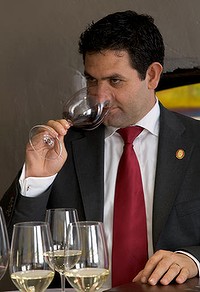
The Fat Duck's wine master, Isa Bal.
This coincided with the effective work of the human dynamo that is Hazel Murphy at the helm of the generic body in London's Australia House. At times it seemed as if there could be no Aussie winemakers in Australia, so many of them having flocked to London and other British cities to spread the gospel of shiraz and luscious golden chardonnay.
By the 1990s, Australian wine was the British favourite. In terms of volume sold, it even overtook French labels. In terms of affection generated, no other country could touch Australian wine. We loved how reliable it was, how technically perfect (in stark contrast to the dreaded ''dirty French wine'') and how easy it was to appreciate its bumptious, sunny oakiness.
But in the noughties, the zeitgeist changed. Dirtiness, or at least funkiness, began to be seen as a positive attribute in wine. Predictable technical perfection came to be seen as b-o-r-i-n-g. Australian winemakers were pigeonholed as slightly sinister manipulators of nature, in stark contrast to the men of the soil who supposedly characterised Europe's vignerons. This caricature was encouraged by the agglomeration of Australian wine companies into just three big, apparently greedy corporations, which then, perhaps predictably, imploded into inefficient, badly run monoliths, leaving little room for the sort of ocker mateyness that had won so many hearts over a drink in a Fulham pub.
By 2005, anti-Australian sentiment among European cognoscenti was running so high, fuelled by the myths peddled in the film Mondovino, that I wrote the first of several articles designed to counter the prevailing belief that all Australian wine was ''industrial'' while all French wine was somehow pure and artisanal.
Now, seven years later, I detect a slight turning of the tide. My fellow British commentators are at last more likely to highlight the best wines of the great dynasties of Australian wine and, especially, those of the new wave of Australian artisan winemakers, than to complain about the homogenisation and deterioration of the boring brands that still dominate our supermarket shelves. (A succession of tax increases on wine in Britain has diluted mass-market wine quality across the board but particularly of wines priced in a rock-hard currency such as the Australian dollar.)
British wine importer David Gleave MW, a Canadian by birth, deserves special praise for sticking by his Liberty Wines stable of fine, individual Australian wine producers through thick and thin. But fine Australian wine is still seen as something of an oxymoron in Britain's better restaurants. At Heston Blumenthal's the Fat Duck, for example, the (Turkish) master of its admirably wide-ranging wine list, Isa Bal, says: ''Until three to four years ago, Australian wines were very well-received, but the enthusiasm started to fade and nowadays some of our current Australian listings are as fallow.''
It can be even more difficult to sell fine Australian wine in the US today. The staggering commercial success there of Yellow Tail, which accounts for almost half of all exports of Australian wine to the US by volume, has left most Americans with the impression Australian wine is sweet, cheap and adorned with a ''critter''. As for the US's love affair with high-end Australian wine, this was both more recent and more intense than its British counterpart and, as Newton would have tipped, the aftermath is even more bitter.
By 2007, powerful critic Robert Parker had fallen hook, line and sinker for a series of special bottlings - notably of late-picked ''blockbuster'' South Australian shiraz - that seemed to have been designed expressly for his palate, many apparently made almost exclusively for specialist US importers. They were virtually unknown in Australia but garnered rave reviews in the Wine Advocate magazine, so US collectors snapped them up. But so many were disappointed by their lack of subtlety and keeping qualities that it has affected the reputation of all serious Australian wine, which is struggling to make a positive impact on the US market, regardless of how assiduously Wine Australia courts US sommeliers - whose influence there is waxing, while that of wine writers wanes.
Of all the international representatives of Wine Australia, I think Angela Slade in New York must have the toughest job. Lucy Anderson in Hong Kong and Willa Yang in Shanghai probably have the easiest. Partly thanks to all the Chinese business activity in Australia, Australian wine at all price levels is well-regarded by the Chinese (even if, or perhaps because, it is never as cheap as Chilean bulk wine). And the top labels of Penfolds and Jacob's Creek are regularly paid the highest Chinese compliment of all: forgery.