Central not about to explode with bubbles


 Before we get all in a tizz over Central Otago fizz, let's put the launch of a couple of new bubblies from this part of the world, and the prospect of more, into some sort of perspective.
The Deep South is not, as some might suggest, about to turn into a southern branch of Champagne, dare I mention the word for fear of upsetting the Champenoise or breaching laws which restrict its use.
But the release of two new bubblies by Akarua, with another to come, is likely to see the production of only the odd new methode traditionelle by southern vineyards. Why?
Though there is a growing demand for good bubbles, and Central Otago produces one of the key ingredients, pinot noir is in even greater demand as a varietal. Which means that unless there is an over-supply of fruit (as there has been but does not appear to be now), that is where it goes.
Producing methode traditionelles (sparkling wines made in the traditional way) is also a lengthy process, and a costly one.
The truth is that even Central Otago's, and one of New Zealand's finest methodes, is not made from pinot noir that was planted for that purpose.
When Rudi Bauer of Quartz Reef broke new ground by planting pinot noir at Bendigo in 1990-91 he was not sure that it would work.
So he developed what he calls a plan B, which was, if the worst did come to the worst, to use the pinot to produce methode traditionelle.
The plantings were, in fact, a great success.
But, encouraged by Clothilde Chauvet's success in producing Central's first methode (Emma) for Rippon in 1993, he decided in 1998, after he was joined by Clothilde, to produce one anyway.
Clothilde is now winemaker for Marc Chauvet, the family Champagne house back in France, and the irrepressible Rudi continues to make three different methodes, all of them with a distinctly Champagne influence.
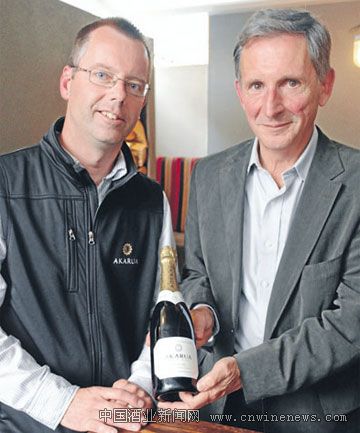
Which brings us back to the new boys on the block – Tony Jordan and Matt Connell, who have combined their skills and interest in sparkling wines to launch a new range under the Akarua (Bannockburn) label.
Dr Jordan is the former chief executive of Domaine Chandon in Australia and of Cloudy Bay, in Marlborough, where he helped develop Pelorous methode traditionelle, and he is still a consultant to wineries around the world.
Mr Connell is the chief winemaker at Akarua, which decided to make some bubblies because it was impressed with other sparkling wines produced in Central (Rudi Bauer's, I presume) and also recognised that this was an ideal place to produce them. 
As he also says, a continental climate (cool nights and warm days) means Central Otago can produce grapes with the acidity levels required to create more complex quality sparkling wines than are possible in some other regions of New Zealand.
The initial releases from Akarua are both non-vintage wines – a brut ($33) and a brut rose ($36), neither of which I have tasted yet, with a third, a 2009 vintage brut, to follow.
This, to my knowledge anyway, brings the number of wineries producing sparkling wine in Central Otago to just four.
Amisfield has made two under the Arcadia label (the 1999 blanc de blancs brut sells at $65, the non vintage brut at $30).
Aurum makes a non-vintage blanc de blancs ($34); and then there is Quartz Reef and the bubblies which have shown the way:
Quartz Reef Methode Traditionelle ($30)
A classy non-vintage blend of mostly pinot noir and chardonnay that's pure and crisp with many of the characters we expect from champagnes twice the price.
Quartz Reef Methode Traditionelle Rose ($35)
Another non-vintage wine, this salmon pink model made entirely from pinot noir.
Vibrant, fresh strawberry flavour with a hint of spice.
Quartz Reef Methode Traditionelle Vintage 2007 ($40)
An 80/20 blend of chardonnay and pinot noir that was four years in the making. Citrus driven with yeasty, nutty characters. Smooth and refined.