Mixing it up


|
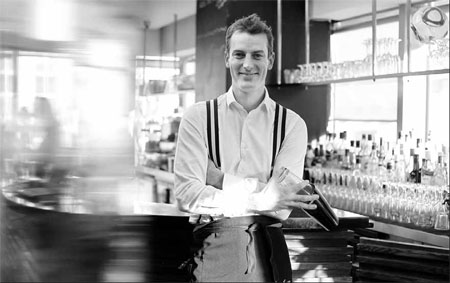
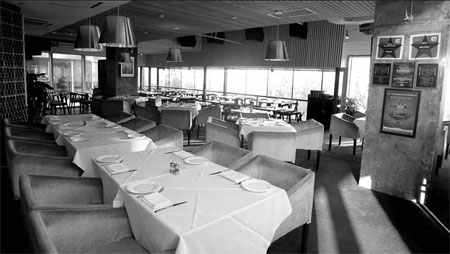
Paul Mathew tends bar at Flamme in Beijing's Sanlitun district and coaches the staff on cocktail-making. Photos by Wang Jing / China Daily |
British bar guru is in perpetual motion on duty and off. B.W. Liou catches up.
Paul Mathew, part bar consultant, part bartender, part bar owner, part teacher, part writer, full-time father, is wiry thin. A recent day shows why:
He wakes up at 6 in the morning, well before most people are thinking of hitting "snooze". Runs for an hour (as in training for a triathlon).Takes daughter to class. Teaches bleary-eyed men and women for a few hours at The Hutong mixology workshop. Conducts a phone interview for a story as the associate editor of DRiNK magazine (Asia). Writes the story. Attempts to build muscle on tall, lanky frame at the gym. Finally eats something. With the sun barely dipping into the horizon, heads over to Flamme in Sanlitun. Preps the bar. Tends the bar for the entire night.
While most people sweat just reading Mathew's routine, it really is all in a day's work for the 34-year-old Brit.
In recent months, Mathew actually has added to his daily grind, mixing in sessions of Heyrobics fitness classes, stalking Beijing's bars for the best Chinese bartenders the city has to offer and sitting on a panel of judges for Diageo's World Class Bartending Competition for the capital.
Wait - add trainer for the bar academy of Diageo, the global alcoholic beverages company based in London, to that list of duties.
"It all fits together somehow," Mathew said, wiping down the bar at Flamme on a recent afternoon, "though it has been a long week."
Mathew came to Beijing in 2008 on a resume that's as impressive as his current obligations: master's degree in conservation at the University College London, conservation program officer at Birdlife International, then two years as corporate ecologist of Fauna & Flora International, an NGO and conservation charity.
In his field work conducting ecological surveys around the world, he experienced what he calls "the great drinks" of the world, tasting the rums of the Caribbean and the tequilas of Mexico. Having worked a bartender to help pay for his education, Mathew gradually fell out of love with his corporate life.
"When you're drinking a Caipirinha in London, it's just not quite the same as when you're next to the beach in Rio," Mathew said. "And that traveling helped me get infused into the cocktail world."
In 2006, he set up The Hide Bar in London with a partner. Two years later, he landed in Beijing, where the lack of spirits and the exorbitant prices for wine came as a shock. Helped by a tight international community of bar owners and bartenders, he established Blood & Sand Ltd, a bar consultancy that helps small to large bars set up cocktail and wine lists, trains staff and develops a bar's brand.
His work has been one of the recent driving forces behind the blooming bar industry in the capital. His biggest accomplishment is the bar at Flamme - he helped design it, manage it and trained the staff behind it.
The Beijing bar scene "is definitely still evolving," Mathew says.
What impresses him most about bars in Beijing is the evolving style of making and serving cocktails, a mix between Western traditions and the Japanese discipline of bartending.
"The Japanese style is very precise," Mathew says. "If you want a particular drink at a Japanese bar, they will have a gin they normally use. In the Western style, bartenders will start asking all these kinds of questions: What kind of gin do you want, how diluted do you want the martini, do you want it dry. It's a long process."
The least impressive aspect of Beijing's bar scene? Getting bartenders that he trains to actually drink spirits.
"In the West, people I've worked with tend to be alcohol drinkers, but in China, most just don't drink spirits," he says. "It's very interesting."
But as more and more Chinese people take a serious look at bartending as a career, he said the level of professionalism in the capital is growing.
He believes that as more bars, such as Beijing's Maomaochong and Glen, push the envelope in cocktails and as more drinkers in the city embrace spirits, eventually there will be a Chinese style of bartending.
"I'd love to see more cocktails that are more tailored toward Chinese food," he says. "I'd love to see something that uses the flavors of (North China), with the plum sauces and the sesame sauces. These are flavors that bartenders could use, especially with a whiskey that has hints of applewood smoke. There are all these flavors here."