A Good Year for White Burgundy at a Good Price .


Every time a great vintage is declared, it's always a mixture of good and bad news. Bad because the best wines can be scarce and the prices often high. Good because even the "lesser" wines are likely improved—and also well-priced. This column actually contains only good news: It's about the great inexpensive 2010 white Burgundies now arriving in stores.
The 2010 vintage in Burgundy came right after another successful vintage in the region, albeit of an altogether different sort. In 2009, the weather was good, the harvest was large and the wines were uniformly supple, generous and ripe. The 2009 wines are also remarkably approachable while young. Aubert de Villaine, director of Domaine de la Romanée-Conti, the famed Burgundy, compared the 2009 vintage to 1959, one of the best vintages of modern times.
By contrast, the 2010 vintage was more difficult: There was frost, there was hail in both summer and fall—in other words, it was a much more Burgundian year. (Hail is frequent in this region of France.) It's the sort of weather that winemakers like to call "challenging" and that regular people simply deem "bad." But bad weather can turn good, and experienced winemakers can—and did—turn out some very good wines in the end.
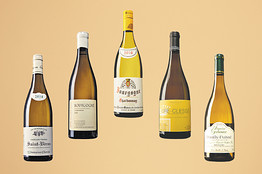
In fact, the white wines from 2010 are not merely good but "classic," with good acidity and structure according to wine importers, merchants and producers alike. Daniel Johnnes, an importer of top Burgundy domaines like Comtes Lafon, compared 2010 to the wines of two previous vintages: "It has the purity and weight of 2002 and the acidity of 2007," he said. Prices were up a bit thanks to a small crop, he said, but the increase has so far been small, about 5%. This could change, however, as most of the top wines won't be on the market until this summer or fall.
Retailers are practically giddy on the subject of the 2010 white wines (although the reds are pretty good, too), and most of their sentences on the topic seem to end in exclamation points: It's a terrific vintage! Quantities are small! The best wines are likely to disappear soon! Tim Finch, wine buyer of K&D Wines & Spirits in New York, noted that the 2010 Mâcons and Pouilly-Fuissés were practically flying off the shelves of his store, to the tune of 10 cases a week. California Chardonnays in that same price range, he noted, weren't selling nearly as well. (The grape of white Burgundy is Chardonnay, too.)
Mr. Finch was one of several retailers I turned to when it came time to acquire the wines for my tasting. I ended up buying almost 30 bottles, although I might easily have purchased more as enthusiastic retailers kept suggesting wines they loved: "The Lafon Viré-Clessé Mâcon is amazing…and I have some 2010 Chablis under $15 that really rocks," said Dan Posner of Grapes in White Plains, N.Y.
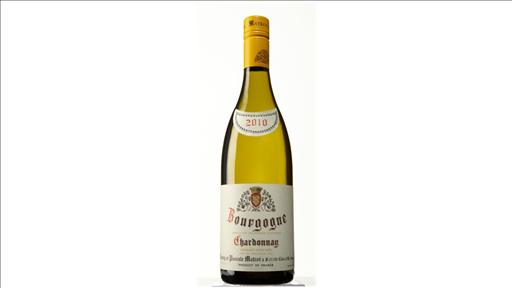
The inexpensive 2010 white Burgundies now available in stores are not merely good, they're classic. Lettie Teague has details on Lunch Break.
My final assortment covered a wide swath of Burgundian geography. Although most wine drinkers may think of Burgundy in terms of the Côte d'Or, since it's the subregion where the great wines (Montrachet, Corton, etc.) are produced, there are four other subregions where the vast majority of white and red Burgundy is actually produced. These are the wines that most people drink—and can afford.
These four subregions include Chablis (which is at a remove from the rest of the region and so far north that map readers may be excused for thinking it's part of Champagne); the Côte Chalonnaise, just south of the Côte d'Or and possibly the most overlooked subregion of all because of its proximity to greatness; the Mâconnais, where Mâcon-Villages, St. Véran and Pouilly-Fuissé are produced; and finally, Beaujolais.
I began with the Bourgognes (which sounds like the Cole Porter song), many of which were produced by vintners within the Côte d'Or. These are the most basic wines—hence the generic Bourgogne aka "Burgundy" appellation, with prices ranging from $14 to $30 a bottle. Interestingly enough, all of the wines were labeled "Chardonnay" as well as Bourgogne. Did that mean buyers of cheap Burgundy couldn't be trusted to know what grape was inside?
“Retailers are practically giddy on the subject: It's a terrific vintage! Quantities are small! The best wines are likely to disappear soon!”
The wines were uniformly excellent: From a 2010 Pierre-Yves Colin-Morey Bourgogne ($22) that was positively pearlescent to the bright, floral 2010 Domaine Jomain Bourgogne ($21) and the impressively concentrated Domaine Chavy Chouet Bourgogne Les Femelottes ($25), there wasn't a wine I didn't like. The one possible exception was the 2010 Maison Charlotte Bourgogne, which was a bit herbaceous and thin but also the cheapest of the group, at $14 a bottle.
I also loved lots of wines from Mâconnais and Chablis. I had to agree with Mr. Posner that the 2010 Les Héritiers du Comte Lafon was particularly good—rich, full-bodied and remarkably intense. But then it's made by the great Dominique Lafon, whose Meursaults sell for several decimal points more. (At $40 it was at the upper limit of what could reasonably be called "cheap" Burgundy.)
There were several more delightful surprises—a 2010 St. Véran from highly regarded Domaine Corsin that was crystalline in character and brimming with bright, juicy acidity, as well as the 2010 Gilbert Picq Chablis that was an excellent $19 a bottle and the 2010 "La Pierrelée" from La Chablisienne, a top cooperative of Chablis growers who produced an excellent $15 bottle of wine.
The list went on: a tangy and clean 2010 Domaine des Gerbeaux Pouilly-Fuissé from Drouin (also noted as "100% Chardonnay" on the back of the label) and an elegant, rather spicy 2010 Marie Antoinette Pouilly-Fuissé from JJ Vincent. Vinified in small oak barrels, the wine is named after Jean-Jacques Vincent's mother. (Both wines are good buys at $24 and $20 a bottle, respectively.)
At risk of echoing my retailer friends, I have to admit I didn't taste much that wasn't good, and there were even a few wines I'd even call great, particularly in terms of price-quality ratio. In fact, this may have been one of the best tastings I've held in a very long time. Now, having written that, I think I'd better run out and buy as many wines as I can. (Exclamation point here.)